

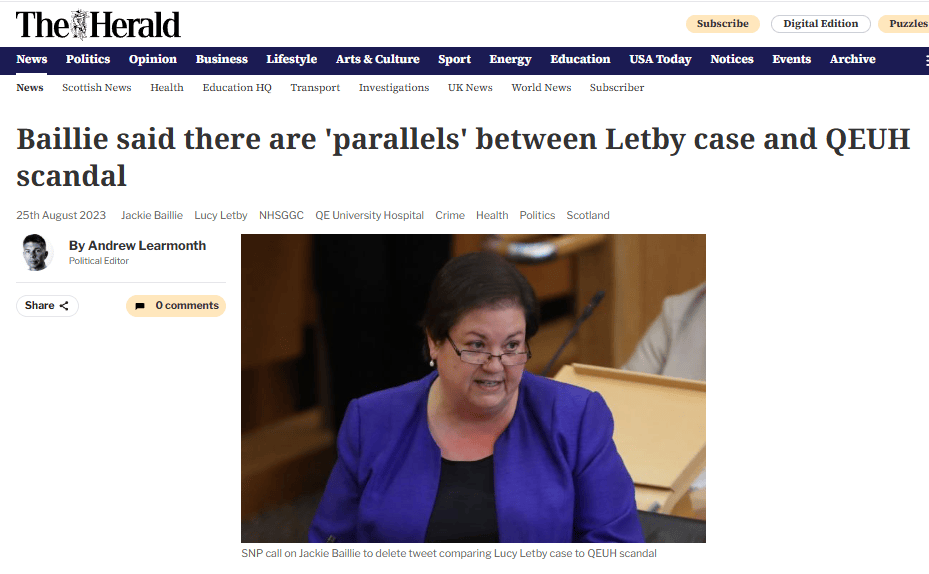
Two years ago, Jackie Baillie tried to suggest that the senior management incompetence and cover-ups associated with the Lucy Letby case were also present in the QEUH child deaths which Anas Sarwar was trying to connect to the Scottish Government.
‘Scotland’s model is the most radical, for it instead tries to align organisation with professional models and thereby use, rather than attack, the professionals’ role in rationing and treatment. It is radical because it starts with the way health services actually work.’ Greer, 2004: Page 4
Help Talking-up Scotland keep going

Crowdfunder at: https://www.crowdfunder.co.uk/p/help-talking-up-scotland-keep-going

Or by direct bank transfer to: JOHN WATSON ROBERTSON Sort Code – 08-91-04 Account – 12266421
Today, the Guardian has:
Tom Dolphin’s excellent article on the failings of NHS management made sombre reading (The Letby inquiry report makes one thing crystal clear: too much NHS management is scandalously poor, 16 September). Yet I believe that most of our public services are thoroughly over-managed, with frontline professionals neither listened to nor respected by their institutional superiors, and at risk of damaging their careers if they speak out about poor decisions, excessive workloads and impossible targets or “performance indicators”.
Like so many of our current woes, the rise of managerialism can be traced back to the public service reforms of the Thatcher governments in the 1980s, and the mantra of “management’s right to manage”. As professionals were supposedly self-serving vested interests, the transfer of power to managers was supposed to increase efficiency and responsiveness to service users.
https://www.theguardian.com/uk-news/2026/sep/21/lucy-letby-the-nhs-and-the-rise-of-managerialism
Is there the same culture in NHS Scotland?
The most cited framing is Scott Greer’s four-nations comparison: England “bet on markets” and managerialism (trusts, contracts, competition, regulation); Scotland “bet on professionalism” (clinical networks, weaker internal market, stronger professional elites). England is described as having the strongest managerialist thinking in the UK.
From the opening key points in the above:
Scotland has bet on professionalism in which it tries to align organisation with the existing structure of medicine. This means reducing layers of management and replacing them with clinical networks, increasing the role of professionals in rationing and resource allocation.
England has bet on markets in which independent trusts, similar to private firms, will contract with each other for care while approximately thirty regulatory organisations will ensure quality. Competition, management, and regulation will be the keys to getting value from health spending while severing the link between frontline health services and the Minister.
Full text at: https://www.ucl.ac.uk/social-historical-sciences/sites/social_historical_sciences/files/106.pdf
Help Talking-up Scotland keep going

Crowdfunder at: https://www.crowdfunder.co.uk/p/help-talking-up-scotland-keep-going

Or by direct bank transfer to: JOHN WATSON ROBERTSON Sort Code – 08-91-04 Account – 12266421
Footnote – The raw sewage? See:
Help Talking-up Scotland keep going

Crowdfunder at: https://www.crowdfunder.co.uk/p/help-talking-up-scotland-keep-going

Or by direct bank transfer to: JOHN WATSON ROBERTSON Sort Code – 08-91-04 Account – 12266421
Discover more from Talking-up Scotland
Subscribe to get the latest posts sent to your email.


I just wonder if now that Sarwar is gone will lab keep on about QEUH and child death or quietly drop it now that the truth has come out,well done to this great blog and Prof John thanks for that.Will Baillie try and keep it up.
LikeLiked by 2 people
I suspect that Baillie will try and keep it in the very compliant Scottish media, if nothing else to indicate that “Scottish Labour” is still actually a thing.
Same with old Gordy trying to inject some more life into the Branchform investigation in yet another attempt to smear Sturgeon and by implication the SNP.
Stephen McKenzie
LikeLiked by 2 people
Baillie trying to draw ”parallels” between QEUH and the Letby case is just what you would expect from a habitual Ambulance Chaser !
It is surprising that she has , so far , avoided drawing parallels between :
The sinking of the Titanic and the occasional CalMac ferry breakdown
The Opium Wars and Scotland’s drug deaths
Al Capone and Peter Murrell
She does find it difficult drawing a parallel between A Party of Government and The Scottish Labour Monster Raving Loony Party .
LikeLiked by 2 people
@Anonymous @ 12.34PM today.
Absolutely brilliant comment.
Liz S
LikeLiked by 1 person
Baillie supported Malcolm Chisholm not least in the Scottish Parliament when he signed off on the sewage works site for the QEUH / RHCG in 2002. Chaudhry Sarwar, father of his lordship, was the local MP. There was strong cross-party condemnation of the Lib/Lab Scottish government at the time including government MSPs (but not Baillie). Nicola Sturgeon was among those who specifically opposed Chisholm / Baillie and pointed out the hazard of building hospitals on a site surrounded by sewage works. To see Baillie and Anas Sarwar abuse the grief of bereaved families one and a half decades later was truly sickening. Btw I posted here https://talkingupscotlandtwo.com/2026/09/18/countess-of-chester-hospital-inquiry-report-omits-one-factor-identified-by-royal-college-of-paediatrics-and-child-health-which-make-such-horror-far-less-likely-in-scotland/ on Lucy Letby…the Guinness Book of World Records states that the highest ever recorded human blood glucose is 147.6mmol/L. The sample which ‘proved’ insulin poisoning in Baby F had a blood glucose of 999.0mmol/L (probably a computer error message completely invalidating the entire sample). Yet TTBOMK there was no mention of this obvious evidential error in either the Letby trial or the Thirlwall Inquiry. What is going on? Maybe Jackie Baillie can tell us?
LikeLiked by 1 person