


Help Talking-up Scotland keep goin
Crowdfunder at: https://www.crowdfunder.co.uk/p/help-talking-up-scotland-keep-going
Or by direct bank transfer to: JOHN WATSON ROBERTSON Sort Code – 08-91-04 Account – 12266421
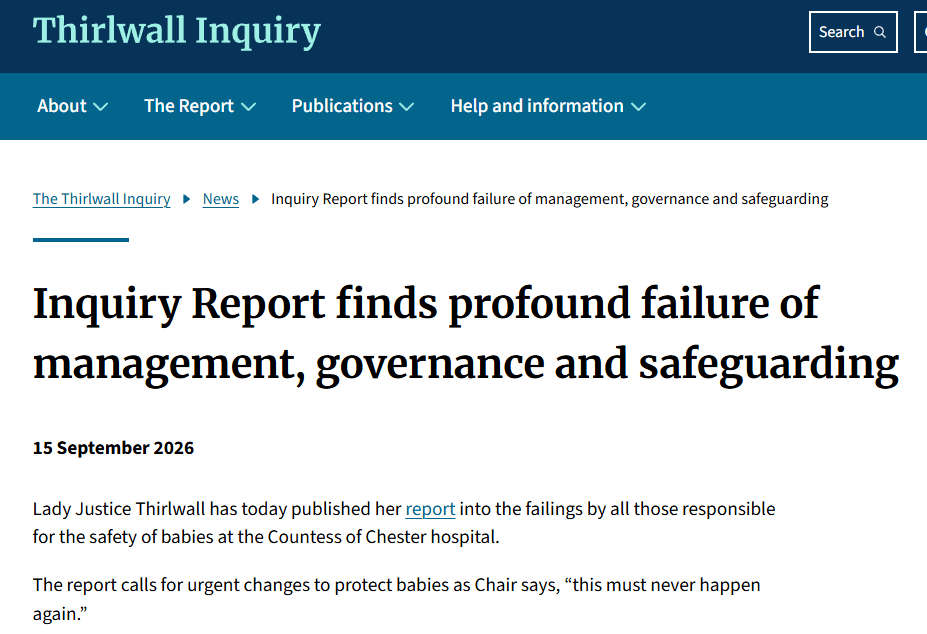
The above report published today makes no reference staff shortages at the Countess of Chester Hospital but the hospital itself and the Royal College of Paediatrics and Child Health (RCPCH) did, 10 years ago in 2016.
In the Guardian‘s Lucy Letby: killer or coincidence? Why some experts question the evidence in 9 July 2024:
In 2013-14, the CoC neonatal unit had four deaths each year. Then, between June 2015 and June 2016, an unusual cluster of 13 deaths occurred. (The hospital has given different accounts of the number and dates of the deaths on different occasions, stating 15 deaths in an earlier response to a freedom of information request.)
The hospital, worried by the deaths, commissioned a review from the Royal College of Paediatrics and Child Health (RCPCH) in July 2016. It found the unit was very short of nursing staff and that consultants were spread too thinly between the paediatric ward and the neonatal unit.
Junior staff did not feel they could call in consultants, often leaving the unit in the care of mid-grade doctors, many of whom lacked sufficient experience, the review reported.
Dr Svilena Dimitrova, an NHS consultant neonatologist who is part of the government-appointed Ockenden review:
“There are fundamental flaws in the justice system when it comes to prosecuting healthcare professionals, which mean that it does not address systemic NHS failures and blames individuals instead … The information presented to court was flawed and not proof of guilt beyond doubt,” she added.
I’m, of course, not competent to have a strong opinion on much of the case presented but I am sure that the prosecution statistics are pure bunkum and that there is a long history of institutions finding convenient scapegoats to protect senior staff and the government ministers at whose door bucks should stop.
Finally, the situation in NHS Scotland? There are 50% more (!) nurses per head of population, in Scotland than in England. See this from 2019, only a few years after the baby deaths in NHS England.
NHS ISD collate statistics on the number of qualified nurses and midwives per 100,000 population for NHS Scotland only. Statistics on the number of qualified nurses and midwives for England and Wales are collected by NHS Digital and StatsWales respectively.
According to the latest available published information, the number of qualified midwives in Scotland per 100,000 population is 45 WTE (whole or full-time equivalent), compared to 39 WTE in England and 43 WTE in Wales.
According to the latest available published information, the number of qualified nurses in Scotland per 100,000 population is 771 WTE (whole or full-time equivalent), compared to 518 WTE in England and 688 WTE in Wales.
I’m not suggesting for a minute that such events could never happen in Scotland but I am suggesting that adequate staffing makes it less less probable, perhaps much less so.
Sources:
https://www.kingsfund.org.uk/insight-and-analysis/data-and-charts/nhs-budget-nutshell
https://www.kingsfund.org.uk/insight-and-analysis/data-and-charts/nhs-workforce-nutshell
https://www.theguardian.com/uk-news/article/2024/jul/09/lucy-letby-evidence-experts-question
https://www.parliament.scot/chamber-and-committees/questions-and-answers/question?ref=S5W-22501
Help Talking-up Scotland keep goin
Crowdfunder at: https://www.crowdfunder.co.uk/p/help-talking-up-scotland-keep-going
Or by direct bank transfer to: JOHN WATSON ROBERTSON Sort Code – 08-91-04 Account – 12266421
Discover more from Talking-up Scotland
Subscribe to get the latest posts sent to your email.


The Thirlwall Inquiry Report -> Volume III -> Part 2 -> Chapter 34. Insulin 34.14 – 34.17
‘High insulin low C-peptide results: Laboratory handling guidance’.
‘NHS England Getting It Right First Time, Laboratory Handling of Insulin Requests in the Investigation of Hypoglycaemia, October 2025 (https://gettingitrightfirsttime.co.uk/wp-content/uploads/2026/07/Laboratory-handling-of-insulin-requests-in-the-investigation-of-hypoglycaemia-guidelines-FINAL-November-2025.pdf)’. Lady Justice Thirlwall stated “I recommend the current guidance be made mandatory and of national application.” The guidance states “If there is unexplained hypoglycaemia, a glucose, insulin and C-peptide test should be requested, with a rapid turnaround of results.” And “Glucose result: knowledge of the glucose result is critical in the interpretation of the insulin result.” And “Glucose must be measured when insulin is requested and, if the insulin is referred to another laboratory, the glucose result must be documented with the reason for the request. If no glucose has been taken, then add on a glucose measurement to an appropriate sample if timing of sample clear or add the comment “Unable to interpret insulin as no corresponding laboratory glucose measured at the same time.” And “C-peptide: Interpretation of insulin and glucose requires knowledge of the C-peptide.”
I agree with every single word.
So why, Lady Justice Thirlwall, was this recommended standard not applied to the Thirlwall Inquiry itself?
In the case of Baby F there is full documentation of a Glucose/Insulin/C-peptide report (document Inq0000844 https://thirlwall.public-inquiry.uk/evidence/inq0000844-blood-test-results-of-child-f-produced-for-the-criminal-proceedings-of-r-v-letby-dated-13-08-2015/). The insulin and C-peptide values are clearly stated in the Thirlwall Inquiry descriptions of the case of Baby F. But there is no mention of the contemporaneous blood glucose measurement on page 2 of Inq0000844. Which is 999.0mmol/L. Almost seven times higher than the highest glucose measurement ever made in a human being as recorded in the Guinness Book of World Records (https://www.guinnessworldrecords.com/world-records/highest-blood-sugar-level). It has simply been omitted from all Thirlwall Inquiry paragraphs regarding Baby F other than the result document (Inq0000844) itself. Without the contemporaneous blood glucose measurement the Thirlwall Inquiry recommended course of action, as described above, is to state “Unable to interpret insulin as no corresponding laboratory glucose measured at the same time.” With the contemporaneous blood glucose measurement of 999.0mmol/L, an impossible value and probably an analytical computer error message, the statement above that “knowledge of the glucose result is critical in the interpretation of the insulin result” must surely mean that the Inq0000844 results are invalid and the test be repeated. This did not happen in the case of Baby F because clinical circumstances had moved on.
In the case of Baby L there is partial documentation of a Glucose/Insulin/C-peptide report via a screenshot of insulin / c-peptide results. A blood glucose result is conspicuously absent though there is a statement at the foot of this screenshot that “ INSULIN” is “Difficult to interpret without concurrent glucose”. https://thirlwall.public-inquiry.uk/wp-content/uploads/thirlwall-evidence/INQ0001175.pdf Once again the test was not repeated, clinical circumstances having moved on.
These result documents constitute the biochemical evidence supporting the case against Lucy Letby for the attempted murders of Baby F and Baby L. Surely neither result should be acceptable as evidence if Lady Justice Thirlwall’s recommendations were applied to the eponymous Inquiry.
My jaw dropped when Inq0000844 was first published on the Thirlwall Inquiry website. I have lost count of the number of organisations including MSM that I have contacted since, to no avail. How is this situation possible?
LikeLike