


Help Talking-up Scotland keep going
Crowdfunder at: https://www.crowdfunder.co.uk/p/help-talking-up-scotland-keep-going
Or by direct bank transfer to: JOHN WATSON ROBERTSON Sort Code – 08-91-04 Account – 12266421
In 2019, The Times reported that a whistle-blower had told Anas Sarwar the pollution/proximity concern dated back to 2002, and the paper covered the subsequent inquiry interest in Shieldhall. Herald and others then reported sewage odour inside the new hospital after it opened.
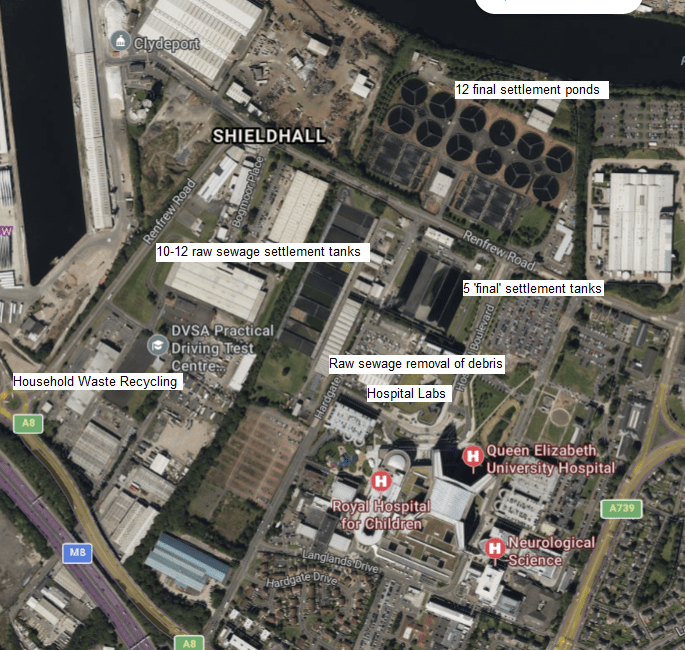
Looking at the Royal Hospital for Children where the child cancer death much used by Anas Sarwar took place, the 5 ‘final’ settlement tanks are around 200m away with the raw sewage removal and tanks to the west, even closer, and upwind.
Those defending the location of the site and denying the infections in patients come from the sewage works, base this on scientific peer-review reports such as Bioaerosol emissions from activated sludge basins: Characterization, release, and attenuation in Science of The Total Environment Volume 753, 20 January 2021, 141852 at https://www.sciencedirect.com/journal/science-of-the-total-environment
They seem to conclude:
The regular, powerful sewage smell confirms that the same turbulence is also stripping volatile compounds into the air. Those gases travel farther than most of the particles, so the odour can be noticeable at distances where viable bacterial counts have already dropped closer to ordinary outdoor background.
Practical implication:
- Close to the ponds (tens to a few hundred metres, especially downwind) bacterial aerosol levels are likely elevated compared with nearby air that is not influenced by the plant.
- At greater distances the particle load falls off faster than the smell, so odour alone overstates the aerosol concentration.
- Workers or anyone spending time immediately adjacent to the ponds face the highest exposure; typical residential distances usually see much lower numbers.
Exact levels still cannot be read from the smell.
Perhaps, as many of us did thanks to media cropping of film, these ‘experts’ only knew of the 12 highly visible and identifiable circular final settlement ponds, reported as 200m from the hospital site and car parks but around 500m away from the Royal Hospital for Children and thus producing ‘odour overstating aerosol.’
However, these 15 tanks, clearly upwind and containing raw sewage untreated, are clearly well within the range to be blowing elevated bacterial levels right into the windows and other air inlets.
Note: Staff, patients and families arriving in the car parks in the North-Western corner of the site are only 5 metres away!
Can any hospital be kept 100% air and water tight to prevent the transmission of bacteria from a large sewage works only 200 metres away?
No. A working hospital cannot be kept 100% air-tight or water-tight.Air
Hospitals are occupied buildings. They have doors, windows, delivery bays, plant rooms, lift shafts, roof vents and people walking in and out. Even isolation rooms and operating theatres are not hermetically sealed: they exchange air in a controlled way through filtered ventilation. Ordinary wards and corridors exchange far more air with the outside.At 200 m, especially downwind of surface-aerated ponds, some bacterial particles can reach the building. Good mechanical ventilation with filtration (and keeping windows closed on the exposed side) will cut indoor levels a great deal. It will not reduce them to zero for the whole hospital, all of the time.Water
Hospitals are plumbed into the public water supply and the sewer network. They are not isolated from municipal water or drainage. Direct contamination of drinking water by a nearby sewage works is uncommon if the water is properly treated and pipes are intact. Flooding, a broken sewer, or unusual groundwater movement would be a different problem — still not solved by making the building “watertight” in the everyday sense.What is realistic
- You can reduce exposure a lot: filtered HVAC, sealed or well-fitting windows on the works side, positive pressure in critical areas, good maintenance.
- You cannot achieve a guarantee of zero bacteria from a source 200 m away in a building that must admit staff, patients, supplies and air.
“100%” is not an achievable standard for any normal hospital. The practical question is how much reduction the ventilation and building design actually provide, not whether a perfect seal is possible.
Help Talking-up Scotland keep going
Crowdfunder at: https://www.crowdfunder.co.uk/p/help-talking-up-scotland-keep-going
Or by direct bank transfer to: JOHN WATSON ROBERTSON Sort Code – 08-91-04 Account – 12266421
Discover more from Talking-up Scotland
Subscribe to get the latest posts sent to your email.


Criminal. Those who did this should be locked up.
LikeLiked by 1 person
Agree with ArtyHetty…plus, when the full story is revealed, asset strip those individuals and companies who knowingly profited. But this is a true story…I witnessed it… Early 1980s, Saturday summer morning Southern General Hospital Maternity Dept. rear single room. Mother and jaundiced baby kept in hospital to complete phototherapy. No new buildings then between Maternity and the Waste Transfer Station less than 50m away. Woman: “It’s stifling in here, gonnie open the window, Doc?” Doc, newly arrived for Sat am – Mon pm weekend shift: “Maybe not a good idea, you might not want to do that!” “Just open the window, I need some fresh air”. “Just parked, it’s not exactly great out there…” “Just open the window!” Window duly opened, morning breeze wafts in. “Oh FFS get that f****** window shut!” Doc, in best Robert Duvall drawl: “Ah luv the smell of sewage in the mornin’!! Smells like…..lavatory”. https://m.youtube.com/watch?v=nx5N-4JvVyk&ra=m
LikeLike
Is it possible to establish whether the infections acquired in the hospital could have come from aerosol contamination from the sewage ponds – or not?
LikeLike
Yes, Tom Makin strongly advised that such studies should be carried out at Shieldhall in his responses to the Scottish Hospitals Inquiry! None of the studies of aerosolisation and distribution of multi-drug resistant organisms from sewage works have ever been carried out in relation to nearby hospitals because no-one was moronic-malignant enough to let the situation arise. And sewage works are often used to monitor large scale disease in the community because the bugs all end up in the sewage. It is also easy to find papers describing at least some of the bugs involved in fatalities at QEUH in sewage works but obviously not specifically at Shieldhall e.g. Stenotrophomonas maltophilia involved in the death of Milly Main can not only be found in sewage works (https://www.sciencedirect.com/science/article/abs/pii/S1438463917304832?via%3Dihub) but can actually be artificially added as part of the waste treatment process (https://www.sciencedirect.com/science/article/abs/pii/S2213343725010012?via%3Dihub). Sorry for a long winded answer, and this is not specific to the QEUH, simply demonstrating the possible.
LikeLike