

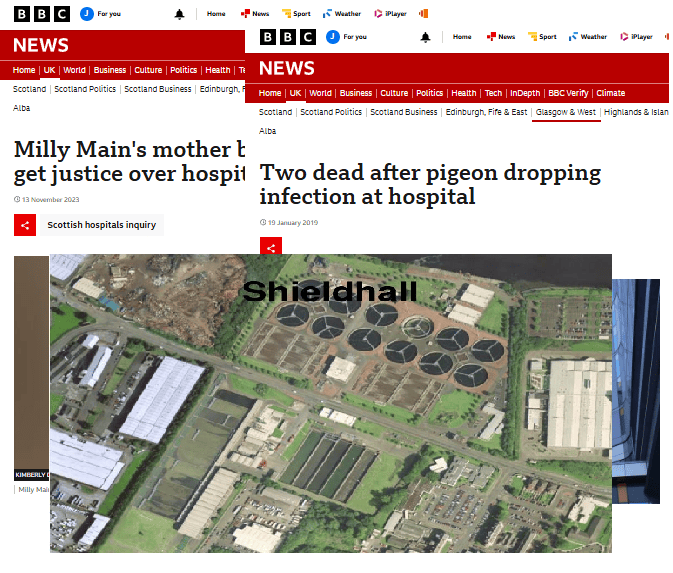
Once more, many thanks to the several readers who have sent us ‘inside info‘ on this.
Briefly, I should note a repeated claim by several readers that the unusual decision to locate next to a sewage works and to reject the Cowglen site, popular with campaigners, was due to Labour's favouring of business interests, donors perhaps, who wanted to build houses and make a lot of money on the Cowglen site. AI can find no evidence for this.
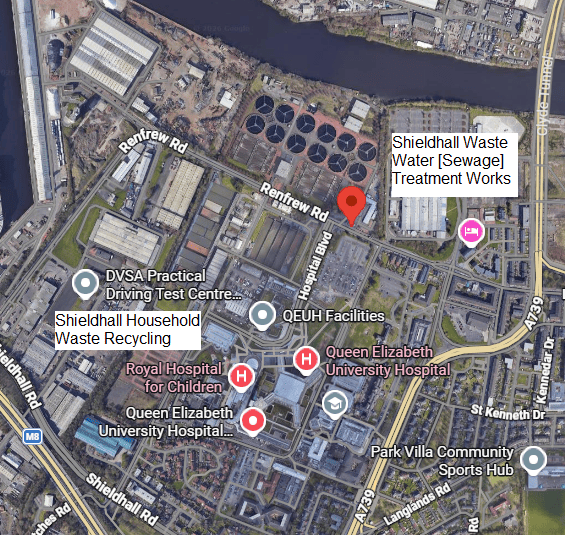
We have previously presented extracts from the expert witness Allan Bennett, initially shocked by the decision to locate the new Southern General (QEUH) next to sewage treatment and waste recycling works but then holding back from, in the end, condemning the decision. On fuller reading, we discover he did not even visit the site.
Then prompted by a reader, we had a look at another witness, impressively qualified for the task:
Dr Thomas Makin BA, PhD, FIBMS, FRSPH, FWMSoc, CSci. I was employed from 1968 in the NHS initially as a Medical Laboratory Technician and subsequently as Biomedical Scientist. I worked in various hospitals in Liverpool – Newsham General Hospital, Mill Road Maternity Hospital, Broadgreen Hospital, Liverpool Royal Infirmary (LRI), and latterly at the Royal Liverpool University Hospital (RLUH). After undergoing rotational training in all aspects of medical laboratory sciences (Haematology, Medical Microbiology, Clinical Chemistry and Histopathology) I specialised in Medical Microbiology while at Newsham General Hospital. I occupied posts of Senior Biomedical Scientist at LRI, and Chief Biomedical Scientist and Senior Chief Biomedical Scientist at RLUH. My last post in the NHS was Directorate Manager of Medical Microbiology at RLUH and I retired from this in 2010.
He wrote to more fully reject the site choice:
Sewage treatment facility – I recall my first visit to the hospital and discovering that it had been built next to a sewage treatment facility. I was astonished by this, and it was the first point I raised when I met Ian Powrie, my main contact at QEUH. I asked why it had been allowed given that the hospital contained some very immunocompromised patients, and I was particularly concerned about potential transmission of microorganisms from the sewage treatment facility, as airborne transmission of microorganisms from sewage treatment works had been well documented.
I’m not aware if the impact of the proximity of QEUH to the sewage treatment works has been fully investigated e.g. if air sampling for airborne microorganisms has been carried out at appropriate times and places and if the possibility of airborne and waterborne contaminants gaining access to the water system at QEUH has been properly considered.
https://www.hospitalsinquiry.scot/inquiry-document/witness-statement-tom-makin-270824
Seeing this, I could not help but wonder if Glasgow Labour’s misguided decision in 2008, unique in the UK, explained the causes of the bacterial infections linked to child and other cancer deaths at the QEUH which the media had desperately, desperately, tried to pin on the SNP Government?
Footnote – prominent in Glasgow Labour’s push for the site was the notion of ease of access for the local population. This was rebutted in 2001 by Mike Watson MSP, Labour Cathcart:
In the middle of last year, the health forum commissioned an eminent chartered civil engineer and transport expert to carry out a travel-time study into south-side hospitals. It showed some startling facts, one of which was that almost 100 per cent of the population of the south-side catchment area reside within a 15-minute car journey or a 50-minute bus journey of the Victoria. For the Cowglen site, 80 per cent of the population are within 15 minutes by car and 65 per cent are within 50 minutes by public transport. For the Southern general site—the option that is being pushed hardest of all—only 30 per cent of the population live within a 15-minute car journey or a 50-minute bus journey. I should say that this argument is not only about the south-east of Glasgow: residents in the Southern general catchment area would get to the Cowglen site more quickly than they would get to the Southern general site. Such considerations must be taken into account, but there is no evidence that the health board has done so. https://www.parliament.scot/api/sitecore/CustomMedia/OfficialReport?meetingId=4278
Anonymous
And finally…Greater Glasgow Heath Board (GGHB) as it was then ignored the overwhelming replies from both health professionals and the general public to its own consultation of April 2000 – September 2000 telling it to site the new hospital at the old Cowglen hospital site. GGHB decisions were ratified by the Lib-Lab Scottish Government and specifically health ministers Susan Deacon, Malcolm Chisholm and Andy Kerr (all Labour). It was Chisholm who actually signed off on the GGHB plans. And Chaudhry Sarwar was the local Labour MP
Discover more from Talking-up Scotland
Subscribe to get the latest posts sent to your email.
 Talking-up Scotland
Imagine the BBC news teams actually did their job and looked into this properly, rather than spewing out Jackie Baillies summer recess instruction sheet…
LikeLiked by 1 person
Imagine BBC news looked into this properly, rather than “reporting” Jackie Baillies sheet of summer recess instructions…
LikeLike
The deeper you dig into this cesspit the stinkier it gets. The BBC and MSM will want to bury this for good.
LikeLiked by 1 person
They can’t bury this one…the horror is that the site can never be clean and the infections will never stop, they can only be covered-up. Or blamed on the target of the moment. Or on the ‘water system’. What they have done…and it is principally GGHB, the Labour health ministers of the Lib-Lab Government, and the Labour administration of Glasgow City Council…is beyond disgust. Was Chaudhry Sarwar, local Labour MP till 2005 part of it, even if only in inaction? Planning a huge hospital almost literally in the middle of a shithole…then transferring the immunosuppressed there. Then building a waste incinerator?? But why couldn’t the SNP administrations wind this back after the 2007 election, no matter the literal shitshow they inherited. And what was that bit about Cowglen? Maybe GGHB and GCC should show us the details of all the deals that were made!! https://www.nhsggc.scot/hospitals-services/main-hospitals/queen-elizabeth/building-the-hospital/
LikeLike
A low key UK Govt announcement from May 2025 about NHS England funding for small scale safety works including new air handling units.
https://www.gov.uk/government/publications/estates-safety-fund-2025-to-2026
“At the Autumn Budget 2024, the Chancellor confirmed £750 million in capital funding for 2025 to 2026 to address critical infrastructure and safety risks in NHS hospital buildings.”
continues
“The Estates Safety Fund will invest in relatively small scale but important building safety works, including:
LikeLiked by 1 person
The sewage treatment works was there decades before the hospital was built, surrounded by businesses & housing. The old Alexander Stephen’s shipyard fitting out berths were right at the boundary fence. I can vouch that the stench in the summer when I worked on ships there was awful. If this was hazardous to humans surely it would have been known about long before the hospital was built and would have been an issue at the old Southern General hospital.
LikeLiked by 2 people