


Thanks again now to several readers for this link.
I see little media coverage of the shocking evidence that emerges in this.
Glasgow City Council approved the location for the new QEUH on 16 January 2008, with a 45 to 22 majority over the SNP, 9 years before the SNP became the administration in 2017. Labour had run the city council, uninterrupted, since 1996 and the Glasgow District Council since 1975
Allan Bennett is a massively published specialist scientific advisor on airborne infection risks and ventilation/biosafety matters, who wrote the above.
His publications cv is at: https://scholar.google.com/citations?user=3T9W4bwAAAAJ&hl=en
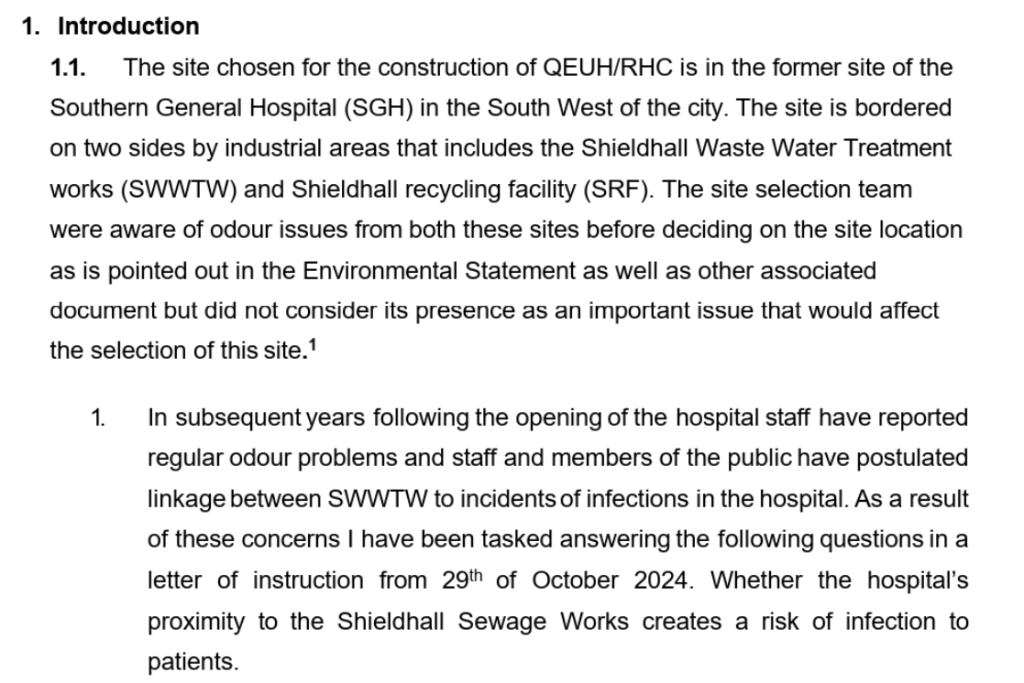
He begins with:
On page 4 he notes:

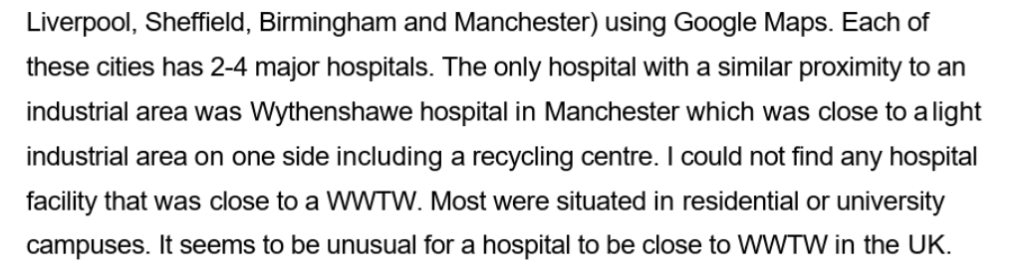
Is that not deeply shocking? What on earth were the Labour councillors on the planning committee and the health board thinking? Had they read nothing?
and on page 5:
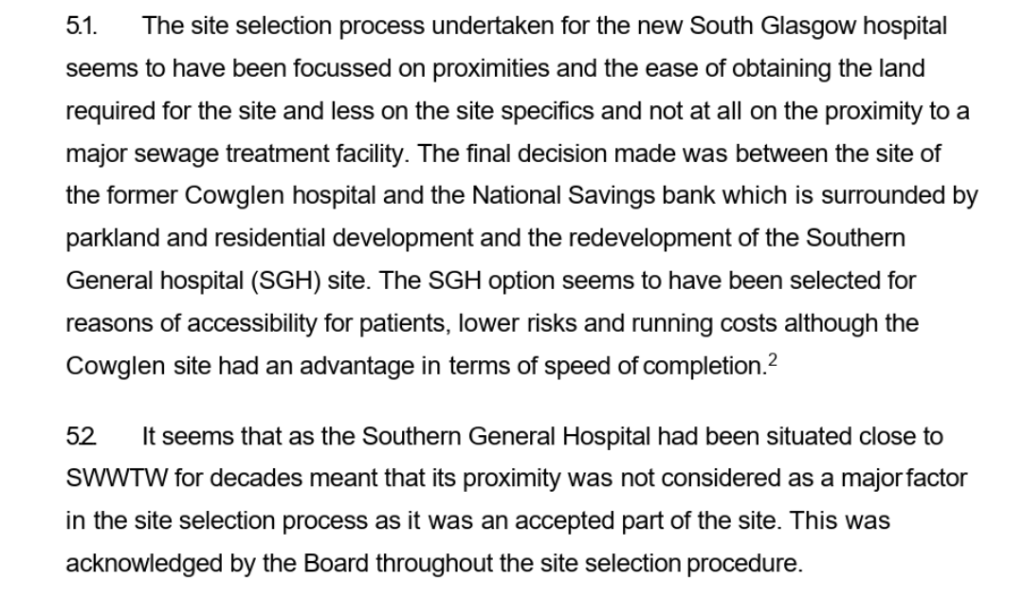
What could more clearly reveal the frankly low-brow, cringing, conservative nature of the Labour Party as it ran Glasgow, unopposed, into the ground?
Despite his opening, shocking, comments, Bennett does not, in the end, wholly condemn the choice of site but many others have condemned similar choices, including presumably, 7 of the 8 mentioned above in cities in England.
Here’s the question:
When a brownfield site suggested for a very large new hospital is directly, on 70% of prevailing winds, downwind of an existing waste water treatment plant and a waste recycling facility, how important are site visit reports and evidence from the local population of unpleasant smells, in deciding to confirm the site choice rather than move it to a site identified by critics, on greenfield land not downstream of the waste plants?
Answer:
Very important—often decisive or near-decisive in a proper planning and site-selection process. Site visit reports and evidence from the local population of unpleasant smells supply the critical real-world data that theoretical factors (such as average wind direction statistics) cannot fully capture. For a very large new hospital they should carry substantial weight when weighing confirmation of a brownfield site that is downwind of a wastewater treatment plant (WWTP) and waste recycling facility.
Why?
Hospitals are high-sensitivity receptors – Patients (including the immunocompromised, elderly, and children), staff, and visitors spend long continuous periods on site. Persistent or intermittent foul odours (hydrogen sulphide, organic volatiles, etc.) degrade amenity, increase stress, undermine perceptions of cleanliness and care quality, and can affect recovery and working conditions. Planning guidance and odour-assessment practice treat hospitals, schools, and similar uses as highly sensitive; even moderate, recurring nuisance is material.
Site visits provide objective, contemporaneous assessment. Professional walkovers, sniff tests / field olfactometry, and documentation under varying weather conditions record intensity, character, frequency, and spatial extent. In comparable cases these have confirmed discernible sewage/recycling odours at hundreds of metres, worse under warm, still, or downwind conditions.
Local population evidence supplies the frequency and severity record. Residents, existing hospital users/staff (if any), and consultation responses document how often, how intensely, and with what effects the smells occur over months or years. Complaint histories, descriptions of “constant” or “sickening” odours capable of causing nausea, and patterns linked to wind or season are highly relevant. This is not mere anecdote; it is empirical evidence of amenity impact that regulators and planners routinely rely upon.
Has there been a case like the QEUH location?
No closely analogous high-profile cases of a major new acute hospital deliberately sited in the same way as the QEUH appear to be widely documented.
The Queen Elizabeth University Hospital (QEUH) / Royal Hospital for Children campus in Glasgow stands out because it involved:
- Redevelopment of a brownfield/existing hospital site (former Southern General).
- Immediate proximity (roughly 200 m at closest points, patient wards ~300 m) to a large municipal wastewater treatment works (Shieldhall WWTP, one of Scotland’s biggest) plus a waste recycling facility.
- Documented awareness of odour issues during site selection and Environmental Statement processes.
- Site visits confirming discernible sewage/recycling odours at hundreds of metres (worse in warmer/stiller conditions).
- Odour concerns influencing design decisions (e.g., sealed building and mechanical ventilation rather than natural ventilation).
- Persistent post-opening complaints and staff/patient reports of unpleasant smells.
- Formal public inquiry scrutiny of whether the site choice was appropriate (primarily focused on infection risk, with odour as a related amenity issue).
Sources:
https://environment.govt.nz/assets/Publications/good-practice-guide-odour.docx
Discover more from Talking-up Scotland
Subscribe to get the latest posts sent to your email.


While all this environmental evidence is all very well , how on earth are Labour councillors expected to come to a fair decision if there are no Brown Envelopes available for their perusal ?
LikeLiked by 2 people
Perhaps there were?
LikeLiked by 2 people
What a catalogue of disaster. I was only vaguely aware of the role of Labour councillors in this saga. It would benefit from more publicity because anyone listening to the MSM would think that Nicola Sturgeon and John Swinney were the decision makers.
LikeLiked by 3 people
Looks like an investigation might be a good idea and those Labour councillors should be outed as being so deliberately irresponsible, criminal really.
LikeLiked by 3 people
What Allan Bennett’s testimony omits is that there are two sewage plants surrounding the QEUH / RHCG. The plant actually bordering the west boundary of the main entrance ‘Hospital Boulevard’ is Shieldhall Waste Transfer Station (SWTS) which is often confused with the nearby (maybe 0.75km to the west) Shieldhall recycling facility (SRF) referenced by Allan Bennet – this is little more than a household waste facility: https://tipsearch.co.uk/recycling-centre/shieldhall-tip. The big problem is that SWTS collects all the raw waste sewage, human and otherwise, from South West Glasgow and well beyond the city including all the effluence from the Shieldhall Sewer Tunnel. This is raw sewage and the job of the SWTS is to remove that which cannot be processed (https://smartcity.quest/safe-water-sanitation-sustainability/wastewater-treatment-preliminary-primary-steps/) then pre-aeration (!!!) before transferring the still raw sewage to Shieldhall Waste Water Treatment Works (SWWTW) across Renfrew Rd. Prof R now has a hard-to-find planning schematic showing the sheer scale of these two plants (nearly same size as the entire hospital campus) but it may be difficult to reproduce on the website. Photos and diagrams online are all curated to remove reference to SWTS, you only ever see SWWTW across Renfrew Rd.
LikeLiked by 1 person
Diagrams illustrating the proximity of Shieldhall Waste Transfer Station (SWTS) to neonatal, maternity and children’s hospital can be found on Glasgow City Council planning website here https://publicaccess.glasgow.gov.uk/online-applications/applicationDetails.do?activeTab=documents&keyVal=RF7TF0EXGFD00 and here https://publicaccess.glasgow.gov.uk/online-applications/applicationDetails.do?activeTab=documents&keyVal=RDXOBNEXHOM00. Where diagrams are cropped to show only ‘car park’ … that’s the multi-storey hospital car park to the far west of the hospital campus near neonatal, maternity, kids etc. it can be identified by its ‘twin turret’ and helps you to orientate. Best to save or screenshot these documents before they disappear. And remember that the second sewage plant, Shieldhall Waste Water Treatment Works is on the other side of Renfrew Road.
LikeLiked by 1 person
Here’s the history: Merryflats Workhouse/Poorhouse was build in Govan between 1867 and 1872. The poorhouse included a hospital site which was expanded and was renamed the Southern General Hospital (SGH) in 1923. The Poorhouse itself fully closed in 1936 leaving only the hospital which became part of the NHS in 1948 and has now been largely replaced by the QEUH and RCHG. Presumably no-one who had a say cared about the opening of Shieldhall sewage works across the road from a mere poorhouse in 1910. Shamefully the sewage works were almost completely redeveloped to near their current extent around 1980. Within the past year the Waste Water Treatment Works and Shieldhall Waste Transfer Station have been complemented by the Shieldhall Sewage Tunnel, Scotland’s largest ever sewer tunnel. Perhaps the wealthier Glasgow Southside NHS users were happy to use the former Victoria Infirmary (and Royal Hospital for Sick Children/Queen Mother’s Hospital Yorkhill) thereby avoiding the sewage stench and infection. Wealthier citizens are no longer able to avoid potential usage of the QEUH and RHCG for themselves or their children even if they can afford private medicine, which in any case is only available for easily treated and profitable conditions largely provided by doctors who also work for the NHS! Ironically the new Ross Hall Hospital facility at Braehead may also occasionally be affected by sewage aerosol and stench depending on how the wind is blowing. The Crookston Rd main Ross Hall Hospital only has to concern itself with occasional waste incinerator particulates depending on conditions at South Clyde Energy Centre and the wind direction!
LikeLiked by 2 people
And finally…Greater Glasgow Heath Board (GGHB) as it was then ignored the overwhelming replies from both health professionals and the general public to its own consultation of April 2000 – September 2000 telling it to site the new hospital at the old Cowglen hospital site. GGHB decisions were ratified by the Lib-Lab Scottish Government and specifically health ministers Susan Deacon, Malcolm Chisholm and Andy Kerr (all Labour). It was Chisholm who actually signed off on the GGHB plans. And Chaudhry Sarwar was the local Labour MP
LikeLiked by 2 people