

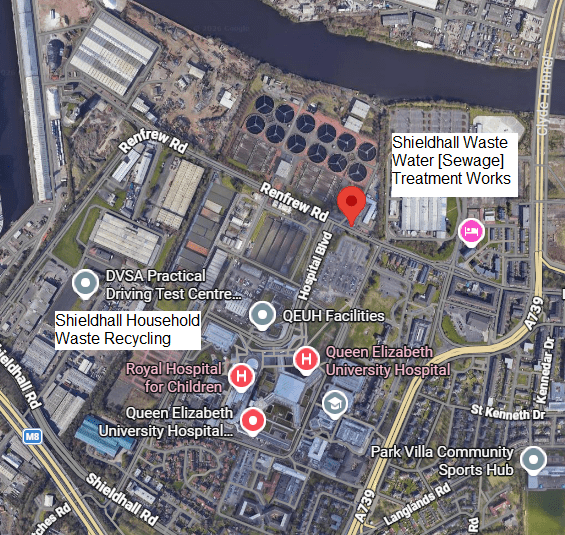
More than one friend of Talking-up Scotland has joined in to feed me useful info on the at-first-sight disturbing and surprising location of the new QEUH approved by Labour-led Glasgow council in 2008. Some are posting as Anon, in email with names and sometimes telling not to mention those..
I’m mixed up so apologies if I don’t credit you but thanks all round.
From Anon today:
What Allan Bennett’s testimony [specialist scientific advisor on airborne infection risks and ventilation/biosafety matters] omits is that there are two sewage plants surrounding the QEUH / RHCG. The plant actually bordering the west boundary of the main entrance ‘Hospital Boulevard’ is Shieldhall Waste Transfer Station (SWTS) which is often confused with the nearby (maybe 0.75km to the west) Shieldhall recycling facility (SRF) referenced by Allan Bennet – this is little more than a household waste facility: https://tipsearch.co.uk/recycling-centre/shieldhall-tip. The big problem is that SWTS collects all the raw waste sewage, human and otherwise, from South West Glasgow and well beyond the city including all the effluence from the Shieldhall Sewer Tunnel. This is raw sewage and the job of the SWTS is to remove that which cannot be processed (https://smartcity.quest/safe-water-sanitation-sustainability/wastewater-treatment-preliminary-primary-steps/) then pre-aeration (!!!) before transferring the still raw sewage to Shieldhall Waste Water Treatment Works (SWWTW) across Renfrew Rd.
Is any other large new hospital in the UK sited so close to two waste plants including one that handles raw sewage?
No — according to the expert evidence presented to the Scottish Hospitals Inquiry, the Queen Elizabeth University Hospital (QEUH) arrangement appears unusual in the UK.In his report for the inquiry, Allan Bennett carried out an informal comparative review of the locations of major hospitals in a range of UK cities of similar size to Glasgow (Newcastle, Leeds, Edinburgh, Nottingham, Bristol, Liverpool, Sheffield, Birmingham and Manchester). Each of those cities has two to four large hospitals. Key findings from that review:
- The only hospital that showed a broadly comparable proximity to an industrial area was Wythenshawe Hospital in Manchester, which sits next to a light industrial zone that includes a recycling centre.
- He could not find any hospital facility that was close to a wastewater treatment works (WWTW / sewage works).
- Most large hospitals were sited in residential areas or on university campuses.
- Overall, he concluded that it “seems to be unusual for a hospital to be close to a WWTW in the UK.” https://hospitalsinquiry.scot/sites/default/files/2025-05/Scottish%20Hospitals%20Inquiry%20-%20Hearing%20Commencing%2013%20May%202025%20-%20Bundle%2039%20-%20Impact%20and%20Infection%20Risk%20of%20QEUH%20and%20RHC%20site%20choice%20by%20Allan%20Bennett%20(External%20Version).pdf
The QEUH is distinctive because it sits roughly 200 m from the Shieldhall Waste Water Treatment Works (a major facility that handles raw sewage) and 200–300 m from the Shieldhall household waste recycling / transfer station. No other large, relatively new UK hospital was identified in the reviewed sample (or in wider publicly discussed comparisons arising from the inquiry) as being sited in such close proximity to both a sewage treatment works and a second waste-handling plant.
The QEUH inquiry rejected any serious risk to patients but other research is less complacent.
Has other research suggested there is a risk especially to vulnerable patients of such proximity to sewage treatment?
Yes. A substantial body of research documents that wastewater treatment plants (WWTPs / sewage works) emit bioaerosols containing bacteria, fungi, viruses, endotoxins, and opportunistic pathogens, and that these can pose health risks—especially via inhalation. Opportunistic pathogens (e.g., certain Aspergillus species that can cause invasive fungal disease, or antibiotic-resistant bacteria associated with healthcare infections) pose greater threats to immunocompromised individuals, those with chronic lung disease, or other high-risk groups. Fungal particles of respirable size are noted as capable of reaching the lower airways and causing infection in susceptible hosts. https://pmc.ncbi.nlm.nih.gov/articles/PMC11934199/
Discover more from Talking-up Scotland
Subscribe to get the latest posts sent to your email.


the Royal Jubilee Hospital in Clydebank is only a few hundred yards east Dalmuir Sewage and Wastewater Treatment plant.
LikeLiked by 1 person
Good point, Joe.
American investors, Health Care International, bought the vacant brownfield land to build a private hospital facility in 1994, which struggled under its American and later Middle Eastern owners, before the NHS bought it later in 2002.
It was formerly Beardmore’s naval yard which closed in 1930 and then a Royal Ordnance factory until Babcock closed it in 1969 and after that the whole site became Clydebank Industrial
Estate.
LikeLiked by 1 person