

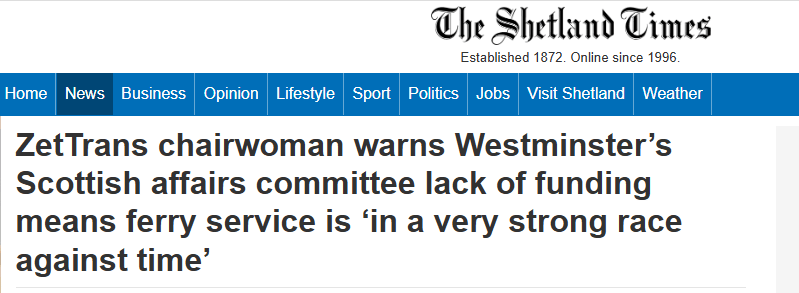
So, a representative of some Shetland Islands business group gets to tell the Westminster Scottish Affairs committee that ferry transport is underfunded in Scotland. Watch now a Labour member of that committee invite the PM to damn the SNP Government with that claim.
is the claim true?
How do the relative subsidies for ferry transport in Scotland, Norway, British Columbia, Washington State, UK Channel Islands and Isle of Wight compare in light of this claim – https://www.shetlandtimes.co.uk/news/lyall-tells-mps-isles-are-in-a-race-against-time-to-resolv-437901/
Scottish island ferries (especially CalMac/CHFS and Shetland inter-island services) receive among the highest per-passenger operating subsidies of the listed regions, with very low farebox recovery ratios. https://www.transport.gov.scot/publication/strategic-framework-of-options-for-the-chfs-network-project-neptune/benchmarking/
The linked Shetland Times article (June 2025 context) features ZetTrans chair Moraig Lyall highlighting deteriorating Shetland ferry services as a “huge drain” on the local economy, due to reliability issues, an ageing fleet, staffing shortages, weather/climate impacts, and insufficient long-term investment. She describes it as a “race against time” and notes that continuing the current model is unsustainable, advocating fixed links (e.g., tunnels) to reduce future capital needs. The article contains no specific subsidy figures or direct international comparisons.
Key Metrics for Comparison
Comparisons use approximate recent operating subsidy per passenger (a common benchmark for “relative” support on lifeline services). Figures draw from government reports, operator data, and benchmarking (primarily pre-2025/2026 data; exact recent totals can vary with contracts, fuel, and one-off funding). Passenger numbers are annual; subsidies are operating (capital grants separate).
- Shetland inter-island ferries (SIC/ZetTrans, local lifeline services): ~£33 per passenger.
Fares cover only ~10% of costs; annual deficit/subsidy ~£25 million for ~762,000 passengers (plus ~397,000 vehicles). Very low fares (e.g., many adult singles ~£2.80). Serves small remote populations with a fleet of ~12 vessels. Extremely high subsidy reliance due to low volume and geography.https://www.shetland.gov.uk/shetland-statistics/transport-4 - CalMac (Clyde & Hebrides Ferry Service – main Scottish islands): ~£30 per passenger.
~5 million passengers; farebox revenue ~£76 million; subsidy ~£149 million. Farebox recovery ratio ~34% (subsidy covers ~66% of operating costs). Covers many remote routes. https://www.transport.gov.scot/publication/strategic-framework-of-options-for-the-chfs-network-project-neptune/benchmarking/ - NorthLink (Orkney/Shetland to Scottish mainland): High (often £100s per passenger on some metrics).
Substantial annual subsidies (e.g., older figures ~£77 million; recent multi-year deals in the hundreds of millions). Fewer passengers than CalMac (~200k–few hundred k pax range historically) on longer routes; high per-pax support for these “lifeline” services. - British Columbia Ferries (BC Ferries): ~£6.60 per passenger.
~22 million passengers; farebox ~£360 million; subsidy ~£145 million. Recovery ratio ~71%. Larger scale, more popular/shorter routes, and regulated model allow much higher cost recovery than Scottish equivalents. https://www.transport.gov.scot/publication/strategic-framework-of-options-for-the-chfs-network-project-neptune/benchmarking/ - Washington State Ferries (WSF): ~£7–8 per passenger (approximate).
~20 million passengers (2025); fare revenue ~$200 million USD; farebox recovery ~50% in FY2024 (subsidy covers the rest, funded via state highway funds/gas tax plus federal support). Historically higher recovery (~60–70%+ in some years). Stronger cost recovery than CalMac due to volume and route mix. https://wsdot.wa.gov/sites/default/files/2025-07/WSF-RouteStatements-FY2024.pdf - Norway: Moderate/low per passenger (exact recent total subsidy not pinpointed)
- Isle of Wight (UK): Near £0 ongoing operating subsidy.
Commercial operators (Wightlink, Red Funnel, Hovertravel). Market-driven fares; no routine public operating support (unlike Scottish lifeline services). Occasional one-off grants (e.g., COVID support). Higher fares reflect fuller cost recovery + profit. Recent debates focus on lack of subsidy/exemptions compared to Scottish islands. - UK Channel Islands (Guernsey/Jersey inter-island and external): Minimal/near £0 routine operating subsidy.
Mostly commercial. Small targeted grants (e.g., £75k marketing support or startup funding for specific inter-island services). No large-scale lifeline subsidies like Scotland’s.
Discover more from Talking-up Scotland
Subscribe to get the latest posts sent to your email.


I can’t imagine this is the opinion of all the people in Shetland given that they very recently voted for an SNP candidate.
Anyway, if it’s the thinking of the business community then maybe a little more thought is necessary before they shackle themselves to Scotland via a tunnel. After all, the unionists amongst them wouldn’t want to be permanently tied to an independent Scotland, would they?
LikeLiked by 3 people
A tunnel, to Scotland? This site at its academic peak!
LikeLike
The real ”intolerance” in Scotland is the continuing presence of sectarian Orange Walks .
Imagine 130 Muslim or Sikh or Catholic marches in Glasgow flaunting intolerant attitudes to their fellow citizens each year .We would be ashamed and demand action to prevent them .
Yet every year we are subjected to this Orange blight on our streets with the subsequent ”hangers on ” displaying clear evidence that Darwin’s theory was correct .
If nothing else we should be sensitive to those poor members of the public who are polyester intolerant and are faced with the massed ranks of cheap , quasi-military uniforms .
LikeLiked by 2 people
OOOPs ! Attached to wrong story !
LikeLike