

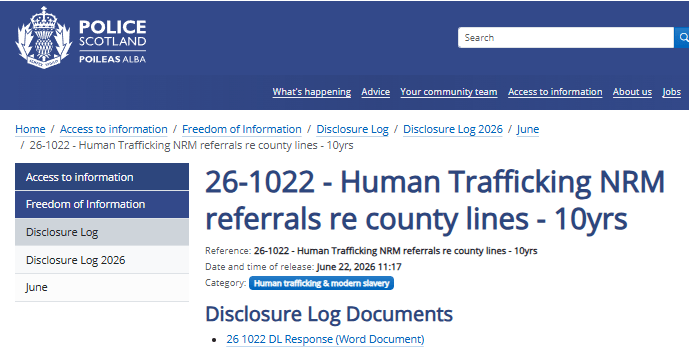
From Human Trafficking NRM referrals re county lines – 10yrs published by Police Scotland today, that ‘referrals made by Police Scotland to the National Referral Mechanism (NRM) where county lines and suspected criminal exploitation was a factor‘ was:
Under 16 year-olds – from 6 in 2020/2021 to 39 in 2025/2026, almost a seven-fold increase.
16-17 year-olds, from 16 to 65, a four-fold increase.
What forms does that exploitation take?
County lines refers to a violent, exploitative model of illegal drug distribution in the UK, where urban gangs and organised criminal networks export drugs (primarily heroin and crack cocaine) into other areas using dedicated mobile phone “deal lines.” A core feature is the exploitation of children and vulnerable people to handle the risky, visible parts of the operation (transporting, storing, and selling drugs and money), allowing higher-level criminals to remain at a distance.
gov.ukThis is officially recognised as child criminal exploitation (CCE), a form of child abuse. It often overlaps with modern slavery/trafficking and can include elements of child sexual exploitation (CSE). Children as young as 12 (sometimes younger) are targeted; the activity may initially appear consensual due to grooming, but victims cannot consent, and they remain victims even if they commit offences under duress. https://learning.nspcc.org.uk/child-abuse-and-neglect/county-lines
Main Forms of Exploitation
Gangs use a power imbalance to groom, coerce, control, manipulate, or deceive children. Official sources list these common tactics and forms:
- Grooming and enticement/exchange: Perpetrators befriend children online (social media, gaming platforms, messaging apps) or offline (schools, streets, parks). They offer gifts, money, drugs, clothes, status, protection, a sense of belonging, or perceived friendship/affection in return for carrying or selling drugs. Fake job adverts or “quick cash” offers are sometimes used. Peer grooming (older exploited children recruiting younger ones) also occurs. https://www.gov.uk/government/publications/criminal-exploitation-of-children-and-vulnerable-adults-county-lines/criminal-exploitation-of-children-and-vulnerable-adults-county-lines
- Coercion, intimidation, and psychological control: Threats of violence to the child or their family; emotional/psychological abuse; monitoring movements via phones or apps; blackmail (forcing a child to commit a crime then threatening to report it). Abduction or kidnapping happens in some cases, with victims forcibly moved and held away from home. https://www.gov.uk/government/publications/criminal-exploitation-of-children-and-vulnerable-adults-county-lines/criminal-exploitation-of-children-and-vulnerable-adults-county-lines
- Debt bondage (“taxing”): A key control mechanism. Gangs create or fabricate debts—e.g., by initially giving money/drugs (which the child must then “repay”), staging robberies of drugs/cash in the child’s possession, or claiming inherited family debts. The child is then forced to work off the debt through drug running, storage, or sales. https://www.gov.uk/government/publications/criminal-exploitation-of-children-and-vulnerable-adults-county-lines/criminal-exploitation-of-children-and-vulnerable-adults-county-lines
- Forced transportation, storage, and dealing of drugs/money: Children are instructed to carry drugs and cash long distances (often by train, coach, or taxi) between urban hubs and suburban/rural “county” locations; store drugs/money; or sell drugs in target areas. They take the highest physical and legal risks. learning.https://learning.nspcc.org.uk/child-abuse-and-neglect/county-lines
- Cuckooing (forced home invasion): Gangs take over the homes of vulnerable adults (e.g., those with addiction, mental health issues, or in debt) by coercion or force, using the property as a “trap house” or base for dealing/storage. Children may be involved in establishing or maintaining these. https://www.gov.uk/government/publications/criminal-exploitation-of-children-and-vulnerable-adults-county-lines/criminal-exploitation-of-children-and-vulnerable-adults-county-lines
- Invasive concealment (“plugging”): Children are coerced into internally concealing drugs (swallowing or inserting into body cavities, often wrapped). This is life-threatening and constitutes sexual abuse. learning. https://learning.nspcc.org.uk/child-abuse-and-neglect/county-lines
- Sexual abuse and exploitation: While the primary driver is criminal (drug-related), there is a documented link to sexual exploitation and violence. Gangs may sexually abuse or exploit children of any gender as part of control, punishment, or additional exploitation. Official definitions explicitly include “violence (including sexual violence).” https://www.gov.uk/government/publications/criminal-exploitation-of-children-and-vulnerable-adults-county-lines/criminal-exploitation-of-children-and-vulnerable-adults-county-lines
- Financial exploitation and money laundering: Using or forcing children to open/use bank accounts (or crypto) to move illicit funds from drug sales. https://www.gov.uk/government/publications/criminal-exploitation-of-children-and-vulnerable-adults-county-lines/criminal-exploitation-of-children-and-vulnerable-adults-county-lines
- Technology-enabled elements: Online grooming, control via burner phones/deal lines, and cyberstalking or monitoring. https://www.gov.uk/government/publications/criminal-exploitation-of-children-and-vulnerable-adults-county-lines/criminal-exploitation-of-children-and-vulnerable-adults-county-lines
Children may also be exposed to weapons, serious violence (including between rival groups), substance misuse, and trauma. They often go missing, carry unexplained items (phones, cash, drugs, weapons), show signs of injury or distress, or have controlling relationships. https://learning.nspcc.org.uk/child-abuse-and-neglect/county-lines
Are all county lines gangs based in England?
Yes.
In the Law Society of Scotland Journal in July 2025:
Criminologist Ross Deuchar presents insights from his research into Scottish gang culture, and makes the case for the courts to apply supportive, problem-solving approaches to the teenagers and young adults affected.
While in England young people are sent out from their own towns with drugs to be sold in provincial markets (known as ‘County Lines’ dealing; see Harding, 2020), the young men I interviewed tended to suggest that drugs are most commonly collected from afar before being brought back to Scotland and sold within or around the home town, village or city. https://www.lawscot.org.uk/members/journal-hub/articles/inside-scotlands-youth-violence-drugs-and-gang-culture-epidemic-with-a-leading-a-criminologist/
This finding reinforces the position held here, for years now, but evaded in MSM, that Scotland’s drug problems are being exacerbated by an influx of cheap and more powerful drugs into parts of the country, even small villages, by drug gangs employing new levels of violence and based entirely in English cities.
The wider evidence for the above claim:

In just one day, Aberdeen’s P&J has two reports of English drug gangs occupying homes in the city to sell new more powerful low cost drugs and, in so doing keep drug deaths high, despite the efforts of the SNP Government which has oversight of a world-leading opium overdose reversal drug programme (Naloxone) and a drug treatment programme running a a target-busting 95%+ treated within three weeks.
The P&J has been reporting this plague for years.
In December 2021, more than three years ago, the had

BBC Scotland have never mentioned the word ‘English’ in their reports of drug gangs not mentioned any English city. The did report the above cases, in these words:
Two men who carried out a violent attack on a disabled man in Peterhead have each been jailed for more than six years.
Jack Cleary, 20, tipped the man from his wheelchair and stabbed him in the leg with a knife before pouring salt in the wound in May 2022.
Ewan Hardie, 52, joined Cleary for a later second assault on the victim.
The men admitted assault to the danger of life. Cleary was jailed for six years and eight months at the High Court in Edinburgh, and Hardie received six years and nine months.
Cleary was 18 when he threatened to stab his 52-year-old victim in the eyes with hypodermic syringes and struck him with a baseball bat as he lay on the floor of a flat.
He robbed him of a mobile phone, bank card and medication, but returned with Hardie to inflict further violence.
During the follow-up attack the victim was pulled from his wheelchair and dragged along the ground with a belt around his neck until he blacked out.
Defence counsel Tony Lenehan KC said Cleary was a young man who had become “enmeshed in the drugs underworld and was guided by others”.
He said: “He behaved in a dreadful manner. There is no question about that. There is remorse shown.”
Solicitor advocate Jim Stephenson for Hardie, who has 150 previous convictions, said: “He has been blighted by drink and drugs. He fully understands he will receive a custodial sentence for this matter.”
Judge Lord Armstrong said “extreme violence” was used and it had “devastating and ongoing long-term negative consequences”. https://www.bbc.co.uk/news/articles/c785z4606deo
Anything missing? Just the word ‘English.’ Not in the public interest?
How are the drug deaths being kept high?
https://www.npcc.police.uk/SysSiteAssets/media/downloads/publications/publications-log/national-crime-coordination-committee/2025/county-lines-strategic-threat-risk-assessment-fy-2024-25.pdf https://talkingupscotlandtwo.com/2025/11/03/why-can-only-bbc-highland-cops-tell-us-straight-that-these-drug-gangs-originate-in-england-and-are-from-london-birmingham-and-newcastle-dont-they-care-about-the-reputation-of-the-union-that-were/
Discover more from Talking-up Scotland
Subscribe to get the latest posts sent to your email.

