


Based on a survey reported in the Lancet yesterday with no breakdown of the figures for the 4 devolved NHS services, the Herald gaily reports this a UK-wide phenomenon.
RESEARCHERS have warned that “wide variation” in the spread of Covid in UK hospitals needs further investigation, with a quarter of infected patients in some acute sites contracting the virus after admission during the first wave of the pandemic.
Experts blamed shortages of PPE, a lack of testing capacity, and confusion over Covid symptoms for contributing to higher rates of hospital-acquired conronavirus earlier in the outbreak.
https://www.heraldscotland.com/news/19510115.one-10-uk-covid-patients-caught-virus-hospital-first-wave/

Only BBC Health reports the story with no links to it for the BBC Scotland or other sites. There is no hint of variations between the nations.
I’ve emailed the lead researcher to ask for a national breakdown. Such requests rarely get answered even.
https://www.thelancet.com/journals/lancet/article/PIIS0140-6736(21)01786-4/fulltext#%20
Only Public Health Scotland publishes the data and it does it weekly, allowing BBC Scotland to report any increases and to ignore any falls:
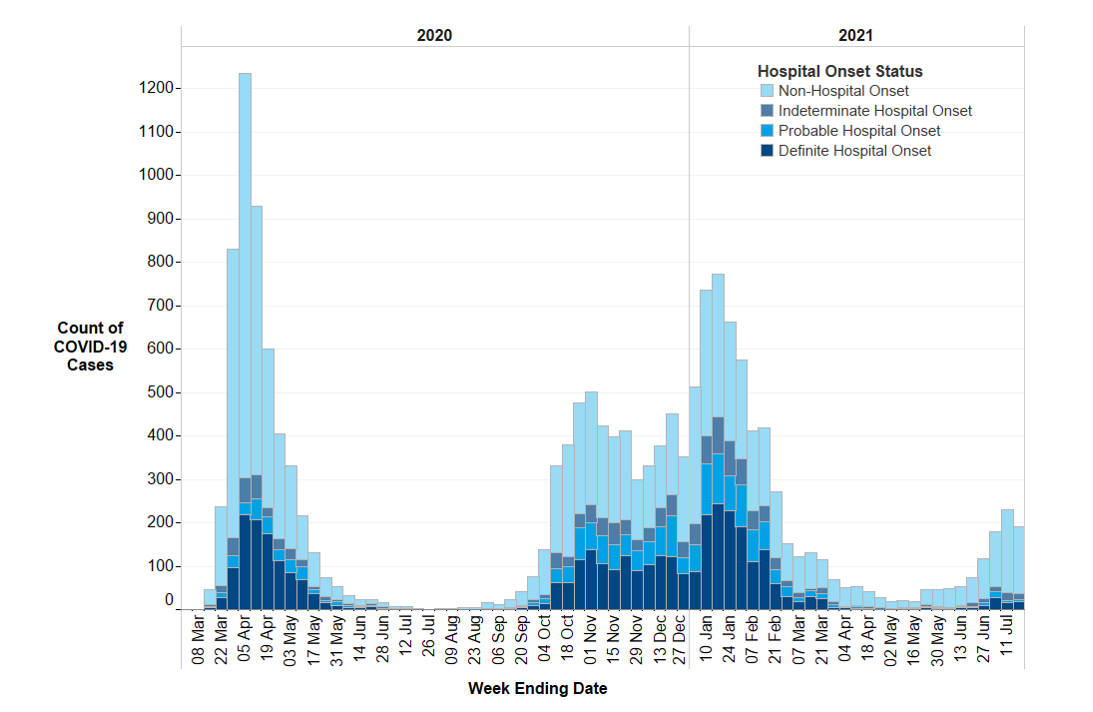
In reading the above graph, it’s worth knowing that the most recent week’s definitive cases added up to 18 or 0.1% of all infections. 13 758 or 98.6% were picked up in the community before admission to hospital.
So, even at the peak of the first wave in April 2020, it was just over 200 or less than 2%. Note the Herald claim that 1 in 4 or 25% of cases were picked up in some ‘UK’ hospitals at some point in the first wave.
How can we compare the performance of Scottish and other hospitals? Must we just accept as ‘our’ journalists are delighted to do, that things were as bad here?
No.
There are bits and pieces of research which are revealing of a large gap.
In November 2020:
Probable Hospital Acquired infections in England remain persistently high: currently, 17.6% of COVID-19 infections fit the NHS England definition of probable healthcare-associated infections (HCAIs). These rates have been as high as 25% in the North West and continue to climb in the North East and Yorkshire.
In February 2021:

Up-to-date figures on hospital onset Covid infections outside of Scotland are difficult to find.
The most recent data we have are from the Nuffield Trust in November 2020 (above) revealing that, by the 14th, 19% of all Covid cases in English hospitals had been acquired after admission.
In April 2021, when definite cases had fallen to almost zero, in Scotland:

So, never above 2% in Scotland, commonly around 10% in England but sometimes far higher in parts, are there calls for ministers to resign there?
Don’t be daft.
Discover more from Talking-up Scotland
Subscribe to get the latest posts sent to your email.
 Talking-up Scotland
And now we come to the Queen’s Award for Undermining Scottish Confidence in their Government’s handling of the Health Crisis .
The finalists are .. Jackie Baillie , Alex Cole -Hamilton , The Herald and BBC Shortbread .
Monica Lennon , will you open the envelope , please …
”The winner is ..well slap my face and call me a Tory ..It’s a dead heat !”
LikeLiked by 4 people
Bad journalism as usual, the selection of a single datum taken out of context and implying that it applies to all hospitals. It is seeking to induce the public to lose confidence in hospitals, in general. Since, hospitals are, in the main, part of the NHS and therefore, to a great degree public services, the writer is pushing the ‘public bad, private good’ message. As an earlier Lord Rothermere said, “We need to give people their daily dose of fear.”
This being The Herald, we can assume that she wishes us to think the same situation applies in Scotland, indeed, is probably, the ‘tip of an iceberg’. In fact, a medic ‘who does not wish to be named’, was reportedly quoted by someone at the bus stop, who’d heard it from her auntie in Greenock, as saying: “things were so bad at one stage that we had to get the army to force patients into hospital for treatment.”
That Jeanne Freeman should be brought back from retirement and made to resign.
LikeLiked by 4 people
I think for once the Herald did report this study accurately. This was a serious piece of extensive research involving several Universities eg Edinburgh, Birmingham etc
It was a UK-wide study involving 314 hospitals and 72,157 patients, about 2/3 of known Covid hospital patients during the first wave. Your comment that the Herald ‘gaily reported this as a UK-wide phenomenon’ implying that the was wide of the mark. It was a UK report and a breakdown was not given because the authors did not want it turned into a blame game. Therefore it is likely that data would have come from Scottish hospitals but the report did not name the hospitals involved to avoid a blame game erupting. This study was about learning lessons and improving outcomes for patients – not a them vs us and we are better than you charade.
The data on the best and worst performing hospitals was not made public but has been shared with the NHS. One of the lead researchers, Prof Semple was quoted in the article stated: “This is about quality improvement, not a blame game,”.
For those reasons I think your request for a breakdown of the results will, rightly, be ignored because of the way they would be used by you.
Lessons were learned from that first wave. As the article states rapid testing has been a ‘game changer’. In the 3rd wave hospital acquired Covid infections have been much lower at 2-5%.
LikeLike
‘For those reasons I think your request for a breakdown of the results will, rightly, be ignored because of the way they would be used by you.’
This is a war?
LikeLiked by 1 person
Aye, McArdled soor milk again, no matter the temperature…
It part explains why the SG Opposition, Scottish Media, Kilgour and Poison Pennington were so desperate to push the “SG marching OAPs to their grave” story line, London would have known early on the extent to which this central decision contributed to outcomes at care-homes in England, so the campaign was both diversion to Scotland and a political gambit.
It also part explains why Johnson is delaying as long as possible a formal inquiry, plenty of time for shredding, losing phones, losing private emails, etc…
LikeLiked by 1 person