

Thanks to rtpscott for alerting us to this:
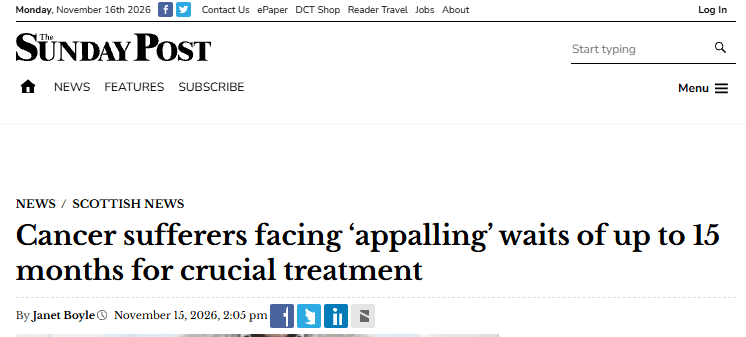
In the Sunday Post yesterday, the above and:
Scotland has the highest number of lung cancer deaths in UK nations, according to Cancer Research UK. Cancer patients point to a desperate need for more radiographers and other staff vital to the chain of diagnosis along with better funding of treatment. Health boards have reported staff and scanner shortages and breakdowns, and delays in lab results for biopsies. https://www.sundaypost.com/fp/cancer-patients-face-waits-of-up-to-15-months-for-crucial-treatment/
Shamefully the post has failed to research this properly. Let’s look at the facts on overall performance, diagnostic delays and staffing.
Overall performance – Lib Dem spokesperson in Sunday Post hiding NHS Scotland’s cancer treatment performing better than and saving thousands who would have been delayed in NHS England
From Cancer waiting times 1 January to 31 March 2026:
There were 4,668 eligible referrals where the 62-day standard applied, a decrease of 2.7% from the previous quarter, but an increase of 25.4% from the quarter ending 31 December 2019, the last full quarter pre‑pandemic. 72.2% of patients started treatment within 62 days, compared with 72.6% in the previous quarter.
There were 7,225 eligible referrals where the 31-day standard applied, a decrease of 2.0% from the previous quarter, but an increase of 13.1% from the quarter ending 31 December 2019. 94.5% of patients started treatment within 31 days, compared with 95.6% in the previous quarter, and 96.5% in the quarter ending 31 December 2019.
Before we go any further, see a big news story there being total ignored? There were 25.4% more referred under the 62-day standard and 13.1% more referred under the 31-day standard than had been in the days before the pandemic at the end of 2019. Performance at the end of 2019 had been 83.7% and 96.5%. They had 25% and 13% fewer patients and yet did not perform, I’d guess, 25% and 13% better.
NHS England does not publish quarterly data for comparison but does provide annual figures:
For NHS England:
62-day Combined Standard – 12-month average for 2025: 69.4% .
31-day Combined Standard 12-month average for 2025: 91.8%.
NHS Scotland annual data can be produced from the supplementary file table and from them we get for 2025, 70.5% and 95% respectively.
Analysis
BBC Scotland and many ornery Joes will say there is little difference there but even the 1.1 difference for the 62-day target is 1% of the around 20 000 who were referred in one year – 200 people who were treated on time who would not have been had they lived in England.
As for the 31-day target, that 3.2% is of around 30 000 referred in one year, 1 000 in just one year who were treated on time who would not have been had they lived in England.
Sources:
Diagnostic delays – Waits for key NHS Scotland diagnostic tests plummet
From NHS waiting times – diagnostics – Waits for key diagnostic tests, published today, the above and:
The total waiting list size (number of ongoing waits) for the eight key diagnostic tests combined was 112,696: 27,931 endoscopy waits and 84,765 radiology waits. This is a 9% decrease (-11,296) from the previous quarter-end, when there were 123,992 ongoing waits. The latest quarter end has the lowest number of ongoing waits seen since 31 May 2021 (111,619).
The graph is perhaps not so easy to read but once explained it’s really good news for the Scottish Government.
First the green shaded area on the right shows a massive reduction, since June 2025, in the numbers waiting for radiology, from around 80% to around 60%.
Based on the lines, in radiology, endoscopy and the cluster of all 8 key diagnostic tests, there have been, since December 2025, surges in the percentage waiting 6 weeks or less.
NHS England’s diagnostic tests waiting list is shocking 800 000 or 71% longer than NHS Scotland’s
Here’s why:

From NHS waiting times – diagnostics – Waits for key diagnostic tests, published today, the above and:
The total waiting list size (number of ongoing waits) for the eight key diagnostic tests combined was 112,696: 27,931 endoscopy waits and 84,765 radiology waits. This is a 9% decrease (-11,296) from the previous quarter-end, when there were 123,992 ongoing waits. The latest quarter end has the lowest number of ongoing waits seen since 31 May 2021 (111,619).
The graph is perhaps not so easy to read but once explained it’s really good news for the Scottish Government.
First the green shaded area on the right shows a massive reduction, since June 2025, in the numbers waiting for radiology, from around 80% to around 60%.
Based on the lines, in radiology, endoscopy and the cluster of all 8 key diagnostic tests, there have been, since December 2025, surges in the percentage waiting 6 weeks or less.
So, all things being equal, per head of population, NHS England might be expected to have around 10 times as many or 1.13m waiting for diagnostic tests. As you can see above, they had 1.92m, around 800 000, 70.8% more than predicted.
Staffing: stewartb
What of the ‘cancer time bomb’ that is headline news in several newspapers in Scotland and above the BBC News website’s ‘Scotland’s papers’ feature and also in a separate BBC Scotland article on the the same website?
This has all been catalysed by the following Royal College of Radiology (RCR) reports: (i) ‘Clinical Radiology – Workforce Census 2024’ and (ii) Clinical Oncology – Workforce Census 2024.
Both reports cover all four nations of the UK although one would be hard pressed to realise this from the newspapers front pages. One would not know of the UK-wide scope EVEN after careful reading the BBC Scotland piece in FULL
I can find no reference to these reports – and this ‘time-bomb’ – anywhere else in the BBC News website. Not even in the Health section – at least up till c.6pm this evening. So can we find the ‘time-bomb’ – is it located only in Scotland?
The RCR issued a press statement (June 5) to accompany the publication of its reports. It has this title: ‘Staff shortages are a ‘ticking time bomb’ for cancer patients, doctors warn’. It also has this: ‘Cancer patients are facing dangerous delays to life-saving scans and treatment as the chronic shortage of doctors threatens to derail cancer care across the UK, new data reveals.’
And: ’A patient’s risk of death can increase by 10% for every month cancer treatment is delayed. Despite this strong evidence, in 2024 every radiology leader in the UK reported delayed diagnostic scans due to staff shortages. Worryingly, 9 in 10 cancer centre leaders reported delays to patients starting treatment, and 7 in 10 were concerned about staff shortages putting patient safety at risk.‘
So the ‘ticking time-bomb’ and the RCR’s more measured statements in the two reports expressing concerns for the state of the cancer-related NHS workforce, are directed clearly, explicitly at NHS management and responsible governments in all four nations of the UK!
The BBC Scotland piece on the BBC News webs site referred to above – ‘Cancer care ‘time-bomb’ warning over doctor shortage’ (it has a ‘Scotland politics’ tag) – provides quotes from Dr Katharine Halliday, president of the RCR. These were lifted from the RCR’s press release on its two new reports: Dr Halliday was commenting on UK-wide issues, not Scotland-only issues as the BBC article either deliberately or though flawed journalism/editing implies.
So candidly, there are specific metrics that reveal Scotland in a less favourable light, specifically concerning aspects of the oncology workforce: there are others which reveal Scotland to be ‘best’.
The BBC News article notes that Scotland currently has a 25% shortage of radiologists. What does the actual RCR report state about the radiologist workforce?
‘Northern Ireland has a 27% workforce shortfall, Scotland a 25% shortfall, England a 30% shortfall and Wales a 32% shortfall.’
Adding: ‘There are also variations at the regional level. Some areas have below-average shortfalls, such as the 6% shortfall in South East Scotland.
‘Some regions’ shortfalls are significantly higher; North and West Wales’ workforce is almost half of what it should be, with a 46% shortfall.’
These substantially worse statistics outside Scotland are seemingly unremarkable, not newsworthy and irrelevant to BBC Scotland which is a context and perspective desert!
Are Scotland’s voters being ‘played’ by BBC Scotland and others – are these media organisations attempting deceit and/or manipulation?

