

Over 36 years, I was school teacher, teacher education lecturer, head of department, Associate Dean Quality Assurance, Acting Dean, Professor, Faculty Research Ethics Chair, External Examiner, PhD supervisor and Research Methods tutor and, oh yes, have a PhD, an MEd and 4 other education PG awards but I was never anywhere near Scotland’s ‘top education expert.
Which education researcher in Scotland has published the most high quality, peer-reviewed research, in high impact journals, in the last ten years?
- Sheila Riddell (Professor of Inclusion and Diversity, University of Edinburgh) frequently appears at or near the top for education/education-related citations at Edinburgh. Metrics include roughly 9,500+ total citations and ~2,600 in the last 5 years in one ranking, with a strong record of peer-reviewed work on inclusion, disability, equality, and social justice in education (e.g., papers on restorative practices and disabled students in higher education that have accumulated hundreds of citations each). Her output is longstanding and continues into recent years.https://research.com/u/sheila-riddell
- Markus Klein (Professor of Human Development and Education Policy, University of Strathclyde) stands out for recent high-quality output. He publishes in high-impact venues such as American Educational Research Journal, Sociology of Education, Child Development, British Educational Research Journal, and others. Papers on school absenteeism, socioeconomic inequalities, and related topics have strong recent citation traction (hundreds of citations on key works from the last few years), plus policy relevance (cited by OECD and others). He has been active at Strathclyde since ~2016. https://scholar.google.com/citations?user=mqMmeLIAAAAJ&hl=en
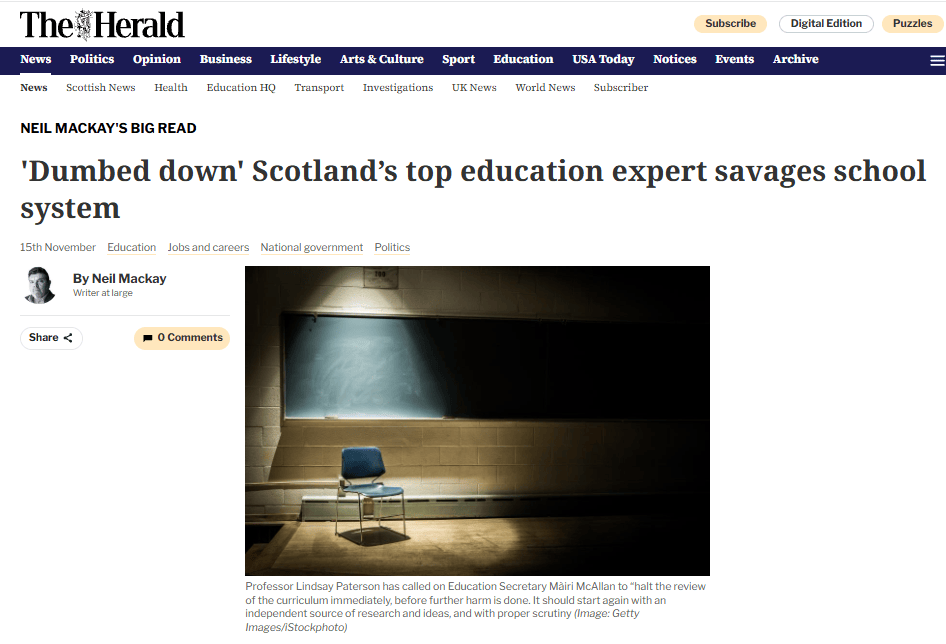
Why doesn’t the Herald’s Neil Mackay feel responsible to tell people what they’re saying rather than this guy:
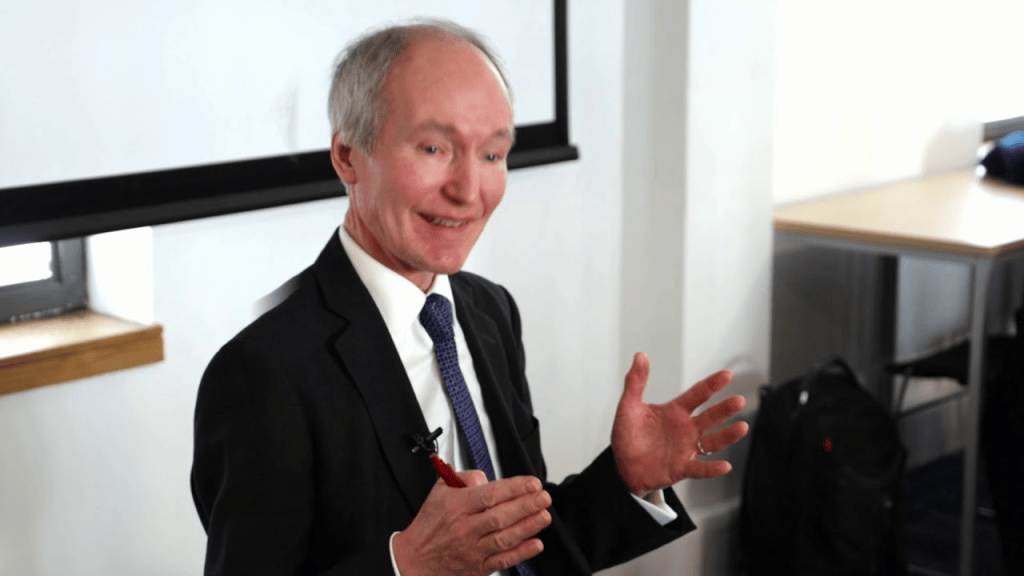
Professor of Educational Policy at Edinburgh University, Lindsay Paterson is a statistician with a background in agricultural and medical research using statistical methods. He has absolutely no experience of teaching in schools or in teacher education methods. He has no experience of school management or of research into the curriculum other than in counting assessment data. He’s just a jumped up bean-counter. Despite that, he’ll turn up on request, rent-a-gob, to say something bad about any Scottish Government decision that involves numbers.
However, to once more, easily rebut the Herald’s stupid headline:
Attainment gap narrows and nine out of ten young people are in positive destinations
The proportion of young people leaving school with five or more passes at National Courses and Highers, as well as their equivalent vocational and technical qualifications, has increased over the past year.
A record high of 68.6% of young people left school with five or more qualifications at SCQF Level 5 (National 5 equivalent), according to the School Leaver Attainment and Initial Destination statistics 2024-25 published today. Those leaving with five or more passes at SCQF level 6 (Higher equivalent) rose to 40.8%. The gap between those from the most and least deprived areas leaving with five or more qualifications narrowed at Level 5.
Nine out of ten young people (95.7%) were in positive destinations – such as work, training, college or university – three months after leaving school. This is the same level as 2023-24 and the second highest on record. Nine out of ten young people (95.7%) were in positive destinations – such as work, training, college or university – three months after leaving school. This is the same level as 2023-24 and the second highest on record.https://www.gov.scot/news/rising-attainment-among-school-leavers/
From the Scottish Government’s Literacy and numeracy standards reach record high report in December 2024:
The proportion of pupils achieving the expected level in literacy and numeracy across primary and secondary schools has reached a new high, officials figures show.
For numeracy, a record 80.3% of pupils across P1, P4 and P7 reached expected levels, while S3 also reached a new high of 90.3%. For literacy, achievement is also now at a record high in both primary (74%) and secondary (88.3%).
The attainment gap between young people from the most and least deprived areas meeting standards in literacy has also reached a new low, according to the latest Achievement of Curriculum for Excellence levels 2023-24 (ACEL) statistics.https://www.gov.scot/news/literacy-and-numeracy-standards-reach-record-high/#:~:text=The%20proportion%20of%20pupils%20achieving%20the%20expected%20level,S3%20also%20reached%20a%20new%20high%20of%2090.3%25.
In England, on 9 July 2024 [latest data], for 11 year-olds [P7]:
[Only] 61% of pupils reached the expected standard in all of reading, writing and maths, up from 60% in 2023. This is below 2019 attainment, where 65% of pupils met the standard. https://explore-education-statistics.service.gov.uk/find-statistics/key-stage-2-attainment-national-headlines/2023-24
Direct comparison with education in other countries is not always reliable but had this stark contrast [20-30% better] operated in the opposite direction, with England at 80% and Scotland at 61%, you can be sure our media would be all over it.
Also, ignored:
A game-changer in education, the narrowing of the attainment gaps and the increased attainment of the most disadvantaged
To my mind, after nearly 40 years in education, more important than narrowing gaps is increased attainment for the most disadvantaged:
At SCQF level 7, the gap in 2009/10, two years after the SNP first came to power, was 24.1 and by 2021/22 it was still 22.2, though down from 25 in the previous year. If you have limited understating of statistics or cynically only wish to accuse the SNP Government of failure, these statistics hide the true nature of change.
In 2009/10 only 4.7% of those in the most disadvantaged 20% had achieved at this level but by 2021/22, the figure was 10.3%, more than doubling in only 12 years. Remember also, that 20% means nearly 3 000 pupils every year. https://www.gov.scot/publications/summary-statistics-attainment-initial-leaver-destinations-no-5-2023-edition/documents/
Discover more from
Subscribe to get the latest posts sent to your email.

