

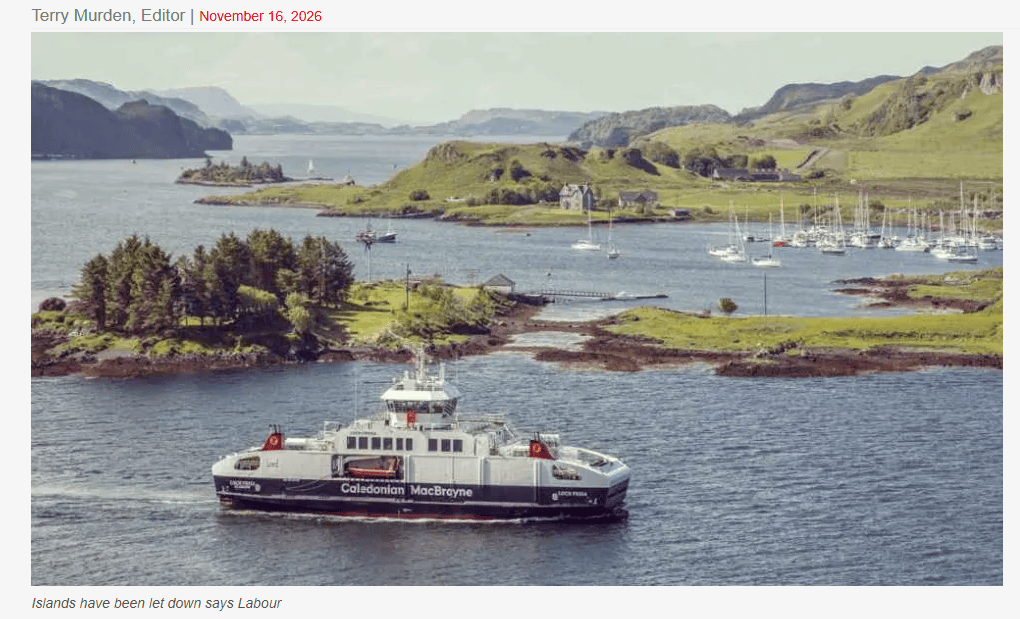
From Daily Business yesterday, the above and:
Scottish Labour has accused John Swinney of breaking a promise over a support package for island businesses affected by ferry disruption. Businesses in the Western Isles have expressed disappointment over the promised compensation scheme, after many began receiving what Labour describes as “paltry offers” to cover huge losses during the ongoing SNP ferry fiasco. Under pressure from islanders, a Scottish Government fund was established earlier this year to provide critical support to island businesses most severely hit by repeated failures of the CalMac ferry service to and between the island chain. However, dismay at the delays in distributing support have turned into a growing sense of anger that the promises made by the SNP Government have amounted to very little. https://dailybusinessgroup.co.uk/2026/11/swinney-accused-of-falling-short-on-ferry-fund/
There are serious doubts as to whether the Scottish taxpayer should be compensating island businesses to periods of downturn. Isn’t that the nature of capitalism?
More significant in an assessment of government funding, subsidising of ferry services is the overall level of support. How does Scotland compare?
If we compare overall level of Government funding of ferry services in Scotland, Channel Isles, Washington State, British Columbia, Norway and Greece:
Norway – £650m per year.
Scotland – similar population but far lower wealth – 400m.
British Columbia – Similar population twice the wealth level – £250m.
Washington State – 60% greater population, twice wealth- £160m.
Greece – nearly twice the population, slightly greater wealth – £140m.
Channel Islands – far smaller population but relatively wealthy – less than £1m.
The top two:
- Norway: Public authorities (state for national roads, counties for others) purchase ferry services via competitive tenders. 2025 total purchases were £650m. Policies include free travel on many low-traffic routes (<100k passengers/year) and reduced fares elsewhere, with compensation to operators. https://snl.no/fergedrift
- Scotland: Lifeline services (Clyde & Hebrides via state-owned CalMac; Northern Isles via Serco) are heavily subsidised under public-service contracts. The new 10-year CalMac arrangement involves almost £4bn public funding. Scottish Government ferry budgets have been ~£440–510m recently. Road Equivalent Tariff keeps fares low relative to driving costs. High subsidy intensity relative to population and traffic volumes. https://www.transport.gov.scot/news/clyde-and-hebrides-ferry-services-agreements-signed/
In short, In short, Norway and Scotland treat ferry services most like essential public infrastructure with high ongoing taxpayer support (and often low fares).
Discover more from
Subscribe to get the latest posts sent to your email.

