

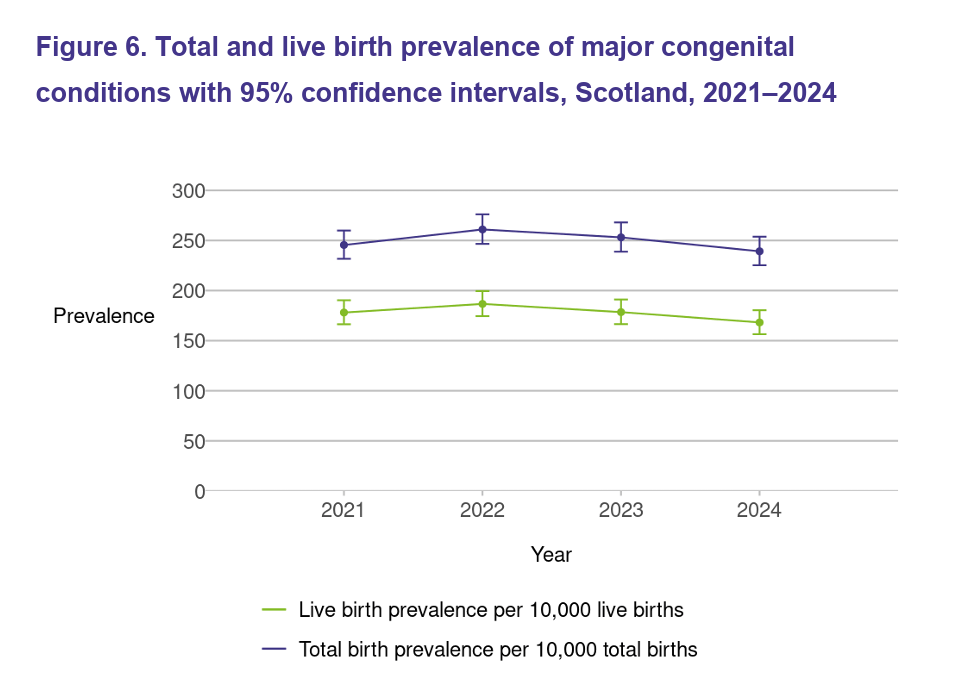
From Congenital conditions in Scotland 2021 to 2024 published yesterday, the above and:
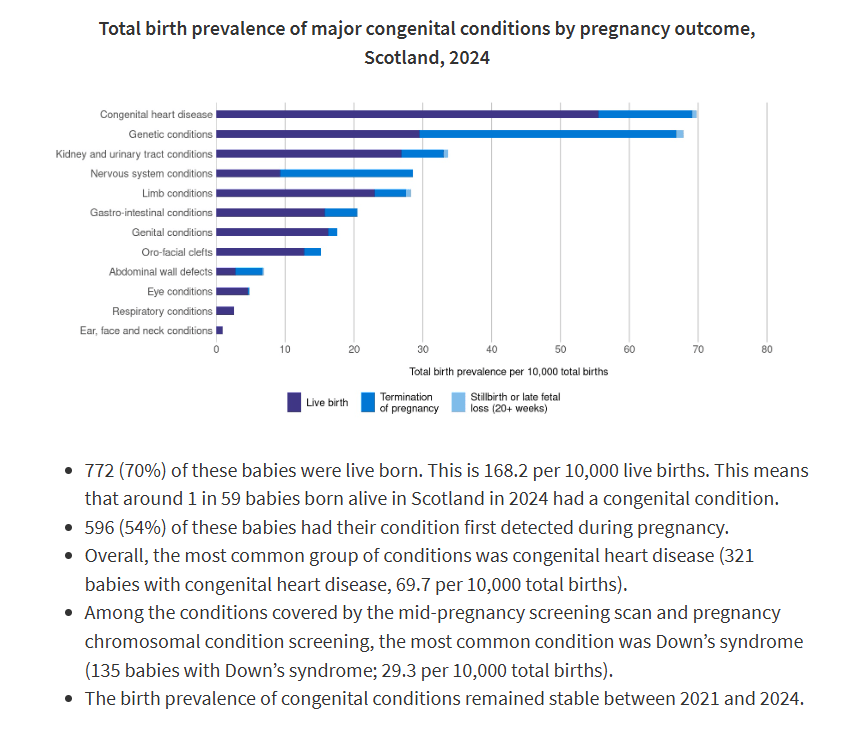
What factors influence the rate of these conditions?
Genetic factors, environmental exposures (often interacting with genes), maternal age, area deprivation, maternal ethnicity, infant sex, and multiple pregnancy are the main factors associated with variations in rates of major congenital conditions.
The rates for these conditions in England and Scotland are similar other than in South Asian communities in England where first cousin marriage is twice the national average rate as is the rate of congenital anomalies. https://www.sciencedirect.com/science/article/abs/pii/S0140673613611320
The line graph at the top shows that the overall rate in Scotland has dropped in the two years, from 261 to 239 per 10 000 births after a rise during the pandemic. That seems like a significant fall of 8.4% and not just ‘stable.’ Should that trend continue, as it may be, to 2026, it will require serious analysis as to causality.Comparable data is not yet available for England.
What might explain the improvement. I can find nothing much so far, but:
Scotland’s long-term lower poverty, better access to affordable housing, free prescriptions enabling better parental heatlh as austerity worsened in England?
The deprivation gradient for non-genetic conditions makes the idea reasonable in principle: better material circumstances can influence some environmental risk factors.
“In 2024, the total birth prevalence of conditions that were not due to a known genetic condition was highest amongst babies born to mothers living in the most deprived areas. By contrast, the total birth prevalence of conditions that were due to a known genetic condition was broadly similar across deprivation groups… The higher prevalence of non-genetic conditions among babies to women living in deprived areas may reflect higher risk of exposure to environmental factors that can disrupt babies’ development.” https://www.publichealthscotland.scot/media/41099/2026-10-27_congenitalconditionsinscotland2024_mainreport_final.pdf
This directly supports the reasoning that a deprivation gradient exists for non-genetic conditions and that it is plausibly linked to environmental exposures that better material circumstances could influence.
Discover more from Talking-up Scotland
Subscribe to get the latest posts sent to your email.

