

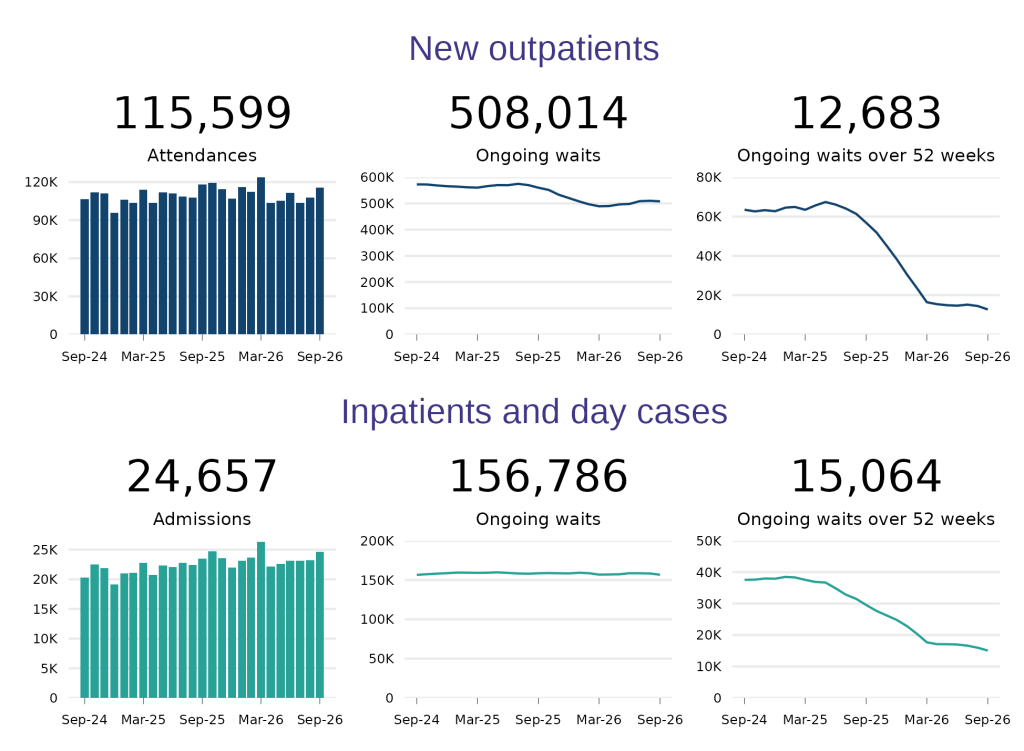
From Stage of treatment waiting times New outpatients, inpatients and day cases, published yesterday, the above and:
At 30 September 2026, there were an estimated 588,864 individuals on at least one new outpatient, inpatient or day case waiting list – a decrease of 2.2% compared to September 2025. This is equivalent to around 1 in 9 of Scotland’s population. In September 2026, 61.3% of these waits were completed in 12 weeks or less, down from 62.8% in August.
Have any experts expressed concern with the accuracy of the figures from England?
Yes. Several experts, think tanks, the independent statistics regulator, and media analyses have raised concerns about the accuracy, completeness, and transparency of NHS England’s Referral to Treatment (RTT) waiting-list figures. The statistics remain Accredited Official Statistics, but there are documented issues.
Pathways can leave the waiting list without being recorded as completed/treated). These “unreported removals” typically average around 13–15% of total removals (hundreds of thousands per month). They can include validation/data-cleaning (removing people who no longer need treatment, duplicates, errors, those treated privately, deceased, or who left the country), timing/reporting lags, non-attendance, and other administrative reasons.
The Nuffield Trust showed that activity alone has not always been enough to explain falls in the list. Unreported removals have played a material role, and public data does not clearly break them down. They described the headline waiting-list size as a potentially “misleading indicator” of how demand is being met without more transparency.
Sky News analysis (2026) estimated that roughly 17% of the recent improvement under Labour was linked to increased non-clinical validation rather than extra treatment activity. The Health Foundation, Nuffield Trust, and King’s Fund all criticised the lack of transparency around these removals.https://news.sky.com/story/nearly-one-fifth-of-improvement-to-hospital-waiting-list-under-labour-down-to-non-clinical-activity-13506698
Hospitals have received financial incentives (around £33 per patient removed via validation in some schemes). Critics (including Nuffield Trust) argue this needs clearer reporting so it is not conflated with genuine clinical throughput.
Experts (particularly at the Nuffield Trust and other health think tanks) and the OSR have expressed clear concerns about transparency and the difficulty of interpreting headline list changes, especially the role of unreported removals/validation versus actual treatment activity. The official figures are still regarded as usable accredited statistics, and NHS England has taken some steps to improve explanation of the issues, but the criticisms centre on incomplete public information that can make progress look stronger or simpler than the underlying activity data supports.
Discover more from Talking-up Scotland
Subscribe to get the latest posts sent to your email.

