

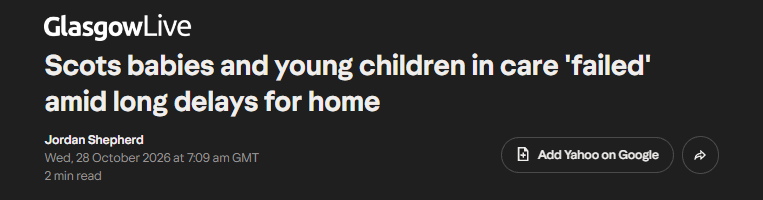
Featured in BBC Breakfast this morning and in Glasgow Live, today the above, with a tasteless image, and:
A charity has claimed that babies and young children in the Scottish care system are being failed by delays in decisions on their permanent homes.
NSPCC Scotland and the Parent Infant Foundation have organised the National Summit on Permanence for Babies and Young Children amid ‘serious concerns’ about the length of time youngsters wait to be placed in a long-term home.
The charity says that kids wait more than two years on average for decisions or recommendations, with many then waiting months or even years longer before moving there. They add that it takes children in Scotland nearly four and a half times longer to find housing than in England and Scotland’s care system for under-fives costs around twice as much as England’s.
https://uk.news.yahoo.com/scots-babies-young-children-care-070923865.html
‘The charity says?’
There is no single official national headcount of children “waiting for a permanent home” in either country that can be directly compared. Official statistics track the total number of looked-after children (those in the care system), while data on time to permanence comes mainly from research studies rather than a continuous national waiting list.
So, little there in terms of actually usefulness but also, I’d argue, importance
This is important:
First, number on child protection register in Scotland falls by 30% in last eight years to nearly 20% lower per head than in England, as public services are protected from the worst of ConLab austerity by 19 years of SNP government
From Child protection statistics 2024: local authority benchmarking tool, published today, we can see that there were 5 653 children on the child protection register in Scotland, in 2017 but only 4 069 by 2024, a 28.6% reduction. https://www.gov.scot/publications/child-protection-statistics-2024-localauthority-benchmarking-tool/
All things being equal, you might expect the figure for England to be around 40 000 but was, in 2024 [latest data], 49 800 making the rate in Scotland 19.7% lower per head: https://explore-education-statistics.service.gov.uk/find-statistics/children-in-need/2024
This is one of the ‘canary in the coalmine’ statistics for any society, like the abortion or stillbirth rates and shoplifting which, in Scotland, have been lower than in England or even falling for the last 10 years or so. In a society where increased numbers of children have to be taken in to care, where abortion rates and stillbirth rates climb, where women are increasingly shoplifting essentials, those children and women are telling you that society, England and Wales, is in deepening trouble.
Second, proportionally 4 times as many children in England & Wales face domestic abuse compared to Scotland
From BBC England 28 February 2026:
An 11-year-old boy who had both legs amputated after being assaulted by his birth parents has won his campaign for a new child safety register. Parents guilty of neglect will face similar monitoring to sex offenders following an amendment to the Crime and Policing Bill, which the government said it expects to table “shortly”. https://www.bbc.co.uk/news/articles/ce3gxkn453ro
Does Scotland also need such a register?
Currently in Scotland, child protection operates differently:
There is a Child Protection Register (CPR), maintained by local authorities. This is a confidential list of children (not parents) identified as at risk of significant harm from abuse or neglect. It supports inter-agency Child Protection Plans to safeguard those specific children. Neglect is a major reason for inclusion (e.g., around 40% of cases in recent stats), but the register focuses on the child’s status and risks, not on registering or monitoring offending parents long-term like a offender database.
Before deciding to follow the English register of offenders idea, we need to establish the relative scale of the problem which has clearly triggered the perceived need in England.
From Open Democracy on 25 June 2025:
An exclusive investigation by Open Democracy has found that 377,000 children in England and Wales have been identified by local authorities as being at risk of domestic abuse in the past five years. Perhaps even more shockingly, 396 of these children have died in the same period. https://www.opendemocracy.net/en/child-victims-domestic-abuse-national-crisis-family-courts-england-wales/
From March 2025:
The Scottish Government has today (26 March 2025) published the latest official annual Children’s Social Work Statistics for Scotland regarding child protection. This uses data collected from all 32 local authorities in Scotland on child protection processes from 1 August 2023 to 31 July 2024.
During the 2023-2024 year, 3,167 children were registered onto the child protection register, a decrease of 2% from 2022-23 (3,234). The figures show that a total of 2,129 children were on the Child Protection Register on 31 July 2024, an increase of 3% since 2023 (2,077).
The most common concerns identified at child protection planning meetings for children registered during the 2023-24 year were: domestic abuse (45% of children registered), neglect (42% of children registered), parental substance use (39% of children registered), parental mental ill health (37% of children registered), and emotional abuse (33% of children registered). https://www.celcis.org/news/news-pages/latest-child-protection-statistics-scotland-published#:~:text=The%20Scottish%20Government%20has%20today%20%2826%20March%202025%29,from%201%20August%202023%20to%2031%20July%202024.
All things being equal, you’d expect the figure for England & Wales to be around 11 times larger than the roughly 1 500 (45% of 3 167) reported as being at risk of domestic abuse in Scotland, or 16 500 but it’s around 75 000 (377 000 over 5 years), more than 4 times higher.
Discover more from Talking-up Scotland
Subscribe to get the latest posts sent to your email.

