

For some time now, if I offer any criticism of the media activity of Royal College of Emergency Medicine (Scotland) officers, I get long 'hurt' comments from Anonymouses. The media keep calling trade union reps, oh, OK 'royal college' reps, 'leading' doctors. They're not especially though all of them are more impressive figures than me. It's misleading and offensive to all the other doctors, some actually leading large teams, some at the 'leading edge' of new methods. Second, they insist on a 'crisis' when performance is demonstrably better than in NHS England where their colleagues seem less concerned to condemn government. Where their research reports are dodgy. Why am I so concerned by the media activity of royal college reps? They are endangering a government (SNP) which has ensured better pay and conditions than in England via far more respectful treatment by ministers and, notably, not one major health service strike in Scotland. Imagine they had helped Anas Sarwar become First Minister, what would a supine Labour Government in Edinburgh have done for them? Reduce them to the same conditions and the same treatment by ministers that their colleagues in England have faced and the same crises leading to millions of lost appointments due to multiple strikes. Think!!!
By Professor John Robertson (75) former Faculty Research Ethics Chair
From STV News yesterday, the above and:
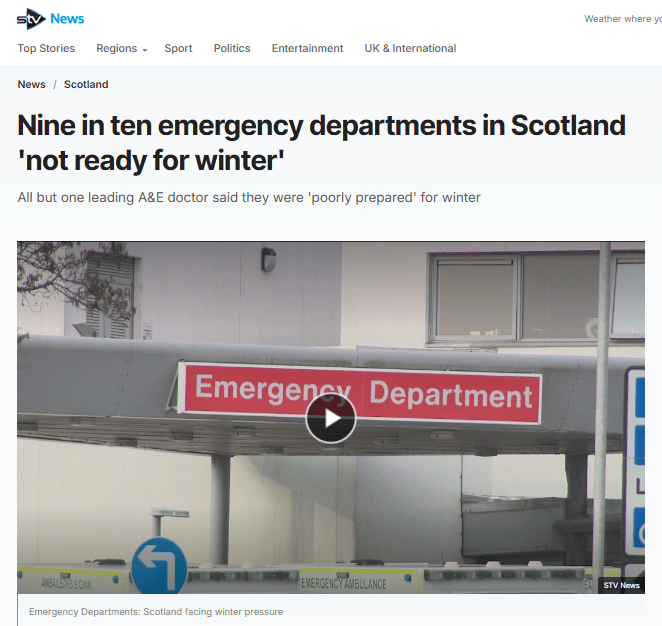
A leading emergency doctor has said “things are only going to get tougher” for emergency departments across Scotland in winter. Research from the Royal College of Emergency Medicine (RCEM) in Scotland shows that nine in ten A&E clinical leads in the country are concerned about the pressure they will face.
“Emergency Departments in Scotland have spent this entire year in a state of crisis”, Dr Fiona Hunter, RCEM Scotland Vice President, said.
“Thousands of people each month come to us, only to face waits for more than half a day before they are treated and sent home, transferred elsewhere, or given a hospital bed.”
The RCEM surveyed 163 clinical lead across the UK about how they are managing and their views ahead of winter. Of the 25 respondents in Scotland, representing almost every emergency department, all but two told RCEM they were either “very” or “extremely” concerned about the pressure they will experience this winter.
So, the facts – I can only, even with AI help, only see the press releases and so cannot scrutinise the actually research for the kind of flaws common in trade union/royal college research – leading questions?
Without being asked a leading question by me, AI was quick to remind me, because I had used the word ‘research’:
It is not a formal academic paper but a snapshot “snap survey” of doctors in charge of A&E departments. RCEM surveyed 163 clinical leads across the UK (covering most EDs). Of the 25 respondents in Scotland (representing almost every ED), the results showed:
- All but two (roughly nine in ten) were “very” or “extremely” concerned about winter pressures.
- All but one (96%) said current pressure was “high” or “very high.”
- The same number said their department was poorly prepared for winter.
- Three-quarters said pressure was much higher than the same time the previous year.
It really matters what questions were asked. Researchers know that you can draw responses of the above kind from any public servants – nurses, doctors, teachers, police officers – if you ask questions like: ‘Is pressure higher than last year.’
‘Pressure is higher than last year’ they shout and it is, has been climbing since the end of the pandemic, but when you check the actual attendance figures it’s actually, essentially, the same as before the pandemic. In September 2019 in Scotland’s Type 1 ED’s there were 124 558 attendances and in September 2026 there were 118 326.
Finally on ‘Thousands of people each month come to us, only to face waits for more than half a day before they are treated and sent home, transferred elsewhere, or given a hospital bed”, see our earlier response noting:
10.1% wait for more than half a day (12 hours) in England but only 5.4% do in Scotland.
I fully recognise that working in A&E can be an experience of intense pressure, often. I am saying, however, that the royal college reps should think and think far more deeply about what they do and how they do it, honestly.
Discover more from Talking-up Scotland
Subscribe to get the latest posts sent to your email.

