

By stewartb
When reading across the press statements that the RCEM makes regularly on the waiting times performances of the NHS in England, the north of Ireland, Scotland and Wales, it is rare to find it refer directly to between nation comparisons. In particular, the longstanding better performance of NHS Scotland tends not to be acknowledged although clearly evident in time series graphs tucked away in the RCEM’s website.
Rare but not never! One such occurrence in a recent RCEM press statement on NHS Scotland (see below) strikes me as rather ‘odd’ if not perverse!
For context, from the RCEM (October 8) on NHS England: “10% of A&E patients waited more than half a day last month as ‘unacceptable’ ED crisis rages on..”
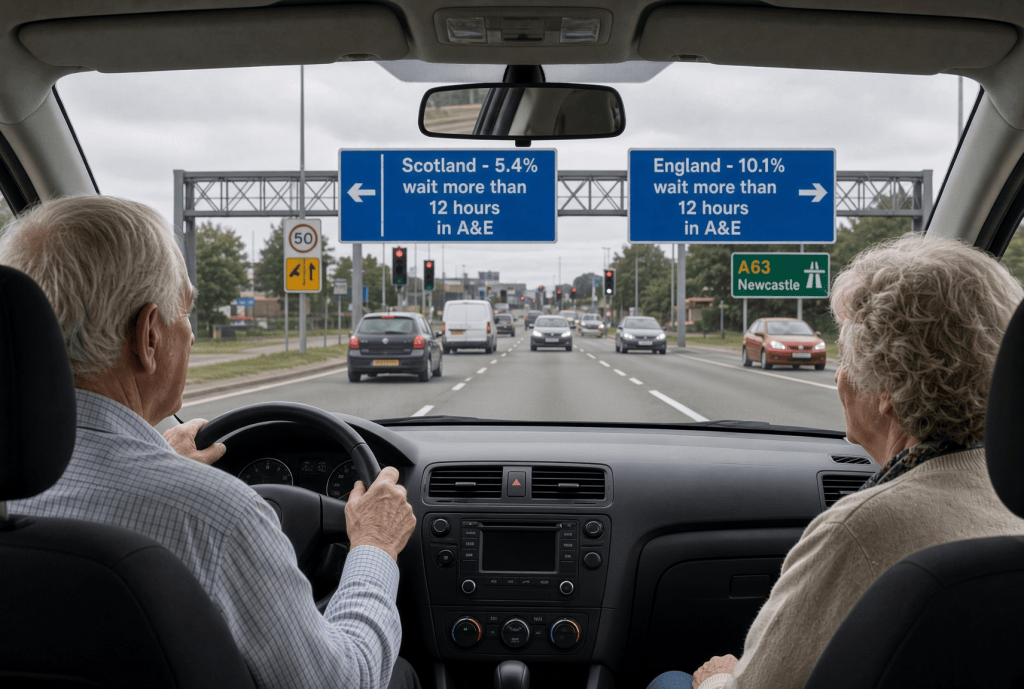
‘The proportion of patients waiting 12 hours is the highest it has been in four years, at 10.1%. That means a total of 157,574 people waiting more than half a day in an Emergency Department (ED) last month.’ (my emphasis)
And it notes: ‘Last month, an average of 13,647 beds were occupied by patients who were medically fit to be discharged – but could not leave hospital. This is typically because of delays in the hospital or a lack of social care capacity.’
Dr Ian Higginson, RCEM President, is quoted: “We need urgent and concrete action to tackle delays at the ‘back door’ of our hospitals from the government.
“The Prime Minister has made it clear he intends to reform social care – that is a welcome step, but we cannot wait years before a decision is made about what changes are needed. There has been too much kicking of cans down the road.” Dr Higginson should be asking why the PM has not drawn on the solutions to such A&E and social care challenges available to him from Lord Sarwar and his former deputy in Scotland, Dame Jackie Baillie. Did they not have well worked-out, ready to implement solutions to similar challenges in Scotland?
Missing from the RCEM’s press statement is this: the official NHS England report notes that 60.6% of patients attending its Type 1 (main) Emergency Departments during September were admitted, discharged or transferred within the 4 hour standard. This compares to 61.1% in August 2026 and 61.1% in September 2025.
Now to NHS Scotland and the rare but ‘odd’ comparison the RCEM opts to make. On NHS Scotland, on October 7: ‘RCEM: Worst August Emergency Department performance on record shows need for urgent action ahead of winter.’
The RCEM states: ‘Only 62.3% of patients were admitted, transferred or discharged within four hours, far below the Scottish Government’s 95% target and almost on a par with performance levels in England.’ So 62.3% compared to 60.6% is deemed newsworthy – and note the use of ‘only’: has the RCEM set out to frame press statements to be especially unfavourable to NHS Scotland?
And then from the RCEM, this in Scotland: ‘5.4% of patients waited more than 12 hours, equivalent to 6,965 patients, almost 20 times higher than July 2019 levels.’
Note the comparison with 2019, one NOT made for NHS England. And note the ABSENCE of a comparison between 5.4% in Scotland and 10.1% in England. This decision NOT to make a comparison of what are very substantially different 12 hour stats in Scotland and in England is despite the fact that it is precisely such long stays in A&E – not 4 hour ones – that the RCEM argues adversely impacts patient mortality rates. Odd?
Discover more from Talking-up Scotland
Subscribe to get the latest posts sent to your email.


And yet Dr Fiona Hunter, of the Royal College of Emergency Medicine, said she was “completely terrified” of the looming winter pressures on the NHS.
Speaking on the BBC’s Sunday show, she said: “There’s been a toxic normalisation of corridor care”.
Who are these senior medics who speak with such authority on behalf of their silent majority of members?
Do they still practise medicine regularly, or have they largely withdrawn from the “front line” to pontificate from behind the sofa?
I’m always suspicious of single spokespersons, having seen
with other organisations that the one who writes it up and/or talks a good game is often portraying their own individual, subjective opinions as representative of a silent majority who’ve got work to do or even better things to do than do media briefings.
LikeLiked by 1 person
Odd? It’s disturbingly odd. It’s almost as though they have an agenda.
LikeLiked by 1 person
Not a reply. Gremlins in the system?
The Tories did not increase NHS funding for ten years. Austerity. Until Covid. Funded Covid over two years. £270Billion. After the damage had been done. Not prepared. Scotland did not get the equivalent of £27Billion. Where did it go?
The Scottish Gov has to mitigate the Westminster cuts to essential services. Westminster borrows and spends £100Million more on the South. Scotland has to repay debt repayments on the money. Not borrowed or spent in Scotland..
LikeLike
Dear stewartb, Derek Scott, Capella, John Robertson et al, I have admired so much of what you all have to say but on this one you’re getting it wrong. It is nearly fifty years since I entered the medical profession and I have seen it all both clinically and politically. Medicine was, for a time, my replacement for religion. Before I realised the sheer corruption, especially ‘big pharma’s’ takeover of ‘evidence based medicine’. In terms of so-called ‘private medicine’ in Scotland there are broadly three categories: 1) Those who simply want to escape once in a while from an overbearing and sometimes (most of the time?) incompetent management system, and who probably feel embarrassed at their participation in the VAT free and charitable corruption. 2) Those who were simply forced into ‘private medicine’ by e.g. the Cameron-Clegg government utterly incompetently changing taxation applying to senior members of the NHS/SPPA pension schemes (and equivalent in England) such that earning £1 more than a certain level of salary by providing extra hours to the NHS would result in an immediate loss of pay of £22,000 and affected doctors couldn’t calculate this tax liability until after the tax year was over. The worst affected were threatened with bankruptcy. They simply guessed at the limit they could work for the NHS then turned to the ‘private sector’ to support their families. Most had no desire at all to work privately. 3) Greedy bastards forsaking their medical oath, and there seems to be a lot of them, but they really are a minority. I am not aware of any private A&E facility in Scotland nor any A&E Consultants who work privately. Specialism in A&E is relatively recent, as is the RCEM – 2008, though predecessor organisations date back to 1993 and 1967. Responsibility for the individual patient in A&E used to be a somewhat loose mutual understanding between specialities which sometimes broke down, orthopaedics taking pole position for most trauma cases.
Medical ethics have been underpinned since WW2 by The Declaration of Geneva (the “modern Hippocratic Oath”): https://www.wma.net/policies-post/wma-declaration-of-geneva/. Hard for any human to live up to, but you can try. And many do, largely the unsung everyday skilled grafters. Watch tv series ‘The Pitt’. Every scale of emergency in one episode for tv drama, but most doctors who have worked in UK emergency medicine think it’s the nearest representation they have seen, not least the personal anguish some of the doctors suffer in trying to fulfill their oath or coping with the realisation that they have failed. And we all fail at some point.
I do not personally know the leaders of the RCEM In Scotland: Dr Fiona Hunter and Dr Jayne McLaren, who are revered by their peers and perform their representative duty without remuneration in addition to an arduous day job which allows no margin for error. 7% corridor care in Scottish A&Es is not acceptable for them. It must be zero. And then? Betcha they campaign even harder to reduce the accidents in the first place. The issue appears to be that this website compares Scotland to England and rightly criticises the bias and lies of mainstream media. However these Doctors speak in absolute terms and wish only to be the very best…for all of us. A&E medicine is not profitable and should be the starting point to clean up the NHS in Scotland and get rid of appalling ‘private practice’ largely subsidised by the state in taxation and moonlighting terms and picking up the pieces when it goes wrong.
This is my lived memory of working in General Practice – https://abetternhs.net/2013/05/10/true-history/ – and it has largely disappeared now save perhaps in rural areas. Some (?all) NHS medical specialties still provide a similar service with Consultants rotating ‘on-call’ on a weekly basis in order to have a family life. That’s 168 hours of availability including the day job. Perhaps they won’t be called on by their teams during those weeknights and weekends including all public holidays but try telling that to Consultants in surgery and general medicine. Give the true heroes support or you will lose it all just as General Practice has largely been lost. The vultures are waiting in the wings.
LikeLiked by 1 person
Point taken. We can only call it as we see it and we see it in the MSM on a daily basis. As for personal experience, I have nothing but admiration for the kindness and care I’ve experienced and I’m sure most people find the same. Our problem is that the media in Scotland bury the excellence in Scotland to give the impression of a failing Holyrood, and there are some spokespersons in the NHS who are very willing to assist them. If Holyrood goes the Scottish NHS will quickly follow.
LikeLike
I really appreciate this comment, and it is what I like about this website. Many users, including the editor (and me) reflect on what others say and sometimes even modify their opinions. I do not personally know Dr Fiona Hunter and Dr Jayne McLaren (and wonder if they’re getting extra flak because they are female in a formerly male preserve) but they are even giving up their own family time (Dr Hunter mentioned in an article that she has – I think – two children) totally unremunerated to campaign in absolute, not relative, terms for a better service. If they are gone and not replaced by like spirits you will know the NHS has ended. But thanks again, you cheered me up.
LikeLiked by 1 person
‘… on this one you’re getting it wrong’.
I too take your point – to a degree. However, my (others’?) problem is that the way certain professional bodies opt to communicate lends itself to politicisation – and a associated degree of negativity – to a much greater degree in Scotland, than e.g in England. This comes repeatedly from Unionist politicians and MSM outlets that oppose the SNP Scottish Government and by extension, the aspirations of c. 50% of voters in Scotland for self-determination. The favoured approach of the BBC and most of the MSM when reporting Scotland is to shun ‘context’, to shun ‘perspective’, to shun objective, evidence-based comparative analysis. TuS strives to counter this in what is a hugely unequal struggle!
From observation over several years, the RCEM’s press releases on A&E performance in Scotland gains much more traction – with an MSM targeting negative reporting on Scotland – than in any other part of the UK. This is DESPITE the fact that performance in Scotland has for long been much better when compared to its rUK peers.
And then there is the FACT that the ONLY government with responsibility for NHS services that has ALL the powers of a currency-issuing, independent nation-state available to resource a ‘fix’ for health and social care across the UK is the government with responsibility for NHS England.
Some of the performance differences between the NHS in the different parts of the UK are candidly, stark – especially on 12 hour waits. Why is the percentage of 12 hour waits in NHS Scotland around half of the percentage in NHS England? Would the RCEM not like to see the percentage in England cut by half, to a similar level to Scotland’s? Is there NO MERIT in the RCEM acknowledging what is being achieved in Scotland, albeit with substantially more constrained access to financial resources and agency? (And IMHO no-one in the Scottish Government or in NHS Scotland’s boards will view the status quo as acceptable!)
Is the RCEM aware of its ability to gain attention from BBC Scotland and the MSM in Scotland to a degree – from lengthy observation – far in excess of what its communiques on the NHS elsewhere in the UK achieve? No need to wonder why?
And whilst mindful and indeed sympathetic to your views on the valuable contribution to communities of individual named clinicians, for the avoidance of doubt I maintain that my actual summary of notable differences in how and what the various RCEM’s press releases opted to include remains valid … and from my viewpoint, regrettable.
LikeLike
Hi stewartb and your above message is a return to form. Dr Fiona Hunter and Dr Jayne McLaren are doing their near (just in case any Scottish RCEM NHS Consultants actually do dissent – your own AI search broadly confirms) 100% supported representation unpaid and in their own time (what there is of it) and the Scottish ‘branch’ of the RCEM is part devolved, hence their ‘vice-chair’ and ‘vice-president’ appellations. And I think you have taken on board that the Drs are speaking in absolute Scottish terms not relativisms. My real point is that TUS is going for the wrong targets. Wonderful human beings like Dr Fiona Hunter and Dr Jayne McLaren are the very people we need to make NHS Scotland great again. A&E medicine is a good marker for the health of the NHS because of its urgency and immediacy…harder for the beaurocrats to cover up any flaws. And look what Dr Fiona Hunter and Dr Jayne McLaren and their colleagues have given us – literally a fraction of the level of ‘corridor care’ experienced by the rUK. Professor Robertson did a magnificent job of highlighting this then spoiled it all by hitting the wrong targets. If only he had praised and supported those who made that 7% possible. At this very moment Audit Scotland are reviewing orthopaedic services and I am trying to put together a response highlighting orthopaedic Consultant moonlighting to the private sector because lickspittle Audit Scotland is unlikely to. Now that and many more examples across all clinician types including dentistry should be the the TUS target. As I have often posted on TUS, thanks to editorial tolerance, current ScotAccount and MyCare.scot are just the start of American ‘big tech’ control of our most intimate data. As is the centralisation of public bodies including health boards. Pax Americana is taking over in plain sight and easily outmanoeuvring the almost tech illiterate Scottish negotiators. But TUS means talking up the good ‘uns. Like Dr Fiona Hunter and Dr Jayne McLaren.
LikeLike