

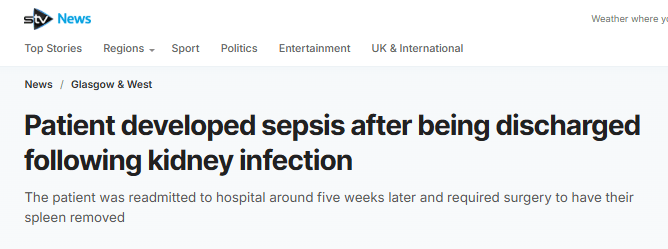
From STV News, Calum Loudon, yesterday, the above and:
NHS Greater Glasgow and Clyde has been ordered to apologise to a patient after they developed sepsis and required surgery to remove their spleen following treatment for a kidney infection. The Scottish Public Services Ombudsman (SPSO) found failings in the follow-up treatment provided to the patient, who was readmitted to hospital around five weeks after being discharged.
The patient, referred to as C in the report, had initially been admitted to hospital for treatment for a renal abscess, a collection of pus caused by an infection in the kidney. They complained to the Ombudsman about their care and treatment, including the decision to discharge them from hospital.
Another of the many, many, single-case health stories tabloidized by STV and BBC Scotland and devoid of any useful public information.
Hey, Calum:
Does this happen a lot? Should we be afraid, wary of going in?
Do you know? Did you not care?
In May 2026, The Sunday Post was on your level too:
Sunday Post fails to tell us how an SNP Health Secretary made sure hospital-acquired sepsis levels would fall way below the level under Labour


The Sunday Post, above today makes much, much too much, of one case of sepsis where diagnosis was later than it might have been. What does it tel us about the wider situation, the ‘news’ dare I say it?
Nothing.
There is, in the Post, of course, no fuller explanation of the situation with regard to sepsis, in Scotland, just the one wee story. Here it is:
How under Scottish Labour, hospitals were ‘death traps’ of hospital acquired infections and how Nicola Sturgeon sorted it
The prevalence of HAI was 4.9%, 2.5%, 6.1% and 1.2% in acute, non-acute, paediatric and independent hospitals respectively [in Scotland in 2006]. https://www.journalofhospitalinfection.com/article/S0195-6701(12)00277-0/abstractThe most recent comprehensive data on hospital-acquired infections (HAIs) in Scotland comes from a 2021 study led by Glasgow Caledonian University, commissioned by the Scottish Government. This study, published in the Journal of Hospital Infection, found that approximately 1% of hospital patients in Scotland develop HAIs annually, equating to about 7,500 patients each year. This incidence rate is notably lower than previous UK estimates (7.8%) and recent European figures (3%). https://www.scotpho.org.uk/health-conditions/infections/data/healthcare-associated-infections/
So, hospital acquired infections under the SNP are between a fifth and a half of the level in 2006, under Labour, an eighth of the level in England and a third of the level in Europe.
Why, so good?
In Scotland, the decision was taken in 2008, against the background of major problems in British hospitals with infections resistant to treatment. The Scottish ministry of health [Health Secretary, Nicola Sturgeon] banned any further contracting-out of these services, so that when existing contracts expire all work returns and remains in-house. It also financed the employment of 600 extra cleaners to raise standards of cleanliness.https://www.epsu.org/article/uk-hospital-cleaning-brought-house-scotland-wales-n-ireland
New research shows that NHS hospitals that employ private cleaners are associated with a higher incidence of MRSA, a ‘superbug’ that causes life-threatening infection and has previously been linked with a lack of cleanliness…on average, the incidence of MRSA infection between 2005 and 2009 was 2.28 in every 100,000 bed days in trusts that outsourced their cleaning, compared with 1.46 bed days in trusts that used in-house cleaners –.a difference of almost 50 per cent.
The research was conducted by the University of Oxford, with the London School of Economics and Political Science, and the London School of Hygiene & Tropical Medicine.
Discover more from Talking-up Scotland
Subscribe to get the latest posts sent to your email.


The prevailing method of examination in Scottish hospitals when there is a pyrexia of unknown origin is this; IF IN DOUBT, TREAT AS SEPSIS.
First line is high dose broad spectrum antibiotics with hydration support. In all hospitals. But there is always the possibility of sepsis arising as the bacteria responsible can be resistant.
LikeLiked by 1 person