

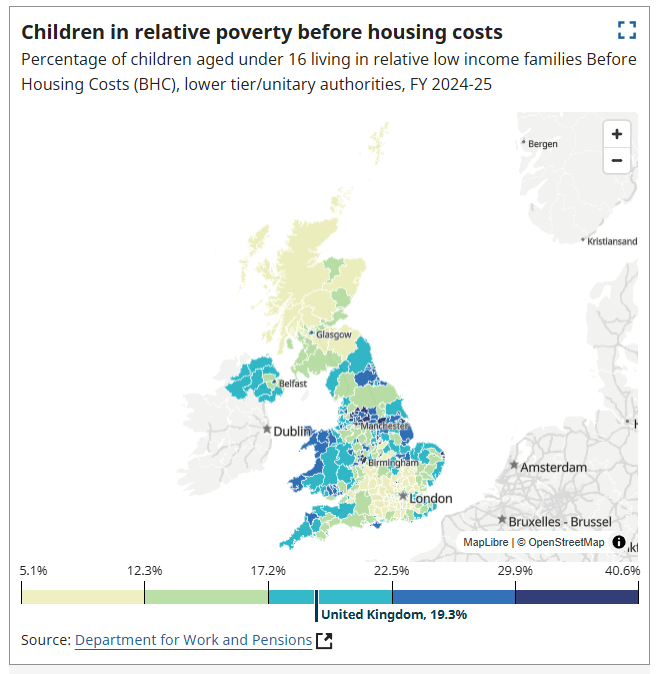
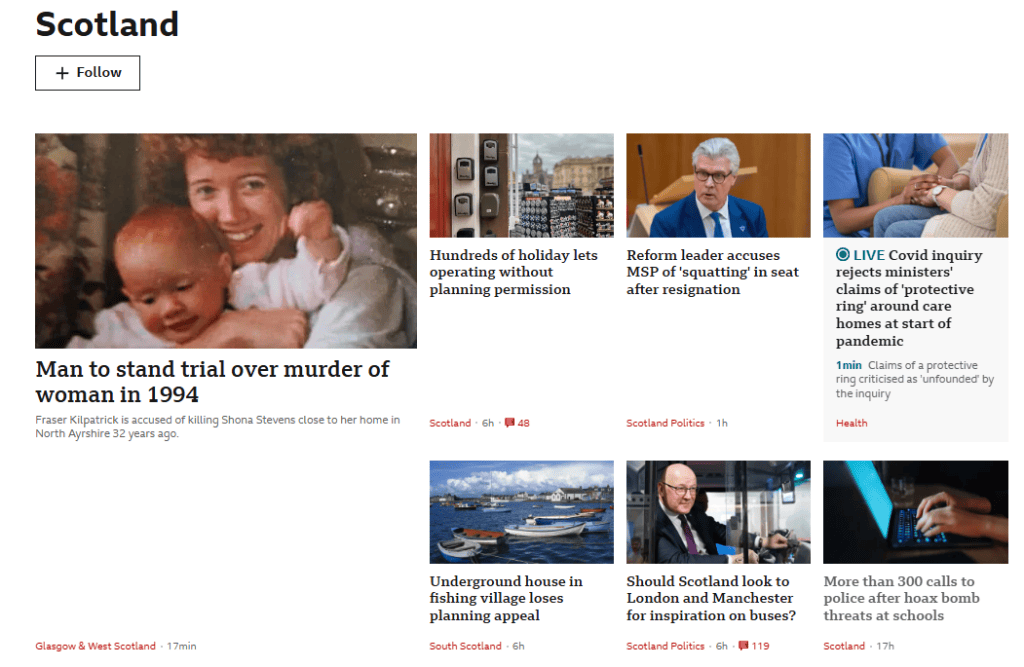
Published earlier today but as yet nowhere to be seen on BBC Scotland – Joint letter from the Scottish and Welsh Governments calling on the UK Government to scrap “punitive” welfare policies, adopt plans to cut energy bills, and to further devolve powers to help drive continued progress in tackling poverty, posted in full here:
To: The Rt Hon Pat McFadden MP
Secretary of State for Work and Pensions
To: The Rt Hon Lucy Powell MP
Secretary of State for Education
20 October 2026
Dear Pat and Lucy,
We are writing jointly to congratulate you on your appointment and to restate our commitment to working collaboratively with the UK Government to tackle child poverty. While each of our governments is taking action within devolved responsibilities, many of the most powerful levers for tackling poverty remain reserved to the UK Government. The forthcoming Budget therefore presents an important opportunity to deliver meaningful improvements for children and families across the United Kingdom.
The Prime Minister has spoken of the need to give households more breathing space in the face of the ongoing cost of living crisis The UK Government’s temporary cut on VAT for household electricity bills has only marginally offset the rise in bills which has taken effect under the new energy price cap starting this month. This means that further action is needed urgently including taking forward action on a social tariff to provide long term relief to households in need.
Wales has some of the oldest and least energy-efficient housing stock in the UK and the most recent fuel poverty estimates show one in four of households in Wales live in fuel poverty with a further 16% at risk of fuel poverty. Wales and Scotland also have a considerable number of off-gas grid properties in our rural and coastal communities. Scottish Government proposals for a social tariff in the form of targeted bill discounts have cross sector support, and published modelling has shown that 660,000 households in Scotland would see their estimated fuel bills go down by an average of £700.
We urge the UK Government to give serious and renewed consideration to these proposals or to set out alternative action which would deliver at the same scale for low income households across the UK – and ensure that fewer households struggle with the cost of energy this winter, particularly those who are being impacted disproportionately by the conflict in the Middle East.
The Prime Minister has also set out his ambition to end homelessness and rough sleeping. We know that we must take a preventative approach to end homelessness for good and for everyone. Right now, in communities across the length and breadth of the country, we can see the growing impact of the freeze to Local Housing Allowance (LHA) rates, which is deepening poverty and driving homelessness. That is why we urge you to end the freeze and take immediate action to permanently repeg LHA rates to cover the bottom 30% of rents as an absolute minimum – a move that is estimated to lift 75,000 children out of poverty by the end of the UK Parliament.
As seen in Wales, rising private rents are increasingly outstripping the support available through LHA leaving many families exposed to significant affordability pressures. While repegging LHA to the 30th percentile would provide welcome relief, it would still leave many households unable to access a substantial proportion of the market. That is why the Welsh Government has repeatedly called for the UK Government to commit to restoring LHA to the 50th percentile over time, ensuring housing support better reflects real rental costs and providing greater security for families at risk of poverty and homelessness.
Collectively we have welcomed the end of the two-child limit across the UK from April 2026. This is a critical step forward which is helping to ease the burden on families across the UK, but it is not enough on its own to break the cycle of poverty. The Benefit Cap, Bedroom Tax and Young Parent Penalty are all driving hardship among households across the country and should be removed in the forthcoming budget. The combined impact of these measures drives thousands of families into the deepest forms of hardship – pushing them further from support and toward emergency provision including food banks.
Beyond these immediate steps, there is wider action that is needed. Enhanced support will only help if families receive what they are entitled to. We note with interest the Department for Work and Pensions’ plans to publish the first estimates of Universal Credit take-up rates this month, but this must be the first step in wider action to drive the take-up of reserved benefits. In both Scotland and Wales, we are taking targeted action to promote the take-up of support and urge you to set out clearly how the UK Government will do so through a new benefit take-up strategy. In Scotland and Wales, we are also taking action to unlock the potential of data and to streamline the benefits for which we are responsible, ensuring that we reach the families most in need of support. We note with interest DWP’s work to share more data with local authorities. This offers real possibilities to make further progress on child poverty, to support public service reform and enable more preventative action. We urge the UK Government to continue to work with us and support local partners to make the most effective use of data and to consider the next steps in this space.
As work in Scotland and Wales has clearly demonstrated, there is considerable potential for devolution to yield new and innovative approaches which can transform the lives and outcomes of families – responding to our local contexts, histories and the needs of our communities. We therefore welcome the Prime Minister’s renewed focus on devolution and a rebalancing of power away from Whitehall. While the devolution settlements of our nations differ, we would welcome an open approach to increasing devolution which would allow us to strengthen support for families in the years ahead.
On these issues and more, our action on child poverty will be stronger if we work together. At the last meeting of the Four Nations Ministerial Group on Child Poverty in March, all four nations agreed on the need to continue meaningful collaboration. We urge you to work with us to maximise our collective impact in the months and years ahead.
Ensuring that no child’s life is limited by poverty is a mission that we all share. We urge you to prioritise the steps we have set out and to work with us to drive further progress.
We are copying this letter to the Secretary of State for Scotland and Secretary of State for Wales for information.
Shirley-Anne Somerville
Sioned Williams:https://www.gov.scot/publications/tackling-poverty-joint-letter-to-uk-government-ministers/
How is Scotland doing on this major concern?
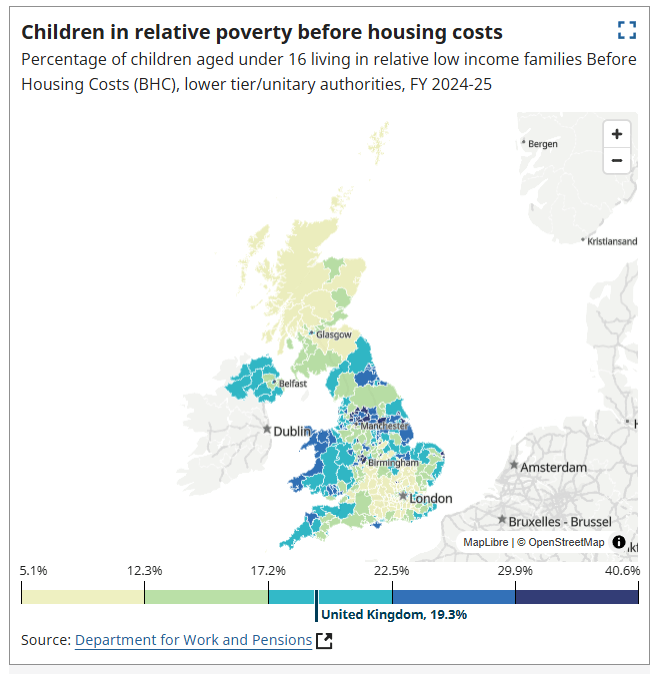
From UK research – Children in relative poverty before housing costs
This indicator shows the percentage of children aged under 16 living in relative low income families Before Housing Costs (BHC), in the UK, for financial years ending 2022 to 2025.
Data source: Department for Work and Pensions published 26 March 2026: https://www.ons.gov.uk/explore-local-statistics/indicators/children-in-relative-poverty-before-housing#map
It also reveals the shocking contrast between Scotland after nearly two decades of determined efforts by the SNP in government in Scotland to resist Tory and Labour austerity policies, despite limited powers, and to Work as if you live in the early days of a better world.
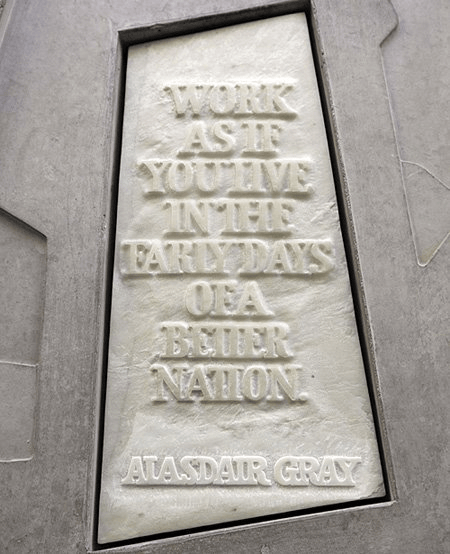
Want more on how different Scotland already is? Try: https://talkingupscotlandtwo.com/?s=different
Discover more from Talking-up Scotland
Subscribe to get the latest posts sent to your email.


Different, and BETTER.
Scotland’s miles better! 🙂
LikeLike
Since Mr McFadden is a Scot-loathing Scot and Ms Powell, like many genuinely progressive people in England, has no real understanding of The UK being something different from England, I do not have high hopes for a positive and constructive response to these arguments which are set out in a respectful way.
I recall when Jeremy Corbyn was leader of the Labour Party and was asked about a proposal which the questioner said would require separate legislation for Scotland and he replied, ‘we do not have different laws in different parts of England’. He was using ‘England’ as a synonym for ‘UK’. This is a man who has long supported reunification of Ireland, but does not actually grasp that Scotland and Wales are not parts of England.
LikeLiked by 1 person