

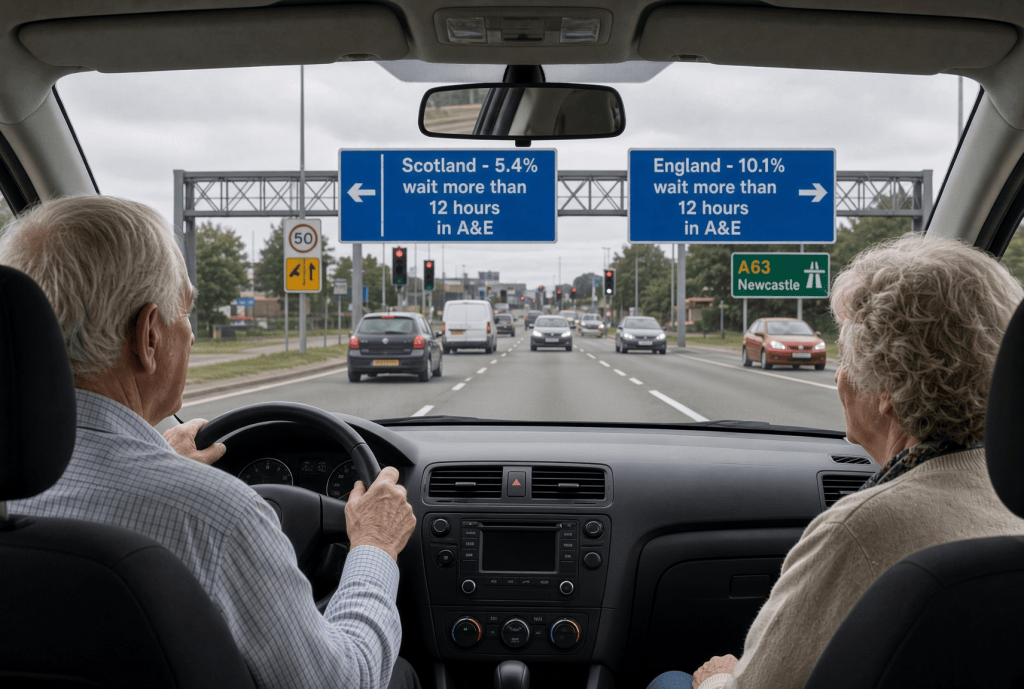
In the Herald today:
More than 30,000 NHS waits are still longer than a year despite a Scottish Government pledge to eradicate them by March. Last year, First Minister John Swinney set a target of March 2026 for no patient to wait longer than a year for their treatment.
Important I’m sure but:
Why A&E should take priority if resources force a choice
- Mortality evidence is clearer and more immediate for A&E delays. Excess deaths in the low tens of thousands annually are estimated from long emergency waits; equivalent quantified mortality impact is not shown for the current scale of one-year elective waits.
- Volume and acuity: Millions experience 12-hour A&E waits every year versus ~100,000+ one-year elective waits. A&E deals with potentially life-threatening conditions by definition.
- Interdependence exists: Poor patient flow and delayed discharges drive A&E crowding, which occupies beds and crowds out elective capacity. Untreated elective conditions can also present as emergencies. Addressing flow (beds, social care, same-day emergency care) helps both. Recent government measures include urgent-care capital investment and modest A&E targets (e.g., reduce 12-hour waits so they occur less than 10% of the time; improve four-hour performance toward 78%).England.nhs
Both problems are serious and require sustained action on capacity, workforce, flow and prevention. But when ranking by documented risk of death and urgency, reducing long A&E waits should come first.
So:
By stewartb
When reading across the press statements that the RCEM makes regularly on the waiting times performances of the NHS in England, the north of Ireland, Scotland and Wales, it is rare to find it refer directly to between nation comparisons. In particular, the longstanding better performance of NHS Scotland tends not to be acknowledged although clearly evident in time series graphs tucked away in the RCEM’s website.
Rare but not never! One such occurrence in a recent RCEM press statement on NHS Scotland (see below) strikes me as rather ‘odd’ if not perverse!
For context, from the RCEM (October 8) on NHS England: “10% of A&E patients waited more than half a day last month as ‘unacceptable’ ED crisis rages on..”
‘The proportion of patients waiting 12 hours is the highest it has been in four years, at 10.1%. That means a total of 157,574 people waiting more than half a day in an Emergency Department (ED) last month.’ (my emphasis)
And it notes: ‘Last month, an average of 13,647 beds were occupied by patients who were medically fit to be discharged – but could not leave hospital. This is typically because of delays in the hospital or a lack of social care capacity.’
Dr Ian Higginson, RCEM President, is quoted: “We need urgent and concrete action to tackle delays at the ‘back door’ of our hospitals from the government.
“The Prime Minister has made it clear he intends to reform social care – that is a welcome step, but we cannot wait years before a decision is made about what changes are needed. There has been too much kicking of cans down the road.” Dr Higginson should be asking why the PM has not drawn on the solutions to such A&E and social care challenges available to him from Lord Sarwar and his former deputy in Scotland, Dame Jackie Baillie. Did they not have well worked-out, ready to implement solutions to similar challenges in Scotland?
Missing from the RCEM’s press statement is this: the official NHS England report notes that 60.6% of patients attending its Type 1 (main) Emergency Departments during September were admitted, discharged or transferred within the 4 hour standard. This compares to 61.1% in August 2026 and 61.1% in September 2025.
Now to NHS Scotland and the rare but ‘odd’ comparison the RCEM opts to make. On NHS Scotland, on October 7: ‘RCEM: Worst August Emergency Department performance on record shows need for urgent action ahead of winter.’
The RCEM states: ‘Only 62.3% of patients were admitted, transferred or discharged within four hours, far below the Scottish Government’s 95% target and almost on a par with performance levels in England.’ So 62.3% compared to 60.6% is deemed newsworthy – and note the use of ‘only’: has the RCEM set out to frame press statements to be especially unfavourable to NHS Scotland?
And then from the RCEM, this in Scotland: ‘5.4% of patients waited more than 12 hours, equivalent to 6,965 patients, almost 20 times higher than July 2019 levels.’
Note the comparison with 2019, one NOT made for NHS England. And note the ABSENCE of a comparison between 5.4% in Scotland and 10.1% in England. This decision NOT to make a comparison of what are very substantially different 12 hour stats in Scotland and in England is despite the fact that it is precisely such long stays in A&E – not 4 hour ones – that the RCEM argues adversely impacts patient mortality rates. Odd?
Discover more from Talking-up Scotland
Subscribe to get the latest posts sent to your email.


OT, but I noticed this.
https://www.liverpoolecho.co.uk/news/liverpool-news/mersey-ferries-suspended-nine-days-34783464?utm_medium=Social&utm_source=Facebook&fbclid=IwY2xjawVDPVxleHRuA2FlbQIxMABwZG9mAWJyaWQRMGV3aHZIanlOTTRoZGdyYU9zcnRjBmFwcF9pZBAyMjIwMzkxNzg4MjAwODkyAAEee456EwgGKr4v5Thn87E2rR6fu_gU5EmG_DjvLNLth_IXl3K-lZSj3NEuNJs_aem_ahSnGRi8KOjw12G3-7HHlg#Echobox=1792402361
LikeLiked by 1 person
“Why does the Royal College of Emergency Medicine avoid comparisons with Scotland?”
Embarrassment ..
Stephen McKenzie
LikeLiked by 1 person
hi Stephen, hoping my main comments from the two previous repeats of stewartb’s piece will be published, summary: RCEM comments in absolute terms e.g. get corridor care down from already best in UK at “7%” down to zero. TUS deals in relative terms. The RCEM leaders in Scotland do all the (a)political stuff in their own time unpaid. They are lambs to the slaughter but it’s worth it if they make the service better! I don’t know for certain how they manage their out of hours, weekends and public holidays but in other acute services Consultants cover a full week at a time (168 hours)…and in the acute services you are going to be called out…a lot! Here is how my lot used to work prior to 2004: https://abetternhs.net/2013/05/10/true-history/. And in hospitals 56+ hours Saturday morning (maybe even Friday morning) until Monday evening was commonplace. Absolutely no offence intended to you, Stephen, people just don’t remember any of this. And some Consultants and rural GPs are still doing it. Please go easier on the RCEM/A&E Consultants, they are the best of what’s left of the NHS.
LikeLike
Shame on this website if my full reply to the triple rollout of stewartb’s piece isn’t published. Why is TUS continually pissing on the best, the very best of Scotland? Why not ‘private practice’ moonlighters (now many other health professionals as well as medical), the ongoing diminution of NHS dentistry still using toxic amalgam for the ‘plebs’ when other countries have stopped, ongoing charitable status and 80%+ discount on non-domestic rates as well as VAT free private medical fees, “appointable” less experienced staff getting on with it without the supervision they should have, skipping lists (sshhh…) by crossing palms with silver, etc.etc. Nope…let’s slag off the purest true NHS service we have left. For goodness sake hit the right targets!
LikeLiked by 1 person
Meant private hospitals have charitable status and 80%+ discount on non-domestic rates as well as VAT free private medical fees. I think I’m right in saying NHS hospitals pay full non-domestic rates. Unbelievable!
LikeLike
I believe you have the wrong end of the stick there…🤔
LikeLike
See what you mean in terms of talking up the semi-devolved (!) Scottish RCEM. But the rUK RCEM are made of the same stuff and also speak in absolutes not comparatives and they’re having an even harder time in keeping the rUK NHS going. And as Capella reminds us in the Burns article (amended):
For a’ that, an a’ that,
It’s coming yet for a’ that,
That Fiona and Jayne and the RCEM
Shall salve us aw for a’ that
LikeLike
‘Please go easier on the RCEM/A&E Consultants’ – Not a word. They are not well represented by their shop stewards.
LikeLike
They are not well represented by their shop stewards.
LikeLike
Saying the same mistruth over and over and expecting it to become true
LikeLike