

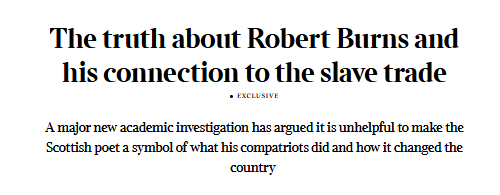
The Times titillates with a headline today designed to cast doubt on the basis for Scots’ love for Robert Burns.
There is nothing there.
In short, direct or indirect economic benefit from Caribbean slavery was widespread among the artistic, collecting, and intellectual classes of the period. Burns’ case—an abandoned plan in period of despair with no material outcome is nothing of substance by comparison with the documented ownership, inheritance, investment, and patronage links of figures such as Beckford, Turner, Raeburn, and Reynolds.
Many of us will look back with sadness, perhaps shame, at episodes in our lives or of those close to us. We all have feet of clay.
Be glad that what you did was all you did.
In his time, Burns was rare and to be praised to have thought it through and turned away as others did not:
- William Beckford (1760–1844), the Gothic novelist (Vathek), collector, and builder of Fonthill Abbey: He inherited an enormous fortune from his father’s Jamaican sugar plantations (thousands of enslaved people across tens of thousands of acres). His literary, collecting, and architectural projects were funded by this wealth.https://www.bbc.com/history/british/abolition/slavery_business_gallery_01.shtml
- J.M.W. Turner (1775–1851): The painter invested £100 in 1805 in a consortium scheme for a Jamaican cattle farm/estate whose profits depended on enslaved labour. He also received patronage from figures tied to the plantation economy. Later, he painted the well-known anti-slavery work The Slave Ship (1840). https://artnewsnviews.com/art-history/turning-turner-s-legacy/
- Sir Henry Raeburn (1756–1823), the leading Scottish portrait painter: He painted numerous wealthy Edinburgh sitters whose fortunes came from slavery. He was also appointed as a trustee involved in the disposal of a Jamaican plantation and the enslaved people on it. Like many portraitists, a significant part of his income came from such patrons.https://www.scotsman.com/heritage-and-retro/heritage/sir-henry-raeburn-he-was-deeply-involved-in-the-profits-of-black-slavery-2883771
- Sir Joshua Reynolds (1723–1792), first President of the Royal Academy: He employed a Black servant in his household (described as likely formerly enslaved) and accepted extensive patronage from slave-owners and those involved in the West India trade. Black servants appear as status symbols in some of his portraits. He later expressed support for abolition of the trade. https://www.royalacademy.org.uk/article/ra-collections-decolonial-research
- John Singleton Copley (1738–1815): The American-born painter is documented as having owned enslaved people in his household.
Turner is perhaps the painter I most admire so it disturbs to see him there but so many benefited it is no surprised.
To his great credit, Burns was to go on to write, perhaps and still, the most powerful song against slavery:
The Slave's Lament

It was in sweet Senegal that my foes did me enthrall
For the lands of Virginia-ginia O;
Torn from that lovely shore, and must never see it more,
And alas! I am weary, weary O!
Torn from that lovely shore, and must never see it more;
And alas! I am weary, weary O!

All on that charming coast is no bitter snow and frost,
Like the lands of Virginia-ginia O:
There streams for ever flow, and there flowers for ever blow,
And alas! I am weary, weary O!
There streams for ever flow, and there flowers for ever blow,
And alas! I am weary, weary O!

The burden I must bear, while the cruel scourge I fear,
In the lands of Virginia-ginia O;
And I think on friends most dear, with the bitter, bitter tear,
And alas! I am weary, weary O!
And I think on friends most dear, with the bitter, bitter tear,
And alas! I am weary, weary O!
As for the mass of rural peasants, tenant farmers, cottars, and agricultural labourers in 18th-century Britain (including Scotland), they did not share. In the Highlands and Islands, still home to many of our ancestors then, returning capital from slavery helped some buyers acquire large estates and contributed to clearances that displaced tenants.
All four of my great grandfathers were in the mines and the lines go back unbroken to the early 17th Century. By 1640, Scottish coal miners (colliers), coal-bearers (often women and children), and salters (salt-pan workers) were bound under a system of hereditary, life-long servitude established by Scottish parliamentary law.
Many readers will also know that the defeated Scottish army at the Battle of Dunbar (3 September 1650) suffered heavy losses, followed by a brutal forced march, mass deaths in captivity, and the transportation of many survivors into coerced labour, including overseas indenture.
Some Scots benefited from slavery and the wider imperial exploitation but, as in England too, we’re talking of less than 1%, perhaps as low as 0.02%. https://www.theguardian.com/world/2015/jul/12/british-history-slavery-buried-scale-revealed
Finally, what about William Shakespeare?
There is no evidence linking Shakespeare to the emerging Atlantic slave trade, colonial plantation investment, or any comparable large-scale exploitation of that kind. His active years (roughly 1590s–1610s) pre-date the full development of the English slave trade and Caribbean plantation system.
However, contemporary records and later archival research show that Shakespeare engaged in several economic activities that were viewed as exploitative or illegal in his own time, and that would generally be considered immoral or predatory by modern standards – grain hoarding and price speculation, money-lending, tax evasion.
Discover more from Talking-up Scotland
Subscribe to get the latest posts sent to your email.


Also “A Man’s A Man For A’ That” which was much admired in Soviet Russia and commemorated by issuing a stamp.
For a’ that, an a’ that,
It’s coming yet for a’ that,
That man to man, the world, o’er,
Shall brithers be for a’ that.
https://www.nts.org.uk/stories/a-mans-a-man-for-a-that#:~:text=The%20poem%20endorses%20equality%20in,now%20as%20in%20Burns's%20time.
LikeLike