

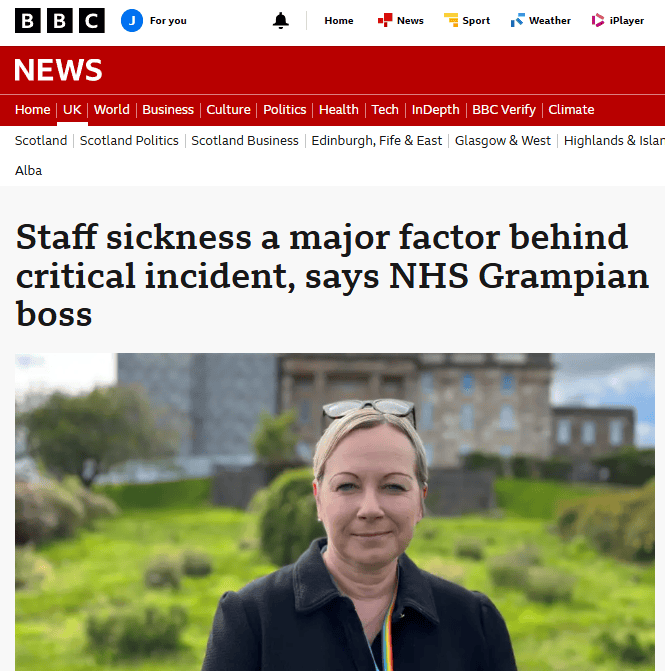
From BBC Scotland yesterday, the above and:
Staff sickness was a major factor behind the critical incident declared by NHS Grampian last month, its chief executive has said. A board-level critical incident had been declared on Saturday 26 September, when A&Es at both Aberdeen Royal Infirmary (ARI) and Dr Gray’s in Elgin struggled to cope with demand.
That was stood down on the Monday, and remained in place at hospital level at Dr Gray’s until the next day. NHS Grampian chief executive Laura Skaife-Knight told BBC Scotland News that staff sickness had been a “challenge”, and ensuring patient safety was the reason for declaring the critical incident.
It was the first critical incident declared by the board since December 2024. The Scottish government defines the status as any localised disruption which results in a board “losing its ability to deliver critical services, or, where patients and staff may be at risk of harm”. The last critical incident declared in Scotland was due to an IT fault at NHS Highland in June 2025. https://www.bbc.co.uk/news/articles/cwly32ylpvvjo
All things being equal with around 11 times the population you might expect NHS England to have had around 11 or 12 critical incidents in 2026, so far.
Nope.
NHS England does not publish a consolidated running list but there have been between 25 and 40, between, at least, more than twice up to pushing four times as many, per head, including:
Publicly reported critical incidents in England in 2026 (to early October) cluster in a few periods:
January (winter viruses and demand)
Several trusts declared around 12–16 January, including Royal Surrey, Surrey and Sussex Healthcare, East Kent (Queen Elizabeth the Queen Mother Hospital, Margate), Nottingham University Hospitals, and Sherwood Forest Hospitals. Reporting also referred to University Hospitals of North Midlands, University Hospitals Birmingham, East Suffolk and North Essex, and University Hospitals Coventry and Warwickshire (stood down after about two days in late January). The Royal College of Emergency Medicine was quoted as saying there were as many as 23 such situations across the country around that time, with doctors arguing more should have been declared; that figure is not an official NHS England count and may include borderline cases.February
Nottingham University Hospitals declared again (stood down mid-month after several days).June heatwave
Trusts declaring included Portsmouth Hospitals (Queen Alexandra, chiller failure affecting critical infrastructure), Norfolk and Norwich (MRI scanners offline from heat/humidity), Surrey and Sussex Healthcare (East Surrey Hospital), Nottingham University Hospitals, University Hospitals of North Midlands, and East Midlands Ambulance Service.Later in the year
East Kent declared again in July (IT disruption) and on 28 September (William Harvey Hospital, Ashford — beds full; stood down within a few days). University Hospitals Coventry and Warwickshire declared on 9 September (high demand; stood down after about a day). Greater Manchester Mental Health NHS Foundation Trust escalated a critical incident in early October over heating failure and leaks at Laureate House.
Crisis? A total f*****g public safety disaster. The UK Health Secretary must go!
Crowdfunder - https://www.crowdfunder.co.uk/p/help-talking-up-scotland-keep-going
Bank transfer - JOHN WATSON ROBERTSON Sort Code – 08-91-04 Account 12266421
Discover more from Talking-up Scotland
Subscribe to get the latest posts sent to your email.

