

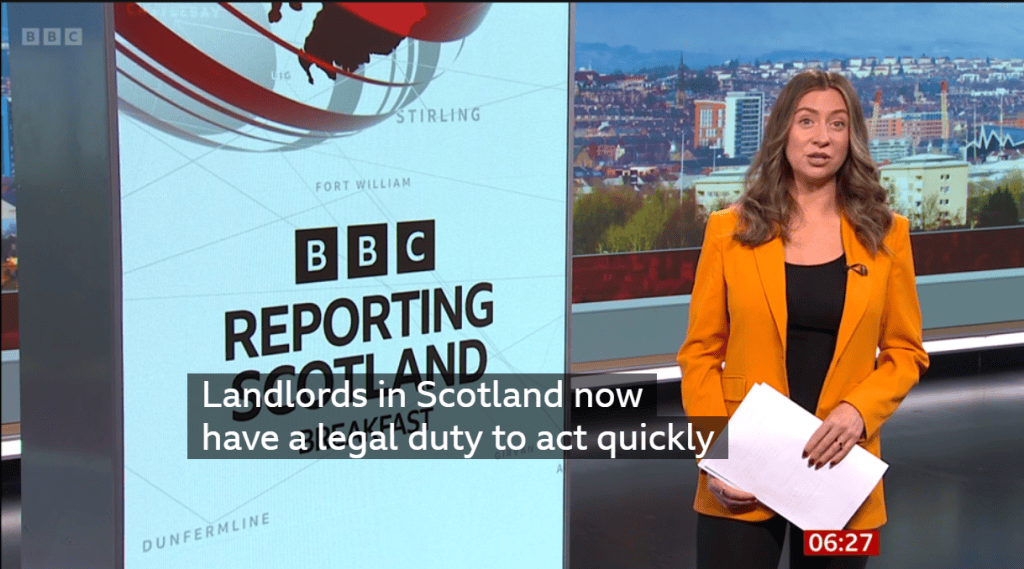
if a tenant reports damp or mould. New legislation aims to hold those in the private and social sector accountable for carrying out necessary repairs within strict timescales. Awaab’s Law is named in memory of two-year-old Awaab Ishak who died of a severe respiratory condition caused by prolonged exposure to mould in his home in England. https://www.bbc.co.uk/iplayer/live/bbcone
This is the Scottish version of the law and crucially, unlike the English version covers most private tenants in addition to social tenants. Awaab’s Law itself does not bind private landlords in England, so they are outside fixed deadlines. A private landlord does not have to investigate within 10 working days, make a home safe within five working days, or meet the 24-hour emergency rule. https://www.westberks.gov.uk/awaabs-law
The health risk is mainly from staying longer in a home with damp, mould, cold, or a failed heating or water system while the landlord is not under a fixed deadline.
Official guidance from the UK Health Security Agency, the Office for Health Improvement and Disparities, and the housing department says damp and mould mainly affect the airways and lungs, and can also irritate the eyes and skin. Effects include cough, wheeze and shortness of breath, more airway infections, and the development or worsening of asthma, rhinitis, bronchitis and other airway disease. In the most severe cases that exposure can cause serious illness and death. Awaab Ishak died from a severe respiratory condition after prolonged mould exposure; that case is why the guidance exists.
People at higher risk are babies and young children, older adults, people with asthma, COPD or other lung disease, and people with weakened immune systems. Mental health can also worsen: cold, damp homes are associated with higher rates of anxiety and depression.
In Scotland:
In 2024 (latest figures), 3% of the housing stock (around 80,000 dwellings) suffered from some degree of penetrating damp. The presence of penetrating damp has fluctuated between 2% and 4% across the past 12 years of the survey. There were a very small number of properties with rising damp in the survey sample in 2024, suggesting that their share in the housing stock is less than 0.5%. Condensation was observed in 8% of the surveyed stock (around 199,000 dwellings) which is similar to recent years. However, this represents a reduction from 11% in 2012. https://www.gov.scot/publications/scottish-house-condition-survey-2024-key-findings/pages/5-housing-conditions/
Crowdfunder - https://www.crowdfunder.co.uk/p/help-talking-up-scotland-keep-going
Bank transfer - JOHN WATSON ROBERTSON Sort Code – 08-91-04 Account 12266421
Discover more from Talking-up Scotland
Subscribe to get the latest posts sent to your email.

