

With only 3 days left, support Talking-up Scotland's work to counter the lies and get you the facts, daily, at:

Crowdfunder at: https://www.crowdfunder.co.uk/p/help-talking-up-scotland-keep-going

Or by direct bank transfer to: JOHN WATSON ROBERTSON Sort Code – 08-91-04 Account – 12266421
From BBC Scotland, two days ago:
Prime Minister Andy Burnham has said he does not support decriminalising drugs for personal use, days after Scotland’s first minister backed it.
After the latest figures showed Scotland’s drug deaths spiked by 11%, John Swinney said his government was in favour of decriminalisation – meaning people would not face criminal punishment for personal drug use.
He said the move could be part of a range of measures which would offer “more control and ability to provide greater support to those affected by drugs use”.
In an interview with BBC Scotland News, Burnham said he would not be pursuing the policy, but accepted there were different views on the issue.
Source: https://www.bbc.co.uk/news/articles/cmn455yy9wwpo
There are different views on this. Some are correct like John Swinney’s and some are wrong like Andy Burnham’s.
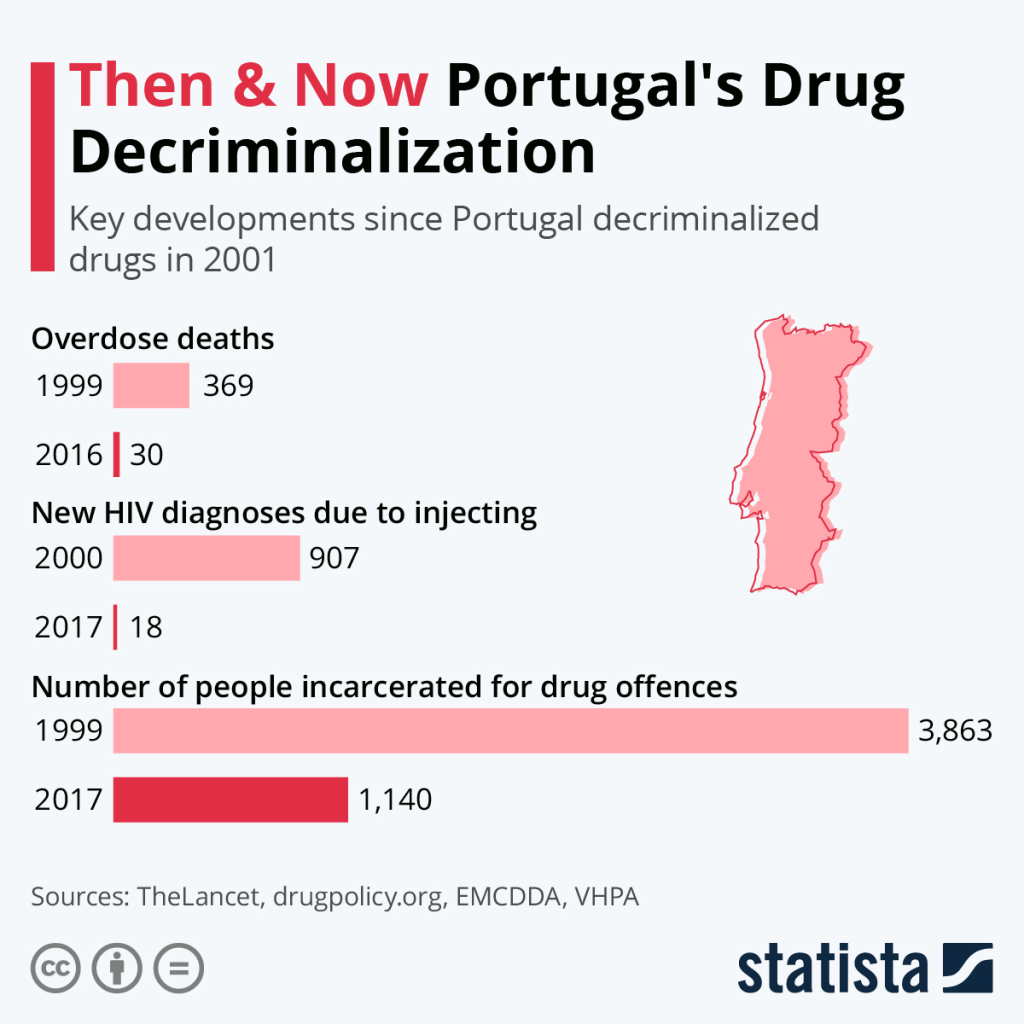
See this from Statista in 2020:
During the 1990s, Portugal was devastated by a drug crisis where one in every 100 people became addicted to heroin and the rate of HIV infection soared to become the highest in the European Union. Portugal’s radical move to put an end to the carnage should prove an example to other countries dealing with similar problems, especially the United States where opioids have killed more people than the totality of American military casualties in Vietnam, both Iraq wars and Afghanistan combined. That move was decriminalizing the consumption of all drugs and Portugal became the first country to do it.
The policy saw the status of using or possessing drugs for personal use remain illegal. However, offenses were changed from being criminal in nature which involved prison as a possible punishment to being administrative if the amount possessed was no more than a ten-day supply. Needle exchange programs have also been in place since 1993 and today, all drug users can exchange syringes at pharmacy counters across Portugal. Drug treatment was also expanded and improved with successful results.
Finding historical data highlighting the severity of the addiction problem during the late 1990s is difficult but some important numbers do exist which help to show just how remarkable Portugal’s recovery has been. The infographic above pulls data together from several sources to illustrate some key developments. Back in 1999, Portugal experienced 369 overdose deaths and in 2016, the number was just 30. The number of new HIV diagnoses due to injecting has plummeted from 907 in 2000 to 18 in 2017. The new laws have also had an impact on incarceration with the number of people behind bars for drug offences falling from 3,863 in 1999 to 1,140 in 2017.
Source: https://www.statista.com/chart/20616/key-developments-since-portugal-decriminalized-drugs/
Wait! We haven’tasked Kevin!
I’m saying nothing.
With only 3 days left, support Talking-up Scotland's work to counter the lies and get you the facts, daily, at:

Crowdfunder at: https://www.crowdfunder.co.uk/p/help-talking-up-scotland-keep-going

Or by direct bank transfer to: JOHN WATSON ROBERTSON Sort Code – 08-91-04 Account – 12266421
Discover more from Talking-up Scotland
Subscribe to get the latest posts sent to your email.


Burnham’s stooge in Scotland, Michael Marra, is now the top story on the BBC website on the main Scotland page and Scottish Politics page.
“Marra to claim Holyrood ‘hoarding power’ in conference speech”
Thankfully the MSM Monitor’s account reminds us that in the leadership contest in Scotland he, Marra, said that “Labour had to devolve more powers from WM”.
So what would these powers be ?
Also what powers are being “hoarded” at Holyrood ?
Has Marra read the contents of the Smith Commission report ?
That “recommended further devolution of powers to the Scottish Parliament”.
The BBC article today states that:
“Michael Marra is set to call for the Scottish government to decentralise power from Holyrood in his first conference speech as Scottish Labour leader”.
So basically he is pandering to his new (as in the real) boss Andy Burnham, thus confirming that yet again Labour in Scotland , via their branch office manager, takes their instructions from Labour HQ.
The article also states that “Marra will claim the Scottish Parliament has “hoarded money and control” in Edinburgh and demand skills policy is devolved to Scotland’s regions”.
So basically it’s devolution Burnham style , as in not in how we, pre and post 2014, were led to believe (lied to) that devolution would evolve within Scotland.
Marra had stated that “Had our regions grown at the same pace as Manchester in the last decade, the Scottish economy would be £30bn larger”.
Hmm, why Manchester as a comparison ?
What’s the connection ? (Ha Ha).
In May 2026 The Herald reported that:
“Glasgow is now outperforming UK powerhouse Manchester”.
“Glasgow City Region’s average gross investment rate is significantly higher than Greater Manchester’s and comparable to the West of England”.
“Glasgow generates an economic output of £8.6 billion in the energy and net-zero sector, matching Manchester’s output despite having roughly 35% fewer registered businesses”
“Glasgow shows higher innovation intensity (35% vs. 31%) and stronger engagement with UK research and innovation (16% vs. 12%) than Manchester“.
Also it was reported that “A higher percentage of firms in Glasgow produce patents (8% vs. 6%) compared to Manchester”.
So where is Marra sourcing his intel from ?
The BBC article then says that Marra said “”Too much power is centralised in Scotland. The Scottish Parliament has hoarded money and control at the expense of Scotland’s communities.”.
So how much power does WM have ?
Also how much money and control does all of the UK governments based at WM “hoard” ?
It seems that Marra , another YES man to Labour HQ, will only want to promote Labour HQ’s message, irrespective of the consequences for us the people of Scotland. (as Marra is seemingly nothing more than a ‘continuation Sarwar’).
That’s why we should never vote Labour as they never learn and never want to learn , as instead all they want to is to hoard all of the power, all control and all of the money on behalf of the English parliament at WM.
Marra , like all of the other Labour branch office managers before him, sees his duty as being to always obey Labour HQ , then he hopes that one day in the future that he too , like some other former branch office managers in Scotland, will also end up in the HOL’s as a Labour Peer.
Michael Marra never even won his constituency seat in the recent 2026 Scottish election, so he is a list MSP – but somehow he now thinks that then gives him the right to dictate to Scotland what we should do and what we should have , and he does that on behalf of his Labour HQ in England.
Really, is that him also “doing politics differently” supposedly like Burnham.
I think not, as it stinks of the same old same old S**** from the new (so called) boss (Marra) in Scotland, in him behaving in the exact same way as the old (so called) boss in Scotland did (i.e. Sarwar , who is now a Labour peer).
Liz S
LikeLike
Follow up to my above comment:
So Marra has now given his conference speech.
He did indeed state the things I mentioned in my above comment.
He also “urged members not to mistake the SNP’s “progressive posturing” for progressive politics”
I think we all know who it is who is doing the “posturing” here and also who it is as a party who lacks “progressive” policies and politics , that would be the Labour party at all political levels.
He said “it was his job to remind the people of Scotland what Labour stood for” .
That would be nothing, other than perhaps, their determination to stop Scotland becoming independent and so then keep the dysfunctional non Union intact.
I see that Marra has decided to be a continuity Sarwar, not that I ever doubted that would be the case , as when it comes to Scotland and the SNP , well Labour , like all other British Nationalist parties, always try to win their (non) argument for the non Union by always only ever talking Scotland down.
I pity the public Service workers within Scotland , whatever their profession , as they are always used as political pawns by deceitful (pro) UK parties.
More power to these workers upon whom we all rely upon at some point in our lives – they put in the work and the dedication and then political chancers try to use them and their profession as a weapon against their political opponents.
#LabourNoMore – if only.
Liz S
LikeLike
Having studied drug use for 50 years, I’ve read some great books that I would recommend: The Pursuit of Oblivion by Richard Davenport -Hines, many books by Terence McKenna, Blitzed by Norman Ohler, Chasing The Scream by Johann Hari.
I’ve also spent many years discussing drugs with psychopharmacists, drug councillors and other experts regarding addiction including David Nutt, sacked as Labour’s Drug Tsar.
50 years after the Netherlands decriminalised marijuana, it’s amazing how behind the times the UK’s drug policy is. The continued criminalisation of marijuana in particular and drugs generally is causing unnecessary social problems while enabling organised crime exploit the market and to profit and thrive. Drug convictions account for 1 in 7 prisoners in our overcrowded jails.
The USA is still paying the price of 14 years of Prohibition which enabled organised crime to enrich itself and expand to the point that it could corrupt every level of society.
While adopting a new approach to drugs policy may not be top of the list of reasons for independence, at least it would reduce the downward spiral of many Scots.
It’s always worth pointing out that alcohol and tobacco cause more harm than illegal drugs.
LikeLike
Smoking is down to 20%. of the population. Alcohol consumption has fallen. MUP. Cocaine and Ketamine are now the drugs of choice. All drug deaths in Scotland are people who are prescribed methadone and take other substances. More total abstinence proper rehabs are needed. Prison £40,000 a year.
LikeLike