

Help Talking-up Scotland keep going

Crowdfunder at: https://www.crowdfunder.co.uk/p/help-talking-up-scotland-keep-going

Or by direct bank transfer to: JOHN WATSON ROBERTSON Sort Code – 08-91-04 Account – 12266421
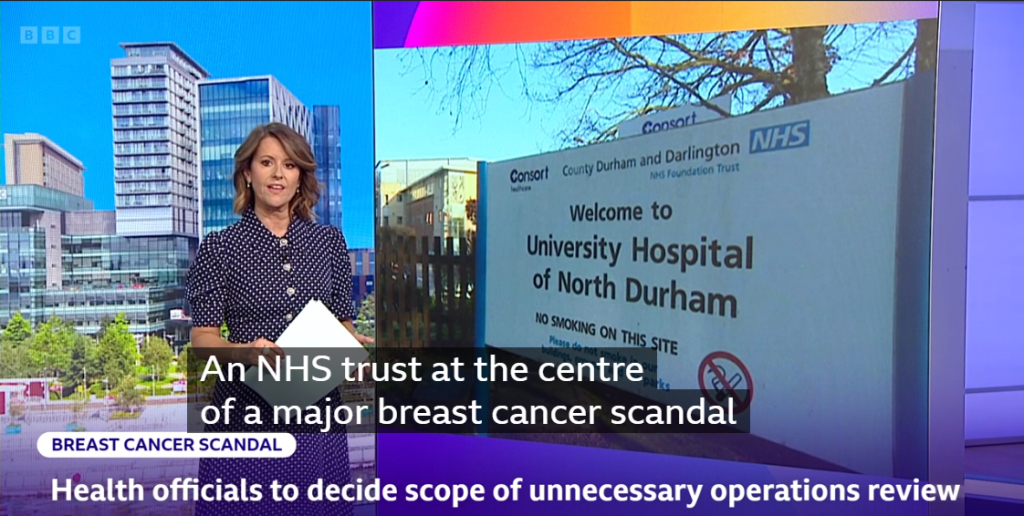
This is a story on BBC Breakfast this morning based on a BMJ study, of:
Twenty women had mastectomies unnecessarily while being treated for breast cancer at County Durham and Darlington Foundation Trust, it has emerged.
In a briefing paper presented to the board, the trust stated that 32 women received excessive surgery when a wide local excision would have been appropriate. Of these, 20 had a mastectomy without clinical need, the trust confirmed.
Delayed diagnosis of breast cancer was also identified in 20 women during a review of more than 500 cases in response to serious failures of care at the trust. https://www.bmj.com/content/394/bmj-2026-100918
This is a real scandal of a kind we rarely get in NHS Scotland, so rare that BBC Scotland’s health correspondent must make them up.
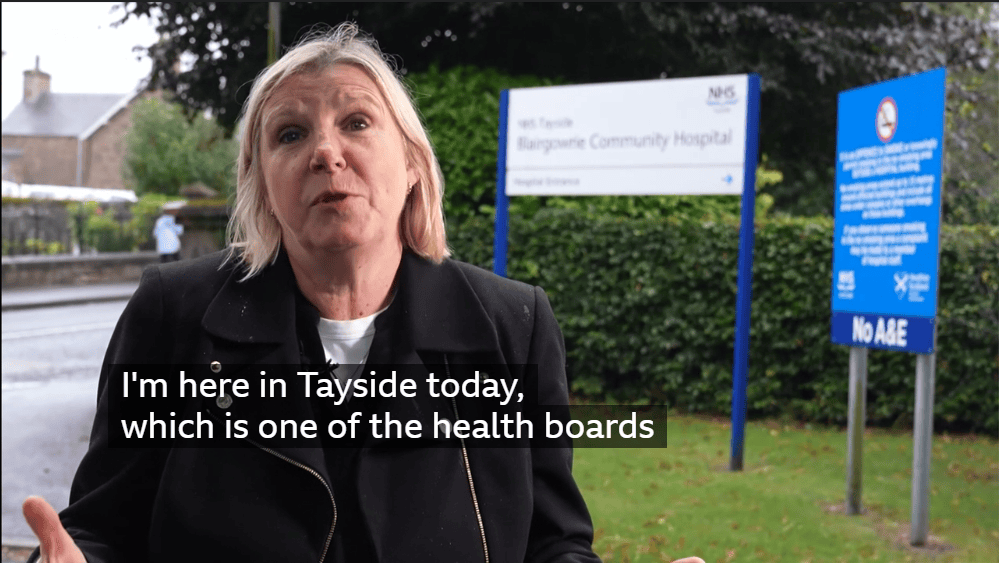
that will no longer exist under these new Government structural reforms but they do have to do something pretty transformational with the NHS because there have long been warnings that it is financially unsustainable.
BBC Scotland‘s Health Correspondent Lisa Summers, above, makes a return to NHS Tayside, the exact same spot, 7 years after she decided, all on her own, that it was ‘dysfunctional.’
As reported here in April 2019, the NHS Tayside breast cancer treatment team, after experimenting with reduced chemotherapy doses to ease appalling side-effects, was shown to have, regardless, a below average mortality rate, was supported by a St Andrews University professor’s evidence and then completely cleared of any suggestion that the lower doses led to additional deaths in an official report.
A BBC Scotland report acknowledged some of this briefly but, sickeningly, Lisa Summers was allowed to repeat the suggestion that initially ‘the finger was pointed at the breast cancer oncologists.’
Whose finger was that? Hers?
Help Talking-up Scotland keep going

Crowdfunder at: https://www.crowdfunder.co.uk/p/help-talking-up-scotland-keep-going

Or by direct bank transfer to: JOHN WATSON ROBERTSON Sort Code – 08-91-04 Account – 12266421
On April 1 2019, Summers said on Reporting Scotland, of the first news that reduced doses were being tried:
‘The report today pointed to the possibility of a dysfunctional department. ‘Detectives’ spoke of pharmacy and nursing staff who said they had concerns about the change of procedures, but they felt they were not being listened to and that their position was one above.’
Only Reporting Scotland use the word ‘dysfunctional’. The BBC website and all the newspapers I looked at (8), did not use the term either.
Summers led the demonising of the Tayside oncology staff for base journalistic gains.
Single-handedly undermining their reputations and beginning the staff departures which now result in closure, she has the nerve to blame the board for not supporting the staff against her lies.
Three days before, Summers and Reporting Scotland had lied directly to suggests patients had died because of the change in dose. The report contained no inaccuracies but through the sequencing of the information presented, created a causal connection not made by the Review Group report which they had supposedly based their presentation on. They said in an uninterrupted sequence:
- There’s further criticism tonight of a decision to give breast cancer patients in Tayside lower doses of drugs during chemotherapy than they would have received elsewhere in Scotland.
- A panel of experts has described the practice as close to being unacceptable.
- Fourteen of the patients involved have since died.
The very strong implication here is that these fourteen patients died because of the lower doses. The Review Group report absolutely does not say that or imply it in any way. Indeed, it says quite explicitly that of the 300 plus patients involved:
‘The overall assessment of the increased risk of recurrence within the treated cohort is extremely difficult to quantify but probably of the order of 1-2%. A risk of harm of 1-2%, allows an estimate that around 1 patient per year in NHS Tayside may have suffered an adverse outcome.’ https://www.gov.scot/publications/clinical-risk-assessment-healthcare-improvement-scotland-report-clinical-management-breast-cancer-nhs-tayside-april-2019/
So, the Review Group has made only the smallest, most hesitant connection between the treatment and perhaps a single death from the 300 plus patients treated. The BBC with its Royal Charter to inform has clearly failed to do so and, disgracefully, has contributed to an uninformed and dangerous scare story which might, in itself, damage the mental health and thus prospects of hundreds of breast cancer patients being currently treated by NHS Tayside. I’d complain, again, but I’m tired of the unprofessional, undereducated stubbornness of those working in Reporting Scotland.
As with the ongoing attempts to keep two child deaths at the QEUH in the public, political sphere, this was a political campaign constructed by sympathetic media to keep pressure on the SNP Government despite the case being long-settled to the satisfaction of expert opinion..
In April 2019, we at TuS found official data showing that, regardless of the experiment with lower doses, NHS Tayside had an average breast cancer death rate and, indeed, a lower one than NHS Grampian: https://www.isdscotland.org/Health-Topics/Cancer/Cancer-Statistics/Breast/#cancer-of-the-breast
On May 2, 2019, St Andrews Professor Mark Chaplain was clear about the research:
‘Women on the lower dose, the same as used in Tayside benefited from fewer side-effects and they did not suffer any inferior chemotherapy treatment because they had statistically speaking, the same recurrence rate and survival probability as the women on the higher dose.’
Finally, in August 2019, we could read:
Dr David Dunlop told NHS Tayside the deaths between 2016 and 2018 were not linked to treatment variation. NHS Tayside had been criticised for offering lower doses of the drugs than in the rest of Scotland. Dr Dunlop said two cases were not relevant, one refused chemotherapy, and the rest had very poor prognoses. https://www.bbc.co.uk/news/uk-scotland-tayside-central-49481813
How low could she and they get?
Dare we hope she goes in the cuts?
Help Talking-up Scotland keep going

Crowdfunder at: https://www.crowdfunder.co.uk/p/help-talking-up-scotland-keep-going

Or by direct bank transfer to: JOHN WATSON ROBERTSON Sort Code – 08-91-04 Account – 12266421
Discover more from Talking-up Scotland
Subscribe to get the latest posts sent to your email.


I hope more like her go in the cuts lets just say them all.
LikeLike
Coverage of this particular topic – well researched, tracked over time and linked into the wider rUK context – offers IMHO a prime example of the quality and the value of having TuS.
I’m still hoping to see a late surge in the number of individual contributions and in the total contribution to the TuS crowdfunder!
The challenge for TuS should not have come to be about the basic resourcing of TuS – but regrettably, it has. Arguably, it should have been around additional resources (and ideas) for amplifying – extending the reach and impact of – TuS’ output.
LikeLiked by 1 person
Didn’t Will Shakespeare have a quote about Lisa ?
” Now is the Summer of our discontent made glorious jobless by this BBC purge !”
LikeLike
Very good, mind you, Richard III would have had them all in the Tower for a bit of compulsory BDSM before being sharply despatched to a better place.
Saves on all that redundancy paperwork as well.
Stephen McKenzie
LikeLike