Or by direct bank transfer to: JOHN WATSON ROBERTSON Sort Code – 08-91-04 Account – 12266421
James Cook today, delighting in being able to regurgitate the last bit below:
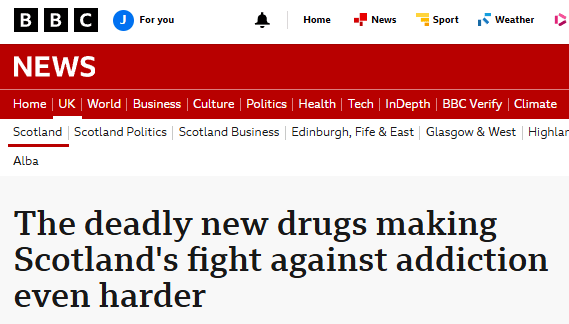
Efforts to bring down Scotland’s sky-high rate of drug deaths are being frustrated by the arrival of hundreds of powerful new synthetic substances that experts warn are making the deadly drugs crisis even more dangerous.
In the past three years, there has been an explosion in the supply of new synthetic cannabinoids and opioids, transforming the illicit drugs trade and increasing the risk of fatal overdoses.
Annual figures to be released on Wednesday are expected to show a rise in the number of drug-related deaths in Scotland, which already has an unenviable record as the drugs death capital of Europe.https://www.bbc.co.uk/news/articles/c39w4n07ekeno
Here, I want to ask questions BBC Scotland will not be asking:
Will Scotland’s world-first opioid overdose reversal kit programme – naloxone be helping to control this increase in drug deaths mainly from nitazenes?
Scotland’s naloxone programme is large, still expanding in reach, and pharmacologically the right tool for nitazene overdose. It will save lives that would otherwise be lost. It will not, by itself, control an increase in deaths if the supply keeps getting more potent and more mixed. Harm reduction still depends on people having a kit and not using alone, calling 999, and receiving further medical care — plus action on supply and treatment.
What is Scotland’s Naloxone Opioid Overdose Reversal Programme and how is it working to reduce deaths?
The SNP Government’s world-first opioid overdose reversal programme increasing, in January 2026, its reach to 84% is protecting hospitals as it fights the effects of the English County Lines drug gangs plague in Scotland
Or by direct bank transfer to: JOHN WATSON ROBERTSON Sort Code – 08-91-04 Account – 12266421
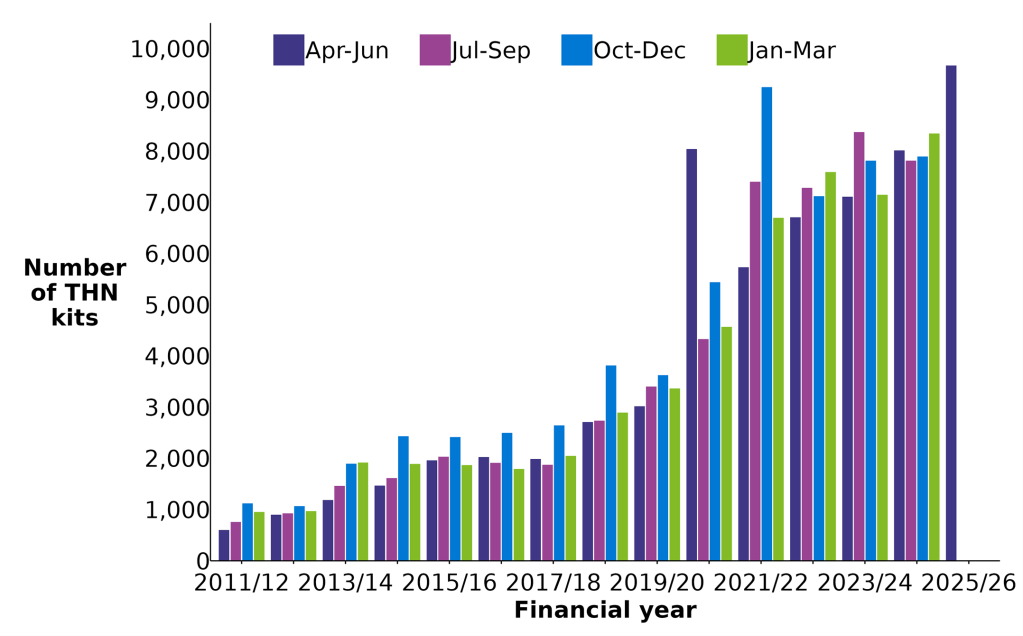
From the National naloxone programme Scotland – Quarterly monitoring bulletin Quarterly Monitoring Bulletin April to June (Q1) 2025/26 published today:
The overall aim of Scotland’s NNP is to prevent fatal opioid overdoses. Administration of naloxone provides time for emergency services to arrive and for further treatment to be given. Following suitable training, THN kits are issued to people at risk of opioid overdose, their friends and family and service workers in order to help prevent overdose deaths.
Drug-related hospital admissions plummet for third year in a row after Scottish Government’s ‘world-first’ opioid overdose reversal Naloxone initiative but are not being reported by media.
During 2025/26 Quarter 1 (1 April 2025 to 30 June 2025):
9,672 Take-Home Naloxone (THN) kits were issued.
7,724 THN kits were issued by services based in the community:
1,049 kits supplied by other non-drug treatment services.
437 kits were issued by prisons in Scotland.
1,045 kits were supplied via prescriptions dispensed by community pharmacies.
441 THN kits were provided by SAS.
A total of 600 kits (318 in prisons and 282 in the community) were supplied by peers (a trained champion/mentor that provides training and a THN kit to others who may witness an overdose).
At the end of 2025/26 Quarter 1, the ‘reach’ of the NNP (percentage of people at risk of opioid overdose who have been supplied with THN) was estimated to be 84.0%, an increase of 1.8 percentage points compared to 2024/25 Quarter 4 (82.2%).1
What is the Naxolone Initiative?
After a pilot phase ending in 2018, the Scottish Government began to embed Naloxone opioid overdose reversal kits across NHS Scotland. Shortly after, the kits which can be administered by anyone, were adopted by Police Scotland, ambulances and prisons, and made available to libraries, community centres, taxi drivers and to the friends and relatives of users.
Scotland was the first country in the world to introduce a national naloxone programme, empowering individuals, families, friends and communities to reverse an opiate overdose.
Anyone in Scotland can now order a free naloxone kit from national charity Scottish Families Affected by Alcohol & Drugs (SFAD) and be trained in its use.
Opioids such as those found in prescription painkillers are now responsible for 81% of all drug deaths in Scotland.
Why are Scotland’s drug deaths not falling faster given the Naloxone scheme’s impact?
County Lines gangs seek new markets along public transport lines, in small towns and rural areas where local dealers can be dominated with threats of extreme violence and a property can be taken over. Using their scale of operations, these gangs can transport and sell more powerful drugs, more cheaply, using couriers as young as 11, to users unused to the low costs and higher strength. Increased drug deaths is a simple and predictable consequence. These same gangs, entirely from English cities, were first reported in Scottish towns, up the east cast rail lines to places such as Aberdeen, Fraserburgh, Inverness and Wick, around 2019, just as Scotland’s drug deaths had begun to plateau and, in 2021, fall.
Scotland has the most centralised, best-measured and highest-coverage take-home naloxone (THN) system in the UK. Wales also runs a national programme. Northern Ireland has a smaller national scheme. England still relies mainly on local commissioning and has weaker national data. UK-wide medicines law was aligned in December 2024, so legal access is converging even while delivery models still differ. https://www.gov.uk/government/publications/acmd-naloxone-review/acmd-review-of-the-uk-naloxone-implementation-accessible
Or by direct bank transfer to: JOHN WATSON ROBERTSON Sort Code – 08-91-04 Account – 12266421
The optimistic place we thought we were in only eight months ago:
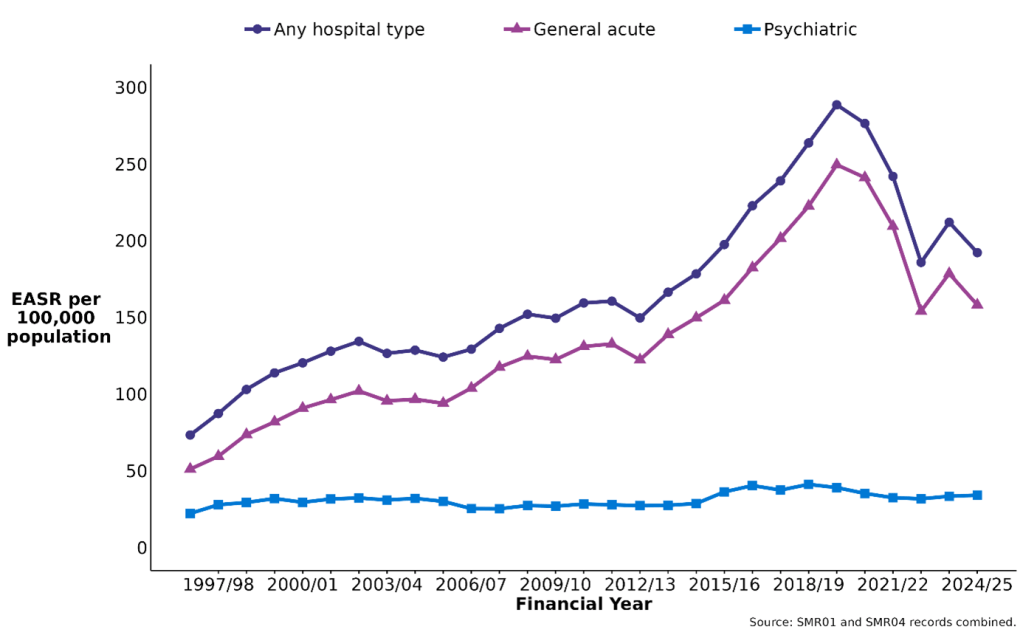
Drug-related hospital stay rates in Scotland plummet by half as SNP’s unique, World-first, opioid overdose reversal kit programme gets on top of the plague after 8 years
From Drug-related hospital statistics Scotland 2024 to 2025, published today the above graph and:
There were 10,185 drug-related hospital stays (2023/24: 11,148). The European Age-sex Standardised Rate (EASR, see background below for more information) of drug-related hospital stays was 192 stays per 100,000 population. This rate was a decrease from 2023/24 (212 stays per 100,000 population) and continued the decreasing trend observed in hospital stays since 2020/21.
Opioid-related stays accounted for 38% of all drug-related stays, the lowest percentage in the time series, continuing a steady decrease from 64% in 2011/12.
The rate of stays for drug poisoning/overdose decreased to 21 stays per 100,000 population, from 27 stays per 100,000 population in 2023/24, and was the lowest rate observed since 2006/07 (21 stays per 100,000).
The decline in opioid stays is simply explained by SNP Government’s world-first opioid overdose reversal programme increasing, in January 2026, its reach to 84% and its protection of hospitals as it fights the effects of the English County Lines drug gangs plague in Scotland
2 thoughts on “Scotland’s world-first Naloxone opioid-reversal kits will help stem the tide of death but cannot stop this cross-border flow”
Drug deaths are 16 times more likely in areas of deprivation =Poverty ! Yet successive Westminster Governments have increased poverty by their actions – e.g two-Child Benefit cap , cuts to Welfare , increasing unemployment etc…
Until Scotland has total control ( Independence ) over all measures to fight Poverty then we will continue to have high drug deaths .
Once again, the way BBC Scotland reports on issues of importance and serious concern smacks of a preference to gaslight voters in Scotland – and in the process undermine the government in Edinburgh – rather than ‘educate’/inform by providing context, perspective and relevant comparative analysis.
In its response to the latest drug deaths in England and Wales based on ONS reporting, the Scottish Drugs Forum (October 2025) stated: ‘The latest report from the Office for National Statistics (ONS) has revealed that drug-related deaths in England and Wales have reached a record high, with a devastating 5,565 people in England and Wales dying in 2024.
‘It is deeply concerning that the ONS acknowledges “undercounts” in its report, with around one in five death registrations failing to specify the drug or drugs involved.’ (my emphasis)
It adds this regarding the data for England and Wales: ‘According to the report, deaths attributed to nitazenes have nearly quadrupled since 2023.
‘We urge the UK Government to expand the harm reduction measures that should be available to people who use drugs and the services that seek to support them – by introducing drug-checking services, expanding naloxone distribution, and rolling out safer drug consumption facilities, while also ensuring that drug treatment services are adequately resourced, evidence-based, and responsive to people’s diverse and changing needs.’
Meanwhile in Scotland: (a) on drug checking services, a national service is now provided by the Leverhulme Research Centre for Forensic Science (LRCFS) at the University of Dundee plus local checking facilities already established in Glasgow and in planning for other main cities. (The latter facilities require a Home Office licence to operate); (ii) on naloxone distribution, extensive distribution in Scotland has been achieved – see regular monitoring reports on Public Health Scotland’s website and the summary from TuS; and (c) on safer drug consumption facilities, the first one has been established in Glasgow after much Westminster government resistance.
Back on July 4, 2024, the UK-based charity, Transform (aka the Drugs Policy Foundation) reflected on Westminster’s 14 years of drugs policy failings on its website under the headline ‘A NEW UK GOVERNMENT… WHAT NEXT FOR DRUG POLICY?’. This is its assessment:
‘As the Conservative government departs after 14 years of largely disastrous drug policy management in the UK, few tears will be shed in drug policy circles. Outcomes have been generally terrible; Drugs-related deaths have doubled, illegal drugs are cheaper and stronger than ever before, drug markets have become more violent and exploitative, prisons are overflowing, and pressures on underfunded drug services are reaching breaking point.’
And: ‘.. it’s been an unrelentingly grim mix of drug war posturing, negligence, and denial. Debate on progressive policy and law reform has been completely shut down, despite accelerating progress around the world. And, even in the face of an unprecedented drug death crisis, policy has been defined by a profound hostility to evidence based harm reduction measures proven to save lives.’
Voters in Scotland reliant on BBC Scotland for news and insight would be wholly unaware of this viewpoint!
Commenting on the incoming Labour government, Transform states: ‘.. the previous Labour government had an almost equally dismal record on drug policy, and has been consistently weak in opposition. Concerningly, despite the urgency of the still-worsening overdose crisis – the drugs issue has barely featured in the election debate for Labour or Conservatives, with ‘tough on law and order’ showboating the preferred default.’
And finally, Transform comments on the SNP: ‘The SNP have been useful advocates of pragmatic drug reform, even if delivery in Scotland has been underwhelming, often stymied by legal constraints imposed from Westminster. As drug related deaths have continued to rise to new records, they have pushed for decriminalisation & innovative harm reduction interventions, including OPCs (overdose prevention centres) and drug checking. The SNP controlled Scottish Government’s vision for the future of Scottish drug policy included a groundbreaking exploration of regulation.
‘SNP MP numbers have, however, been drastically reduced (from 48 to 9) in Westminster, so they will be a much diminished voice – not least with the loss of long time drug reform champions Ronnie Cowan, Alison Thewlis, and Tommy Sheppard.’
A public service media organisation should provide such context, especially on a topic which it has over a prolonged period devoted so much attention. Surely BBC Scotland would not be motivated by another agenda?




Drug deaths are 16 times more likely in areas of deprivation =Poverty ! Yet successive Westminster Governments have increased poverty by their actions – e.g two-Child Benefit cap , cuts to Welfare , increasing unemployment etc…
Until Scotland has total control ( Independence ) over all measures to fight Poverty then we will continue to have high drug deaths .
LikeLiked by 3 people
Once again, the way BBC Scotland reports on issues of importance and serious concern smacks of a preference to gaslight voters in Scotland – and in the process undermine the government in Edinburgh – rather than ‘educate’/inform by providing context, perspective and relevant comparative analysis.
In its response to the latest drug deaths in England and Wales based on ONS reporting, the Scottish Drugs Forum (October 2025) stated: ‘The latest report from the Office for National Statistics (ONS) has revealed that drug-related deaths in England and Wales have reached a record high, with a devastating 5,565 people in England and Wales dying in 2024.
‘It is deeply concerning that the ONS acknowledges “undercounts” in its report, with around one in five death registrations failing to specify the drug or drugs involved.’ (my emphasis)
It adds this regarding the data for England and Wales: ‘According to the report, deaths attributed to nitazenes have nearly quadrupled since 2023.
‘We urge the UK Government to expand the harm reduction measures that should be available to people who use drugs and the services that seek to support them – by introducing drug-checking services, expanding naloxone distribution, and rolling out safer drug consumption facilities, while also ensuring that drug treatment services are adequately resourced, evidence-based, and responsive to people’s diverse and changing needs.’
Source: https://sdf.org.uk/drug-related-deaths-in-england-and-wales-oct-2025/
Meanwhile in Scotland: (a) on drug checking services, a national service is now provided by the Leverhulme Research Centre for Forensic Science (LRCFS) at the University of Dundee plus local checking facilities already established in Glasgow and in planning for other main cities. (The latter facilities require a Home Office licence to operate); (ii) on naloxone distribution, extensive distribution in Scotland has been achieved – see regular monitoring reports on Public Health Scotland’s website and the summary from TuS; and (c) on safer drug consumption facilities, the first one has been established in Glasgow after much Westminster government resistance.
Back on July 4, 2024, the UK-based charity, Transform (aka the Drugs Policy Foundation) reflected on Westminster’s 14 years of drugs policy failings on its website under the headline ‘A NEW UK GOVERNMENT… WHAT NEXT FOR DRUG POLICY?’. This is its assessment:
‘As the Conservative government departs after 14 years of largely disastrous drug policy management in the UK, few tears will be shed in drug policy circles. Outcomes have been generally terrible; Drugs-related deaths have doubled, illegal drugs are cheaper and stronger than ever before, drug markets have become more violent and exploitative, prisons are overflowing, and pressures on underfunded drug services are reaching breaking point.’
And: ‘.. it’s been an unrelentingly grim mix of drug war posturing, negligence, and denial. Debate on progressive policy and law reform has been completely shut down, despite accelerating progress around the world. And, even in the face of an unprecedented drug death crisis, policy has been defined by a profound hostility to evidence based harm reduction measures proven to save lives.’
Voters in Scotland reliant on BBC Scotland for news and insight would be wholly unaware of this viewpoint!
Commenting on the incoming Labour government, Transform states: ‘.. the previous Labour government had an almost equally dismal record on drug policy, and has been consistently weak in opposition. Concerningly, despite the urgency of the still-worsening overdose crisis – the drugs issue has barely featured in the election debate for Labour or Conservatives, with ‘tough on law and order’ showboating the preferred default.’
And finally, Transform comments on the SNP: ‘The SNP have been useful advocates of pragmatic drug reform, even if delivery in Scotland has been underwhelming, often stymied by legal constraints imposed from Westminster. As drug related deaths have continued to rise to new records, they have pushed for decriminalisation & innovative harm reduction interventions, including OPCs (overdose prevention centres) and drug checking. The SNP controlled Scottish Government’s vision for the future of Scottish drug policy included a groundbreaking exploration of regulation.
‘SNP MP numbers have, however, been drastically reduced (from 48 to 9) in Westminster, so they will be a much diminished voice – not least with the loss of long time drug reform champions Ronnie Cowan, Alison Thewlis, and Tommy Sheppard.’
A public service media organisation should provide such context, especially on a topic which it has over a prolonged period devoted so much attention. Surely BBC Scotland would not be motivated by another agenda?
LikeLike