

Help Talking-up Scotland keep goin
Crowdfunder at: https://www.crowdfunder.co.uk/p/help-talking-up-scotland-keep-going
Or by direct bank transfer to: JOHN WATSON ROBERTSON Sort Code – 08-91-04 Account – 12266421
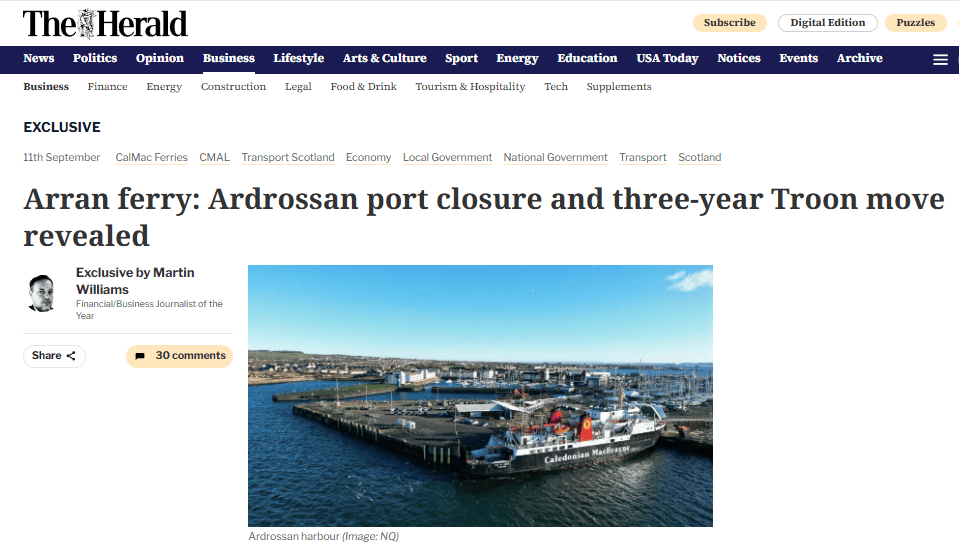
I understand the concerns in Ardrossan about this but the wider picture is important. The summer traffic to Arran warranted the building of larger ferries. Businesses and the islanders campaigned for bigger ferries to cope with and that is where we are.
The move to Troon will and understandable disappointment in Ardrosssan will of course be exploited by the media.
Here’s the case for it, in two parts:
First, Glen Sannox sailing from Troon means the same bus/car, shorter train, journey times from Glasgow and fewer bad weather cancellations
The Herald had this in February 2025, in a letter to the editor:
The excitement of the MV Glen Sannox’s arrival will rightly continue for some time for visitors and infrequent travellers as they explore the ferry’s thoughtfully designed passenger accommodation, but it has passed too quickly for those of us dependent on the ferry service.
The MV Glen Sannox is too large to fit into Ardrossan Harbour (islanders had suggested two smaller ferries would be better suited at time of design), so all sailings are via Troon Harbour. This means longer journey times and fewer sailings, making same-day journeys from Arran to the mainland on the Glen Sannox nearly impossible.
Apparently, according to a Bing search, Troon to Glasgow is 35 miles and 54 minutes by car. Ardrossan to Glasgow is also 35 miles but 52 minutes by car. Given that the Troon route is largely dualled and the Ardrossan route is largely single, I have my doubts about that. By train, it’s 1hr 20 from Ardrossan and only 40m from Troon.
So, lets just agree that Troon does not mean longer travel times bus, car or train.
Sailing time? Troon to Brodick is 25 minutes longer, to have a pint in the bar safely, due to the less choppy more sheltered waters.
As for fewer sailings, see this:
CalMac has switched its main Arran ferry sailing from Ardrossan to Troon for four days as strong winds are forecast. Ferries struggle to dock at Ardrossan’s main berth when the wind blows from the east, and an alternative berth has been permanently closed for safety reasons. The main berth at Ardrossan, the Arran berth, is susceptible to bad weather and CalMac had warned of possible disruption to services in the coming days. But after a trial on Wednesday, the ferry operator announced that passenger sailings could now continue using Troon, about 20 miles further south, as an alternative harbour. https://www.bbc.co.uk/news/uk-scotland-glasgow-west-68234115
Finally, why is she a bigger ferry? So the islanders can still get on in the summer rush?
Help Talking-up Scotland keep goin
Crowdfunder at: https://www.crowdfunder.co.uk/p/help-talking-up-scotland-keep-going
Or by direct bank transfer to: JOHN WATSON ROBERTSON Sort Code – 08-91-04 Account – 12266421
Second, the other reason to favour Troon over Ardrossan for the Arran ferry crossing – corruption on grand scale
There is a bloody good reason to prefer Troon based on the nature of their owners compared with the former owners of Ardrossan, which screwed the Scottish taxpayer for improvements they should have carried out themselves.
Ardrossan harbour was owned by Peel Group. They have a frankly sickening reputation. For example:
Controversies
Hunterston Parc
Campaigners objected to an LNG terminal Peel proposed for Hunterston Parc, Largs. The scheme included a combined cycle gas turbine power station; deep water port; facilities for oil rig decommissioning; a site for the recycling and storage of plastics, and dredging 2.4 million cubic metres of seabed. No environmental impact assessment was provided for the development.
Chat Moss
In 2011, Peel was accused of illegally extracting peat from its land near Salford. Following a 2012 Public Inquiry, Communities and Local Government Minister, Eric Pickles, backed Salford Council and Wigan Council in refusing further extraction at Chat Moss.
Biomass imports
In 2015, Peel established a biomass terminal at Liverpool’s Gladstone Dock for wood pellet imports from wetland forests in the Southern US. The pellets are then transported to Drax Power Station to be burnt. Campaigners objected to the greenhouse gas created in the process.
Car park fines
In 2021, multiple complaints were made about parking fines being issued by automated systems at Stockport Peel Centre even after motorists had purchased parking tickets.
Hunterston fatality
Peel’s Clydeport business was fined £5,000 in 2001 following a shore side fatality at Hunterston Terminal. The prior year it paid a £7,500 fine for an earlier incident.
Flying Phantom
In 2014, Peel’s Clydeport business pleaded guilty to health and safety breaches and was fined £650,000 following a triple fatality. River Clyde tug Flying Phantom capsized in the 2007 incident. Judgement found there had been systematic failure in risk assessments and safe systems of work. The charges also related to a similar incident involving the tug in 2000.
Fracking collusion
In 2014, high level collusion was found between Peel, police and a council. Documents revealed Salford Council, IGas Energy, Greater Manchester Police and Peel were sharing intelligence during anti-fracking protests at Barton Moss.
Congestion charge
In 2008, Peel was alleged to have covertly controlled a group that campaigned against a congestion charge for Manchester. It was claimed Peel feared a congestion charge would harm business at their Trafford Centre. Voters rejected introducing a congestion charge.
Excessive influence
In 2013, a report by Liverpool think-tank ExUrbe criticised Peel’s excessive influence on affairs and development in the Liverpool region, claiming Peel “blurred the boundaries between public and private interests”.
Help Talking-up Scotland keep goin
Crowdfunder at: https://www.crowdfunder.co.uk/p/help-talking-up-scotland-keep-going
Or by direct bank transfer to: JOHN WATSON ROBERTSON Sort Code – 08-91-04 Account – 12266421
Tax evasion
In June 2013, Margaret Hodge, Chair of the Public Accounts Committee, accused Peel of tax dodging, and explained some parts of the group pay on average 10% Corporation Tax, and the more profitable ones paid no tax at all.
HMS Plymouth
In 2006 Peel required the Warship Preservation Trust to leave their Birkenhead premises. The trust was unable to find an alternative location for its vessels and shut down. HMS Plymouth remained berthed and Peel took possession. In 2014, campaigners disputed the legality of those ownership rights. The group accused the port of allowing the ship’s condition to worsen in order to make any attempt to move/preserve her appear unfeasible.
The campaigners were also critical of the way the subsequent sale of the vessel to Turkey for scrap was conducted.
Marine Terminals industrial action
In 2009, following redundancies (layoffs) at Peel’s Marine Terminals Ltd subsidiary in Dublin, and eight weeks of industrial action, strikers seized the cargo handling company’s control room. In co-ordinated action, Dutch FNV Union occupied the headquarters of sister subsidiary BG Freight’s head office in Rotterdam. Peel had hired private security firm Control Risks to police their Dublin facility.
MV Francop
During unloading of the MV Francop at Peel’s Dublin container port a sailor was crushed to death. During the 2018 incident a stack of four cargo containers was lifted off the vessel with a crane, resulting in the bottom container parting from the stack and falling onto the sailor. It was alleged against Peel’s subsidiary Marine Terminals Ltd that there was no appropriate planning, instruction, communication and supervision of the method to insert a missing deck lock under the bottom container in the stack.
Warrington traffic
In 2014, Warrington Council accused Peel’s Manchester Ship Canal of “self interest” and prioritising canal users rather than vehicle traffic in its operation of swing bridges over the canal. The council and canal operator subsequently announced they would work together. Residents were particularly concerned about the situation when the M6 Thelwall Viaduct had to be closed for maintenance, leaving no alternative route locally across the canal.
Land hoarding
In his 2019 book Who Owns England, Guy Shrubsole describes Peel as one of the ‘secretive’ companies that “hoards England’s land” and has made significant impacts, good and bad, on the environment and people’s lives:
Peel Holdings operates behind the scenes, quietly acquiring land and real estate, cutting billion-pound deals and influencing numerous planning decisions. Its investment decisions have had an enormous impact, whether for good or ill, on the places where millions of people live and work.
World Heritage loss
In July 2021, the World Heritage Committee cited the development of Liverpool Waters as a reason for the revocation of Liverpool’s
World Heritage status. https://en.wikipedia.org/wiki/The_Peel_Group
The owners of Troon?
Associated British Ports
Controversy? Nothing – https://en.wikipedia.org/wiki/Associated_British_Ports
Help Talking-up Scotland keep goin
Crowdfunder at: https://www.crowdfunder.co.uk/p/help-talking-up-scotland-keep-going
Or by direct bank transfer to: JOHN WATSON ROBERTSON Sort Code – 08-91-04 Account – 12266421
Discover more from Scotland's First and biggest Rebuttal Service -Talking-up Scotland
Subscribe to get the latest posts sent to your email.
 Scotland's First and biggest Rebuttal Service -Talking-up Scotland
And there is no direct rail link from Ardrossan to Glasgow as you have to change lines at Kilwinning which is a pain in the ar**
LikeLike