


Help Talking-up Scotland keep goin
Crowdfunder at: https://www.crowdfunder.co.uk/p/help-talking-up-scotland-keep-going
Or by direct bank transfer to: JOHN WATSON ROBERTSON Sort Code – 08-91-04 Account – 12266421
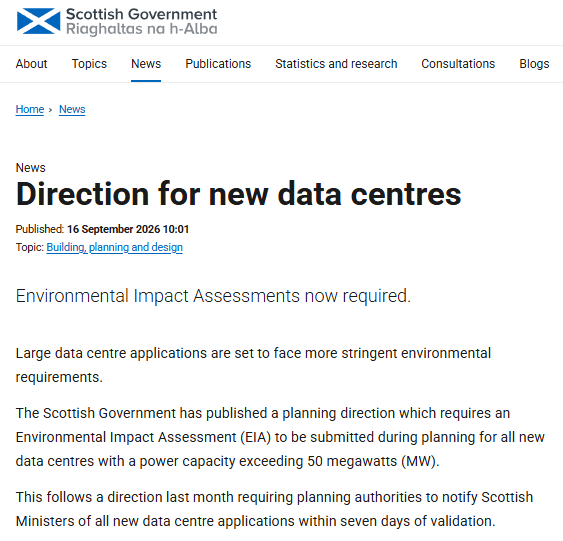
Earlier today, the Scottish Government published the above statement after the Holyrood debate on large data centres.
At around 18:00, BBC Scotland, the taxpayer-funded, public service provider, responded with this:
Planning consent for large data centres in Scotland is “highly unlikely” to be granted in the next three months, the Scottish government says.
The Scottish Greens have called for application processes to be paused until new national guidelines are in force – with an emphasis on energy demand and the environment.
Ministers, while rejecting that call, say they will publish the guidance by Christmas and told MSPs they don’t expect any planning decisions to be made before then.
They have also announced that new and existing applications for AI data centres will have to undergo an environmental impact assessment. https://www.bbc.co.uk/news/articles/cqe9eyn5yry3o
You can read both in full at the links above.
The BBC Scotland report misses out an important point:
The new direction has been developed with input from the Scottish Science Advisory Council (SSAC), Scotland’s highest level science advisory body. It provides independent advice and recommendations on science strategy, policy and priorities, through its Chair, to the Chief Scientific Adviser (CSA) for Scotland and to Scottish Ministers.
To do so, reduces dramatically to a quick tactical political reaction, the measured nature of the Scottish Government’s response to the Greens call, the rigorous basis and scientific objectivity of that response and the scientific basis for its 50MW Environmental Impact Assessment requirement.
This omission makes the Scottish Government position look more tactical and less evidence-based than it was.
Why did BBC Scotland omit this key piece of information? Taken in the light of their long history of bias I can only see it as deliberate and propagandist.
There are other absences in the BBC Scotland report undermining the Scottish Government guidance. The full ministerial framing of the debate in terms of the economy, employment, energy, climate and community wealth, is left out as is any explicit definition and purpose of the Environmental Impact Assessment. However, it is the removal of any mention of the measured scientific consultation leading to the guidance that robs it of authority and opens it up to the kind of ill-informed but widely-platformed criticism we can expect tomorrow.
Help Talking-up Scotland keep goin
Crowdfunder at: https://www.crowdfunder.co.uk/p/help-talking-up-scotland-keep-going
Or by direct bank transfer to: JOHN WATSON ROBERTSON Sort Code – 08-91-04 Account – 12266421
Discover more from Talking-up Scotland
Subscribe to get the latest posts sent to your email.


Large and hyperscale datacentres are not even required in Scotland. ‘AI’ is just clever programming using certain types of data modelling and (Bayesian) statistics, following programming instructions like any other software. Most of the desirable functions of AI are perfectly suited to running in a distributed manner especially in modern peer to peer networks incorporating edge datacentres, basically currently available public and private institutional hardware supplemented by all of our unused computer CPU/GPU cycles. Modern company and institution ‘edge’ datacentres are seen by the multinationals as an adjunct to their behemoths but it is the ‘big tech’ infrastructure that we should be utterly shunning and instead operating the open source systems of Estonia or Flanders. Even France is adopting Linux across government and public systems and abandoning the no longer trustworthy American tech ecosystem just as the BRICS and North Korea have done. Have a look at the Clarifying Lawful Overseas Use of Data Act aka ‘US Cloud Act’ 2018 which essentially allows US federal law enforcement to compel U.S. based technology companies to provide requested data stored on servers regardless of whether the data are stored in the U.S. or on foreign soil. Centralising data with ‘AI’ via hyperscale datacentres is a bit like shutting down all of the world’s libraries and galleries save a few mega-institutions where the collection is curated by a few master librarians (‘Big Lib’) who decide what you are allowed to borrow (at cost) and who reprocess all of the books, videos, photos, music, art etc. into ‘new’ products as ‘Big Lib’ and ‘Big Gov’ (before they merge) see fit. And then they destroy the originals. https://www.telegraph.co.uk/news/2026/07/30/why-ai-companies-are-destroying-millions-of-old-books/.
LikeLiked by 1 person
Mind you, we have plenty of spare water and electricity. Just saying..
Stephen McKenzie
LikeLike
We don’t own either…and are never intended to. Suggestions?
LikeLiked by 1 person
My suggestion would be that maybe those who have the responsibility for the supply networks and generating plants / wind and solar farms etc, could sell to the people who would need it via “Water Rates” or “Electricity Usage costs”, both fixed and recurring.
Call me old fashioned and maybe out of touch, but is that not how it is done?
Stephen McKenzie
LikeLike
How much money will it produce for Scotland? Can it be taxed? Will there be jobs etc. If Yes. One or two might be OK. In remote areas.
Destroying books. Not likely. More books are read than ever. Even kindles developed. There are massive book sales worldwide.
AI is a bit like google. The facts still need back up. Proper reference. It makes frequent mistakes. Many people can live without it. Majority of people do not use Facebook, Twitter etc. They are crooks. Pay no taxes. Illegal practices, blocked competition. They have been discredited. Now being sued worldwide. Bill Gates is discredited. Divorced. Untrustworthy. Vast fortunes go to charity. They could have just behaved in an honourable way. People and victims are coming after them. Including Governments.
LikeLiked by 1 person
I am sorry, whoever or whatever you are, but Tilly Norwood certainly makes a lot more sense than you do.
Stephen McKenzie
LikeLike
Stephen, keep it non-personal please. All our anonymouses deserve respect
LikeLike
Old books have been destroyed to train AI and this is presumably ongoing.
LikeLike