

Help Talking-up Scotland keep going
Crowdfunder at: https://www.crowdfunder.co.uk/p/help-talking-up-scotland-keep-going
Or by direct bank transfer to: JOHN WATSON ROBERTSON Sort Code – 08-91-04 Account – 12266421
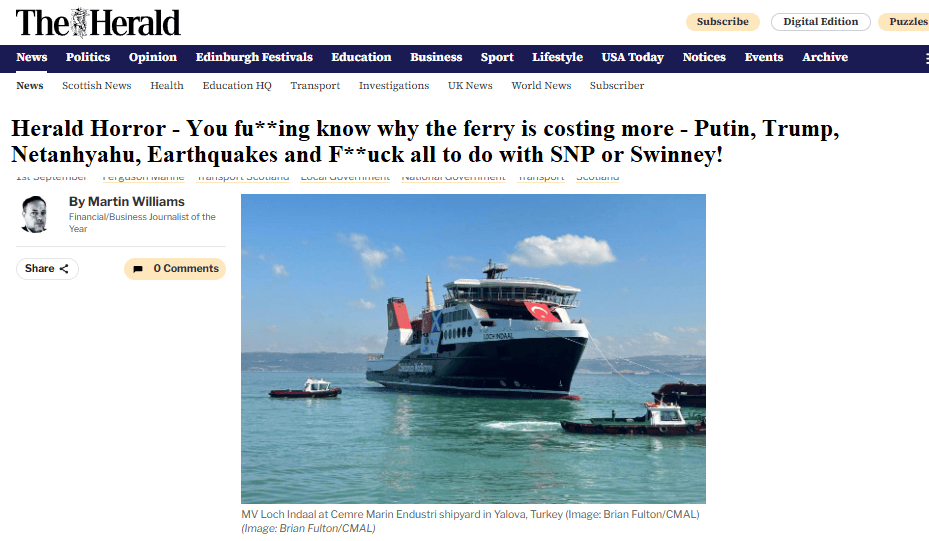
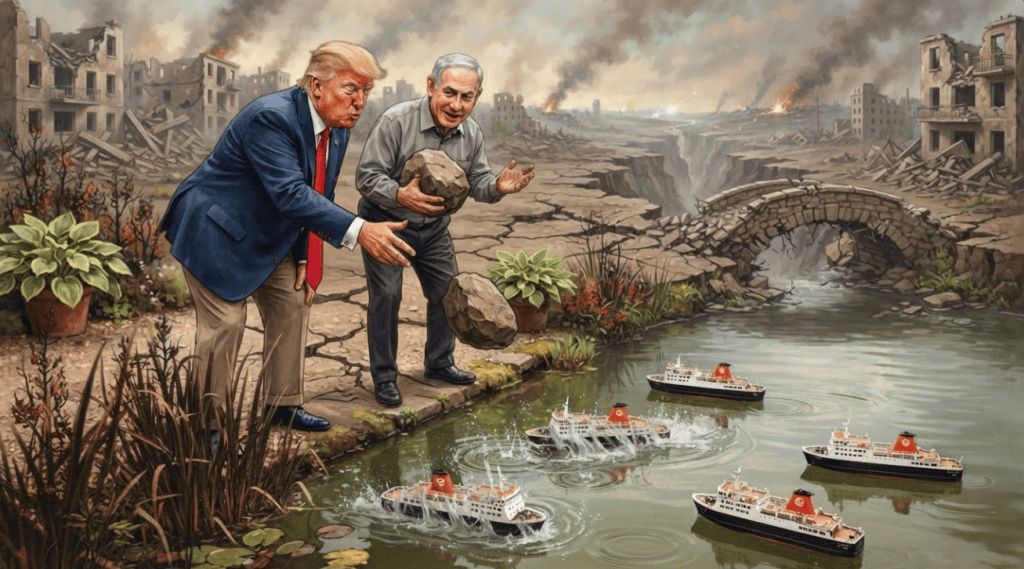
From the Herald of Free Enterprise’s Maritime Williams today, the latest in his wrecking yard of journalism on ferries:
Ferry fiasco 2.0? Why is £20m more needed for Turkish ships? After the ferry fiasco of Ferguson Marine, the Scottish Government and its ferry procurement wing, Caledonian Maritime Assets Limited (CMAL), looked abroad for a shipyard that could build new vessels on time and at a price the taxpayer could stomach.
and:

Aye, right! We know who they are. Try asking a representative sample instead and watch your fiasco metaphor sink.
Will Williams actually tell us the answer? Nope, he just witters on avoiding the answer.
Here it is
The delays stem from a combination of external shocks and yard-specific problems:
- Supply-chain disruption from the war in Ukraine.
- The 2023 Turkish earthquake, which pulled workers away from the yard.
- Broader logistics problems linked to Middle East tensions and Red Sea shipping disruption.
- Persistent labour shortages, particularly specialist commissioning engineers needed after the hull and machinery are in place. These shortages have affected shipyards globally. https://www.bbc.co.uk/news/articles/cm2jw7822xro
What’s wrong with this, accurate, answer? Swinney would have to go some to cause all that.
Finally, a wee reminder:
Help Talking-up Scotland keep going
Crowdfunder at: https://www.crowdfunder.co.uk/p/help-talking-up-scotland-keep-going
Or by direct bank transfer to: JOHN WATSON ROBERTSON Sort Code – 08-91-04 Account – 12266421
Discover more from Talking-up Scotland
Subscribe to get the latest posts sent to your email.


CMAL was set up by Nicol Stephen when he was Transport Minster in the Lib/Lab government. His reason was that EU rules demanded separation of procurement from ministerial influence. However I’m not aware of any other European country adopting the practice.
LikeLiked by 2 people
Rather, EU competition, state-aid and public-procurement rules created a problem which the Scottish Executive chose to solve through this particular CMAL structure.
There were alternatives.
Scotland could have considered:
1. tendering services while retaining assets within a government department or agency;
2. creating a public infrastructure authority;
3. allowing bidders to provide their own ships;
4. using different contractual and state-aid arrangements; or
5. maintaining an integrated operator where it was legally defensible.
Nicol Stephen’s Scottish Executive created CMAL as its solution to the perceived requirements of EU state-aid and competitive tendering rules, rather than because EU law specifically mandated a CMAL-type company.
Other examples among EU members include the following.
Sweden
Swedish ferry services frequently distinguish between the public authority specifying and procuring a service and private or commercial operators running it.
The Trafikverket system, for example, involves the state owning or controlling infrastructure and procuring services, while operations can be contracted separately.
However, Sweden does not have a single CMAL-equivalent company owning a national fleet of publicly owned vessels and leasing them to whichever operator wins a tender.
Denmark
Denmark has considerable separation between public authorities; infrastructure owners;
publicly subsidised route contracts;
and commercial ferry operators.
But again, the Scottish arrangement of one state-owned company owning a large fleet and harbour estate specifically to enable competitive tendering is fairly unusual and distinctive.
Finland
Finland uses competitive tendering and public procurement for many archipelago connections. The state or public sector may provide infrastructure while private companies operate services.
Again, separation exists, but the CMAL model is not followed.
France
France has extensive subsidised island ferry services, particularly in Corsica and Brittany.
There the public authority often defines the public-service obligation; tenders the services; pays compensation; and retains responsibility for ports.
But operators can own or provide their own vessels.
For example, Corsican ferry services have involved different operators competing for public-service contracts. The public authority does not necessarily need to own every ship in order to tender the service.
That is a significant difference from Scotland.
Ireland
The state subsidises certain island services, but the Department of Transport generally contracts operators rather than maintaining a CMAL-style state fleet that is compulsorily leased to the successful operator.
Again, public funding and procurement as interpreted there do not automatically imply the Scottish assets/operations split.
LikeLiked by 1 person
Thanks for expanding the information. You’re obviously clued up on the detail.
LikeLike
EU supports essential services. Even public ones. A case can be made for public health or social reasons. Ie essential to the 100,000 islanders existence.
Build the ferries in Scotland. Essential services can be subsidised for humanity reasons. Islanders survival. EU rules. A case has to be made for it. That boat has now sailed away without us.
Investing in Scottish shipbuilding is productive. Jobs and funding going into Scotland. The innovative ferries will save £Billions over life time. Spend £Millions to save £Billions. Cheaper to run, invest in Scottish industry and work opportunities.
More than covered by Scottish Gov funding.
Better returns. Saving benefits and welfare payments. Employing people in essential jobs, especially training skilled workers, with transferable skills. Worth every penny. Win, win all round.
LikeLike