


Help Talking-up Scotland keep going
Crowdfunder at: https://www.crowdfunder.co.uk/p/help-talking-up-scotland-keep-going
Or by direct bank transfer to: JOHN WATSON ROBERTSON Sort Code – 08-91-04 Account – 12266421
From Ends Waste & Bioenergy in January 2015:
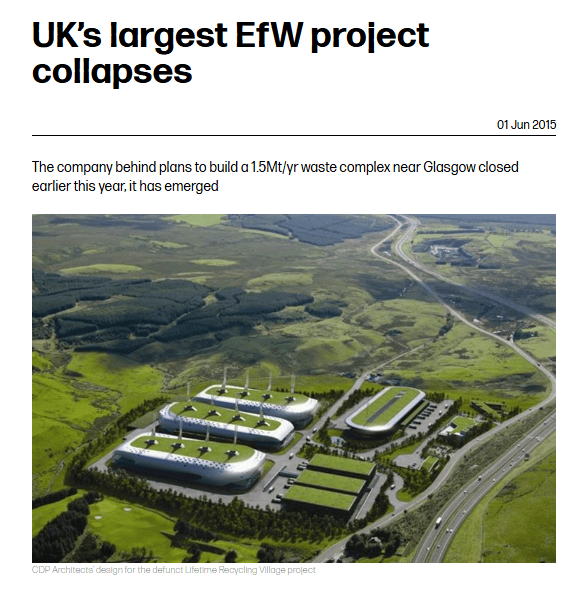
Plans to build the UK’s largest waste management complex [image at top] and energy-from-waste plant have come to an end, it has emerged. Lifetime Recycling Village Ltd, which had planned to build the £640m plant 12 kilometres south of Glasgow, was officially wound up in February, according to government records.
Proposal to build the facility were first unveiled in 2010 by three waste and construction entrepreneurs. Its three gasification lines would have processed a total of 900,000 tonnes of waste per year – over 100,000t more than London’s Riverside, the UK’s largest plant.
The development would have handled 1.5 million tonnes of waste per year in all, separating out some 600,000t of recyclates. The remainder, mostly biomass, would have been processed into fuel.The site would have generated 81MWe (gross) but its high electricity demand would have left only around 56MWe for export to the grid. Heat would have been used on-site for fuel drying and waste separation.
https://www.endswasteandbioenergy.com/article/1349530/uks-largest-efw-project-collapses
A march and rally took place in Newton Mearns in September 2011, involving local residents, community groups, environmental campaigners, and politicians including MP Jim Murphy and MSP Ken Macintosh. Opposition focused on the plant’s scale, traffic, emissions, green-belt location, and inconsistency with waste-reduction policy. A Scottish Parliament members’ debate in February 2011 also expressed concern. https://www.bbc.com/news/uk-scotland-glasgow-west-14765774
In the context of the the massive incinerator, called the South Clyde Energy Centre, positioned deliberately directly upwind and a short distance from Glasgow’s biggest hospital, Anonymous writes:
I was involved in the campaign against the Loganswell incinerator in the early 2010s, not least because several schools were in the path of the prevailing winds. I do not have my data from that time to hand but the main research tactic that I remember was to distinguish between domestic/municipal waste incineration and industrial waste incineration with (again from memory) clear evidence of harm to humans in the path of an industrial waste incinerator, but more nuanced outcomes from purely household/municipal waste incineration. And quoting carefully and selectively thereafter. I would defer to Joe Murray (and his excellent recent contributions) regarding the reality of the true combustion mix and simply point out this recent Australian systematic review of waste incineration:
https://www.sciencedirect.com/science/article/pii/S132602002300732X which concluded:
“A range of adverse health effects were identified, including significant associations with some neoplasia, congenital anomalies, infant death and miscarriage, but not for other diseases.”
I too, am reminded, of the ReChem incinerator near Bonnybridge, in the early 1980s, associated with cattle deaths and human birth defects. They simply moved to Wales.
One law for Newton Mearns but another for Govan?
Help Talking-up Scotland keep going
Crowdfunder at: https://www.crowdfunder.co.uk/p/help-talking-up-scotland-keep-going
Or by direct bank transfer to: JOHN WATSON ROBERTSON Sort Code – 08-91-04 Account – 12266421
Discover more from Talking-up Scotland
Subscribe to get the latest posts sent to your email.


Most people in Newton Mearns are hard working net-taxpayers paying well over the odds for their 1930s bungalows – no better than such houses elsewhere, just dearer – so their kids can access some of the best state schools…as opposed to paying for private schools. State schools as good as private? Maybe what a successful state system should look like. But for all. At least Newton Mearns shows it can be done! There are small enclaves of wealthier housing happy to let ‘the Mearns’ carry the MSM ‘super-rich’ can but it’s a fallacy. Most families are struggling with their net tax burden and overpriced house burden. And many of the Newton Mearns citizens are the doctors, nurses and other health and public service workers who give their hearts and souls to Glasgow and Govan and genuinely want a fair society for all. Loganswell was a completely new development and easier to fight, not least because the inside traitors paving the way for Loganswell were a wealthy business family from the area itself. Hope they were ostracised! South Clyde Energy Centre went through on a subterfuge due to an old planning consent being reutilised. And governance that cares nothing for its citizens. Newton Mearns citizens are among the most prominent fighters against all the GCC and NHSGGC shenanigans, yes because they wanted safe facilities for themselves and their own kids but that still puts them alongside the good guys. Doesn’t matter if any of them are using private medicine…Ross Hall and suchlike only cater for profitable conditions. Not for childhood cancers and stem cell transplants. And no, I don’t live in Newton Mearns, but we need unity.
LikeLike
In agreement with above. Know I’ll get shot down, but my kid is at a private school. Approximately 25% of Edinburgh school age families are in the same boat as me. And yes we know there’s unfairness. But with VAT and other tax changes all of these schools are gradually being forced into mergers or closures and the balance has already passed the point where the Scottish net-taxpayer is losing large sums of money to somehow accommodate the children of those who have been maliciously financially drained. State schools at a Newton Mearns standard and a levelling up such that there is no advantage in private education? Most of us would welcome that scenario. Not a race to the bottom. And the SNP? Hey, I’m a non-SNP nationalist but SNP know that had we remained in the EU VAT on private education is not permissible (save for overt profit making institutions). So the SNP Government were happy to piggyback on Westminster Labour policy and reflect some credit on themselves as class warriors while all the time being disgusting hypocrites. Thanks to above for ‘ostracised’. That’s exactly what 25% of the Edinburgh school age families feel! And who is expected to pick up the tax bill for the switch of unexpectedly large numbers of financial refugees from private to state education systems. Us 25% will be hit again. And I paid over the odds for my house with a huge LBTT bill and the value is creeping towards ‘mansion tax’ range. And I know of elderly whose large home is their main asset but who are relatively cash poor. That’s them finished. And all the time the true super-rich, including Middle Eastern potentates, owning vast tracts of Scotland through all manner of shell companies and tax havens, are laughing their socks off. Thanks, £74,500 salary + huge expenses including second property, SNP and Greens. You hypocrites! VAT on private medicine would have forced moonlighting NHS staff back to the day job!!
LikeLike
Wasn’t attacking Newton Mearns. Well done the campaigners.
LikeLiked by 1 person