

Help Talking-up Scotland keep going
Crowdfunder at: https://www.crowdfunder.co.uk/p/help-talking-up-scotland-keep-going
Or by direct bank transfer to: JOHN WATSON ROBERTSON Sort Code – 08-91-04 Account – 12266421
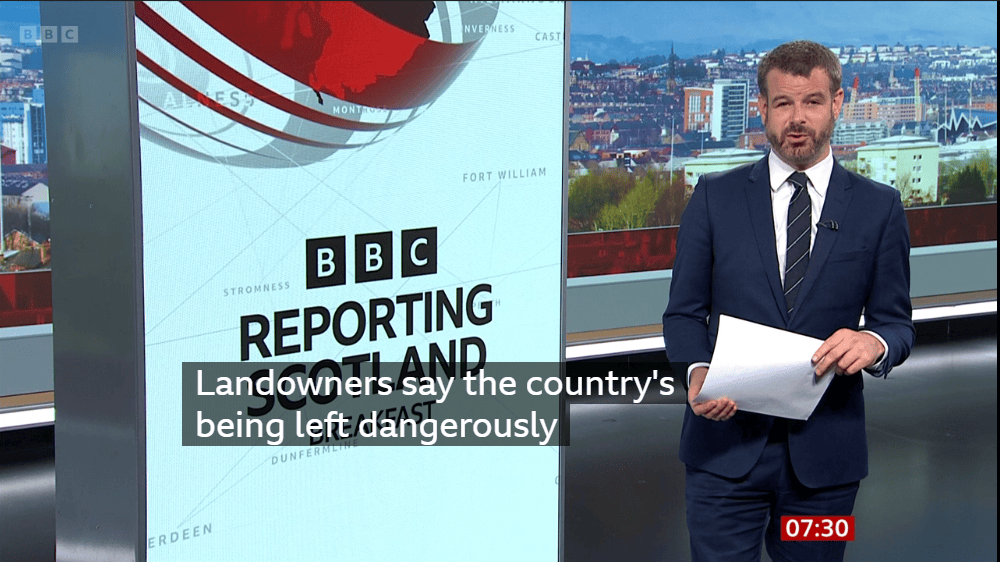
From BBC Scotland this morning, the above, and:
with too much reliance on informal good will
and from ‘Scottish Land and Estates’:
It warns that new ‘muirburn’ regulation must strengthen not ‘hollow out’ wildfire resilience.
I twitch. Who are ‘Scottish Land and Estates?’
Here they are. Howzat for sending a message before a word is said?

A membership organisation that represents landowners, land managers, and rural businesses in Scotland. It acts as their voice to politicians and decision-makers while providing advice, networking, and support. https://www.scottishlandandestates.co.uk/about-us
What do they mean by ‘new ‘muirburn’ regulation must strengthen not ‘hollow out’ wildfire resilience?’
They’re angry and worried by new Scottish Government law that makes it harder for them to burn heather with a view to making it easier for rich folk to blast away at wee birdies with a big shotgun. More below.
Muirburn is the controlled, seasonal burning of heather and other moorland vegetation. Estates and land managers use it to create a patchwork of short and tall vegetation (often for grouse and grazing) and to reduce the amount of dry plant material that can feed a wildfire. From mid-September 2026, doing it anywhere in Scotland without a NatureScot licence will be an offence under the Wildlife Management and Muirburn (Scotland) Act 2024. Rules are tighter on peat 40cm or deeper. https://www.nature.scot/professional-advice/protected-areas-and-species/licensing/muirburn-licensing
They argue that if licensing is too slow, expensive, or restrictive, fewer managers will keep doing muirburn. SLE says that would cut investment in trained people and equipment that Scotland currently leans on in a crisis. That is the “hollow out” point: resilience would look stronger on paper (tighter rules) but weaker on the ground. https://www.heraldscotland.com/news/26509632.cairngorms-wildfire-exposed-weakness-scotlands-response/
Might it improve grouse life-expectancy too?
This is an entirely self-interested claim and critics of muirburn say many wildfires have been linked to escaped burns, that evidence it reliably stops large fires is mixed, and that fuel can also be cut by grazing, cutting, or rewetting peat. https://www.gov.scot/publications/strategic-action-plan-wildfires/pages/4/
More important this:
From the Scottish Government 9 October 2025:
New licensing conditions for muirburn will not come into force until autumn 2026, Agriculture Minister Jim Fairlie has confirmed.
In the aftermath of the wildfires which have affected many parts of the country and caused extensive damage to Scotland’s peatlands, the decision has been taken to move the commencement date from 1 January, when the relevant part of the Wildlife Management and Muirburn (Scotland) Act would have come into effect.
This follows extensive discussions with land managers, game keepers, estate owners and the Scottish Fire and Rescue Service (SFRS). Muirburn is the intentional and controlled burning of moorland vegetation to encourage new growth (either heather or grassland) for the management of moorland game and wildlife or for improving the grazing potential of the moorland for livestock or deer.
The Wildlife Management and Muirburn Bill was passed by the Scottish Parliament in March 2024 and includes a range of measures that will help tackle raptor persecution and ensure that the management of species on grouse moors is done so sustainably and with animal welfare as a priority.
The Bill:
- strictly regulates the use of muirburn, the controlled burning of vegetation on peatland
- bans the practice of snaring in Scotland
- bans the use of glue traps to catch rodents
- gives greater powers to Scottish SPCA inspectors to tackle wildlife crime
- introduces a new licensing framework for grouse moors
Link – https://www.gov.scot/news/muirbuirn-licence-scheme/
Help Talking-up Scotland keep going
Crowdfunder at: https://www.crowdfunder.co.uk/p/help-talking-up-scotland-keep-going
Or by direct bank transfer to: JOHN WATSON ROBERTSON Sort Code – 08-91-04 Account – 12266421
This diplomatic account conceals, I feel sure, a determined policy by the SNP to reign in grouse moor owners and managers, even if delayed by one year, who are responsible for turning Scotland’s uplands into deserts amenable only to the interests of small affluent elites and responsible for events such as the Brechin Floods of 2023 wrongly attributed to Storm Babet and to Scottish Government ‘failures.’
How so?
BBC Reporting Scotland 22 October 2024 were back on the October 2023 Storm Babet and the flood damage to Brechin, with locals complaining of a ‘ghost town‘ and an implied accusation of the Scottish Government not having done enough to prevent the floods in the first place or to help locals in the subsequent year.
There is only a simple acceptance here of climate change and the need for more flood defences, to stay in the same place.
There is no mention of research suggesting another, more scientific and forensic explanation and an identifying a cause which can easily be reversed.
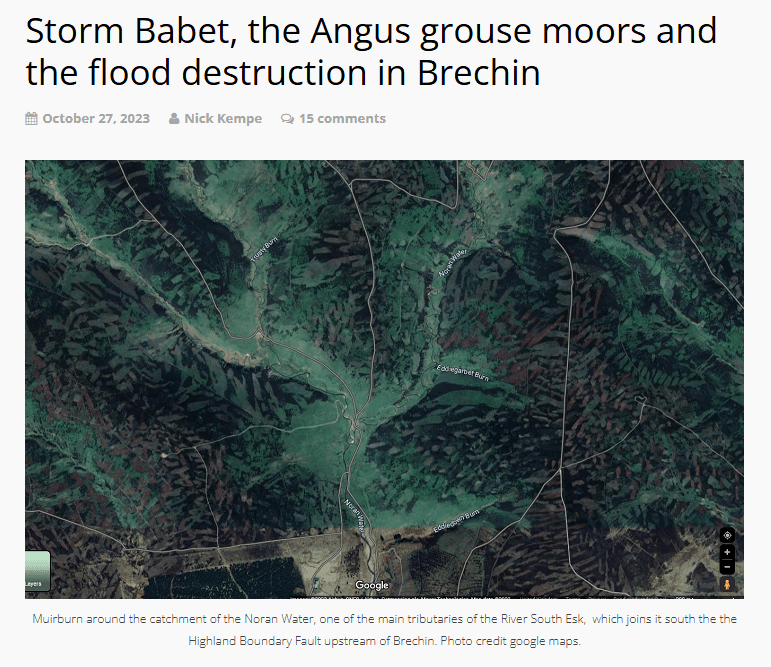
In an extensive, thorough and evidence-based study, Nick Kempe, a researcher and writer at ParkswatchScotland, pins the blame squarely and simply on grouse moor management around the River Esk and upstream of Brechin and Montrose.
He writes:
The south east fringes of the Cairngorms north of Brechin include some of the most intensively managed grouse moors in Scotland or the wider UK. In many parts of the catchment of the River South Esk managing the land for driven grouse shooting is the dominant land-use.
The muirburn, besides destroying peat which helps absorb rainfall, also removes surface vegetation, including plant litter, which helps slow the flow of water downhill. The rate of water run-off is almost certainly sped up further where the burned strips are oriented downhill, rather than across slopes.
Meantime, a google search will reveal that organisations representing sporting interests have issued a stream of claims that intensive grouse moor management actually helps to reduce flood risk.
Muirburn in fact does exactly the opposite of “natural flood management”, the restoration of woodland and peat bogs to reduce the amount of water flowing into watercourses. The conclusion is obvious. If the Scottish Government and its agencies really want to reduce the amount of destructive flooding that affects places like Brechin they need to tackle grouse moor management. Unfortunately Scotland’s whole system of flood prevention and management appears designed to conceal this fact.
Full report at: https://parkswatchscotland.co.uk/2023/10/27/storm-babet-the-angus-grouse-moors-and-the-flood-destruction-in-brechin/
I suspect the Bill also has as its heart the following:
Between 12% and 18% of Scotland’s total land area is currently reserved for grouse moors. Despite this, the economics of such activity has been shown to be significantly worse than any other reasonably conceivable economic activity. https://www.commonweal.scot/policy-library/back-life-mapping-scotlands-alternative-grouse-moors-december
Of all the possible uses of this land, grouse shooting is not only the least moral, it is by far the least economically effective. In fact, almost any other use will create more value and more jobs per hectare. https://www.birdguides.com/news/grouse-shooting-is-the-least-effective-use-of-scottish-land/
Back in the day, Common Weal did things like this. In 2019, with the Revive Coalition they produced: Back to Life: Visions for Alternative Futures for Scotland’s Grouse Moors. It settled the debate once and for all. Common Weal presented some devastating numbers for the supporters of shooting. Neatly summarised for us by Bird Guides:
A new report has shown that, from an economic perspective, grouse shooting is the most ineffective use of Scottish land. The study, published on the final day of the Scottish grouse season, shows the bloodsport produced an annual gross value added (GVA) of just £30 per hectare.
The report – Back to Life – scrutinises a variety of other possible land uses, including agriculture, biomass, housing and solar power, and found all of them to produce far greater value. If the land was used for other purposes, horticulture would return the greatest GVA at £12,412/ha, followed by housing (£11,950) and solar power (£10,952).
Horticulture, which currently uses 0.26 per cent of Scotland’s land area, would create 7,370 jobs, generate £261 million for the economy and would need 3 ha to create one job. In stark contrast, the report said grouse shooting, on the current land use area of 1.5 million ha, created 2,640 jobs, had an annual economic impact of £32m and required 330 ha to create. https://www.birdguides.com/news/grouse-shooting-is-the-least-effective-use-of-scottish-land/
Help Talking-up Scotland keep going
Crowdfunder at: https://www.crowdfunder.co.uk/p/help-talking-up-scotland-keep-going
Or by direct bank transfer to: JOHN WATSON ROBERTSON Sort Code – 08-91-04 Account – 12266421
Discover more from Talking-up Scotland
Subscribe to get the latest posts sent to your email.
 Talking-up Scotland
With regard to the Muirburn legislation, like all legislation there is consultation with ‘interested parties’ during the formulation of the proposed legislation. Then there is Parliamentary debate, scrutiny by committee (which sometimes takes evidence from people involved the topic under discussion, and then the Bill is enacted with various amendments.
And this is when we get the performative rage and biased media reporting involving people who were involved in the process.
In the recent resolution of the Glasgow Council pay restructuring following the years long fiasco denying women equal pay due to a conspiracy between make Labour Councillors and male trade union officials, a majority of employees will receive improved pay, and a significant number of the rest will see no change and around 10% will have pay reduced.
This was hammered out with the unions. When it was announced we had the same union officers denouncing the pay cuts to which they had been party. The pay cuts were to de deferred for 6 months, but unions were demanding a year deferment. They claimed ‘some people’ will see a reduction of £10k, but gave no figure for how many or acknowledged that most of these are men who had benefitted from the discriminatory action.
So, we had the grubby spectacle of the Herald and Scotsman who are usually hostile to trade unions supporting these claims in favour of a minority against an ‘SNP Council’ because they hate support for independence even more. On other pages inside there are attacks on trade unions in other disputes, usually with private companies. BBC Scotland’s ‘news values’ require it to be hostile to independence and to make enemies of that their ‘friend’, but will attack those ‘friends’ in contexts where they are acting against the wealthy and landowning classes.
LikeLike