

Help Talking-up Scotland keep going
Crowdfunder at: https://www.crowdfunder.co.uk/p/help-talking-up-scotland-keep-going
Or by direct bank transfer to: JOHN WATSON ROBERTSON Sort Code – 08-91-04 Account – 12266421
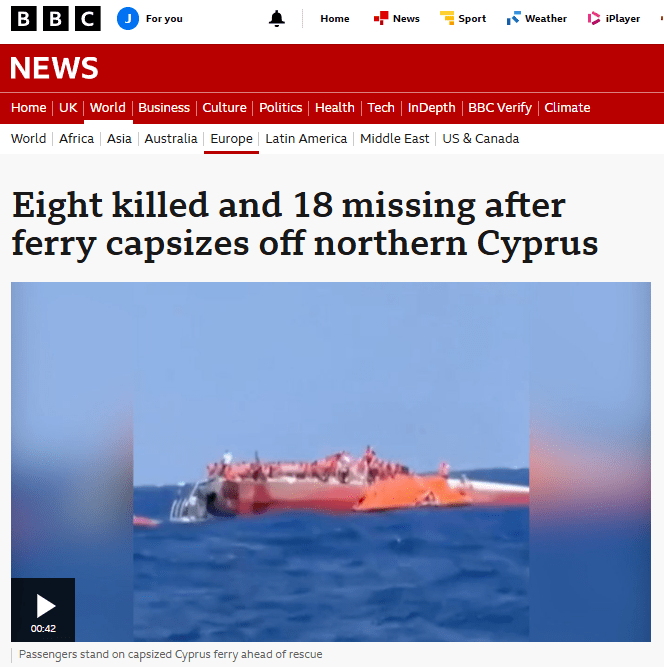
Widely broadcast this morning and from BBC Europe yesterday, the above and:
At least eight people have died and 18 others are still missing after a passenger boat [a twin-hulled catamaran] capsized off northern Cyprus, the head of the Turkish administration there has said.
Ünal Üstel, prime minister of the self-proclaimed Turkish republic on Cyprus, said the ferry had been carrying 259 passengers and eight crew members when it began taking on water after departing the coastal town of Kyrenia on Sunday.
and:
Üstel said the boat had been scheduled to travel to Turkey on Saturday, but had been delayed due to poor weather conditions.
He told Turkish media outlet TRT that the boat was hit by two waves before it capsized.
While the captain of the vessel was trying to recover from the first wave, a second wave hit and it began taking on water, he told the outlet.
Regulars here will remember the media and Liberation Scotland‘s campaign on behalf of cheap catamarans, fully demolished here.
Once more:

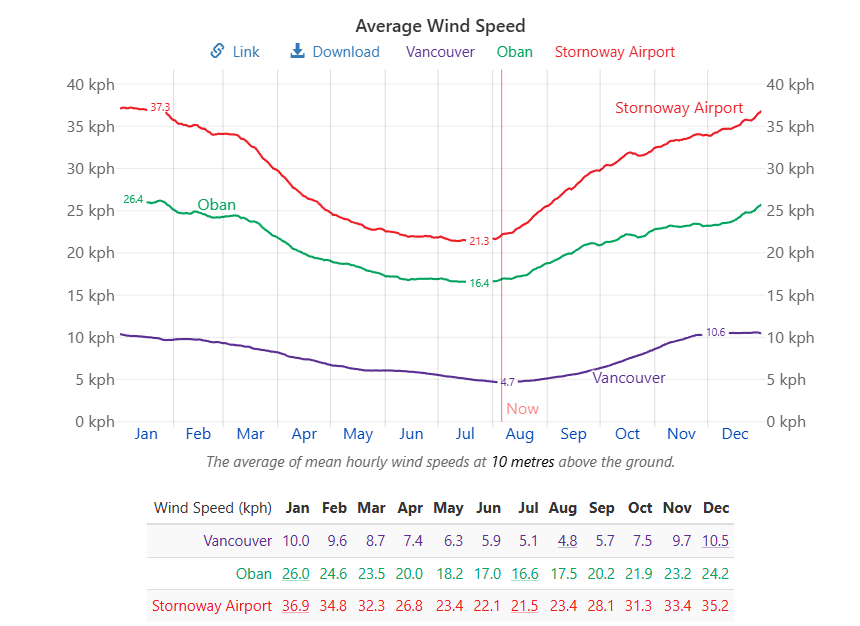
https://weatherspark.com/compare/y/476~35100~147702/Comparison-of-the-Average-Weather-in-Vancouver-Oban-and-Stornoway-Airport#google_vignette
I fully support Liberation Scotland‘s UN mission to have Scotland recognised as a colony. Who ever thought it wasn’t?
However, their other agenda to abuse the SNP and everything it has achieved in government, is risible and divisive. Here’s the latest – bloody catamarans again!
By no measure, based on evidence globally, is Scotland’s ferry system failing. It’s the best in the World.
Simlarly, catamarans are not the answer.
Here’s the answer:
Throughout much of 2024, the Herald worked with opposition politicians in a campaign aimed at undermining CalMac and, by association, the SNP’s competence in government.
We, at TuS found several reports of the unsuitability of catamarans across the globe, even in milder conditions than off the West coast of Scotland and today we have used the X AI platform Grok to finally answer the question – Are mono hull or catamaran ferries better for the West Coast of Scotland island routes?
The findings were unequivocal in favour of the mono-hulls:
Choosing between mono hull and catamaran ferries for Scotland’s West Coast island routes depends on several factors, including sea conditions, route characteristics, passenger comfort, and operational efficiency. Here’s a concise comparison based on available information and the specific context of the West Coast of Scotland:Mono Hull Ferries
- Stability in Rough Seas: Mono hulls, with their deeper drafts and heavier displacement, are generally more stable in the rough, unpredictable waters of the West Coast of Scotland, where strong winds and high waves are common, especially in winter. They are better suited for handling adverse weather conditions, which is critical for year-round reliability on routes like those operated by CalMac.
- Capacity: Mono hulls typically offer greater capacity for vehicles and passengers, which is advantageous for high-demand routes to larger islands like Skye, Mull, or Arran. They can carry heavier loads, including freight, which is vital for island economies.
- Fuel Efficiency: Mono hulls are less fuel-efficient at high speeds compared to catamarans but perform well at moderate speeds typical for longer routes. Their fuel consumption is more predictable in rough conditions.
- Maneuverability: Mono hulls are less agile than catamarans, which can be a drawback in tight harbors or when quick turnarounds are needed.
- Examples: Most CalMac ferries, such as the MV Caledonian Isles or MV Isle of Mull, are mono hulls, designed for durability and capacity on routes exposed to open sea conditions.
Catamaran Ferries
- Speed and Efficiency: Catamarans are generally faster and more fuel-efficient at high speeds due to their lighter construction and dual-hull design, which reduces drag. This makes them suitable for shorter, high-frequency routes or calmer waters, such as sheltered routes to smaller islands or during summer months.
- Passenger Comfort: Catamarans offer a smoother ride in calm to moderate seas due to their wide beam and reduced rolling. However, in rough seas, they can experience more pitching and slamming, which may reduce comfort and increase seasickness for passengers on exposed routes.
- Maneuverability: Their twin-hull design allows for better maneuverability in ports, which is beneficial for quick docking and undocking in smaller harbors.
- Capacity: Catamarans typically have lower vehicle and freight capacity compared to mono hulls of similar size, which may limit their suitability for high-demand routes or those requiring significant cargo transport.
- Examples: Catamarans like the MV Alfred (operated by Pentland Ferries in the Orkney region) have been used successfully in Scotland but are less common on CalMac’s West Coast routes due to capacity and sea condition constraints.
Context-Specific Considerations
- Sea Conditions: The West Coast of Scotland, particularly routes to the Outer Hebrides or exposed islands like Barra, experiences frequent storms and high swells. Mono hulls are better equipped to handle these conditions, ensuring reliability and safety. Catamarans may struggle in severe weather, leading to more frequent cancellations.
- Route Length and Demand: For longer routes (e.g., Oban to Barra, ~5 hours) or high-capacity routes (e.g., Ardrossan to Arran), mono hulls are preferred due to their ability to carry more passengers and vehicles. Catamarans may be viable for shorter, less busy routes, such as between smaller islands or in sheltered waters like the Firth of Clyde.
- Infrastructure: Many West Coast ports are designed for mono hull ferries, with loading ramps and berths suited to their size and draft. Catamarans may require infrastructure upgrades, which could increase costs.
- Environmental Impact: Catamarans can be more fuel-efficient on certain routes, reducing emissions, but newer mono hull designs (e.g., CalMac’s hybrid ferries like MV Hallaig) are closing this gap with greener technologies.
Conclusion
For the West Coast of Scotland’s island routes, mono hull ferries are generally better suited due to their stability in rough seas, higher capacity for passengers and freight, and compatibility with existing infrastructure. They ensure year-round reliability in the region’s challenging weather conditions. Catamarans could be considered for shorter, sheltered routes or as supplementary vessels for high-frequency summer services, but their limitations in capacity and rough-sea performance make them less ideal as the primary choice for most routes.
If you need more recent assessment of this particular incident:
Would a deep draught mono hull ferry have been safer in this situation? – https://www.bbc.co.uk/news/articles/c770jyd4l7lo
A conventional deep-draught monohull would almost certainly have been safer in the conditions that sank the Filo Jet. https://en.wikipedia.org/wiki/Sinking_of_the_Filo_Jet
The vessel that capsized was a small, ageing high-speed catamaran (roughly 40 m long, 10 m beam, built 2000). Survivor accounts describe it repeatedly lifting and slamming in the seaway until the bow structure failed and water entered; it then rolled after being hit by successive waves while the master was trying to recover. High-speed cats of this type have high initial stability but a righting-moment curve that peaks early and then falls away; once one hull is flooded or the vessel is knocked beyond a modest angle they can invert quickly and stay inverted. They are also structurally sensitive to slamming if driven too fast for the sea state. https://www.reuters.com/world/europe/boat-with-around-270-people-capsizes-off-north-cyprus-media-says-2026-08-30/
A displacement monohull of comparable passenger capacity would have been heavier, slower, and far more deeply immersed. Its mass and inertia reduce slamming loads, its reserve buoyancy and typical subdivision give more time to respond to flooding, and its righting arm continues to increase well past the angles at which a catamaran’s stability collapses. The same two waves that overpowered the lightweight cat would have produced large but recoverable rolling and pitching on a well-found monohull ferry. Historical Ro-Ro disasters show that monohulls can still capsize if doors are left open or stability is compromised, but the particular failure sequence seen here—structural breach from slamming followed by rapid inversion—is far less likely.Weather, operational decisions and the age of the hull remain the dominant factors; no hull form is immune to poor seamanship. In the sea state and speed regime that actually occurred, however, the monohull’s seakeeping and residual stability characteristics would have given passengers a markedly better chance.
Help Talking-up Scotland keep going
Crowdfunder at: https://www.crowdfunder.co.uk/p/help-talking-up-scotland-keep-going
Or by direct bank transfer to: JOHN WATSON ROBERTSON Sort Code – 08-91-04 Account – 12266421
Discover more from Talking-up Scotland
Subscribe to get the latest posts sent to your email.

