

Help Talking-up Scotland keep going
Crowdfunder at: https://www.crowdfunder.co.uk/p/help-talking-up-scotland-keep-going
Or by direct bank transfer to: JOHN WATSON ROBERTSON Sort Code – 08-91-04 Account – 12266421
From the Higher Education Policy Institute yesterday and echoed in reports from Universities Scotland and the NUS:
How Scotland has 21% more to spend on each school pupil but 24% less to spend on each undergraduate than England.
This is all much more important than it might initially sound. Policymaking in Scotland is shaped by the size of its relatively small polity, meaning the political class is tighter and universities have more direct engagement with their political overlords, at least compared to England. This changes the nature of the debate, in some good ways and some bad.
Most notably, the dominance of the ruling Scottish National Party and their long-standing ‘free’ higher education policy, meaning Scottish-domiciled undergraduates who attend Scottish institutions do not have to pay tuition fees, has tended to stifle debate on alternatives. No major political party, with the possible exception of Reform UK, have promised to change tack – at least, not recently or not yet.
Paying tuition fees is non-starter in Scotland thanks to SNP dominance and the other parties, rightly, fear challenging the idea. Good, we can leave that alone but the opening claim reminds me. I taught in Primary, Further and Higher education and along with most ‘Educationists’ I knew the finding was upside down, spending far more per student in higher education than in Primary or for that matter, Pre-school education.
The above claim does not, of course, and sneakily by the author, tell you what the actual spending level is.
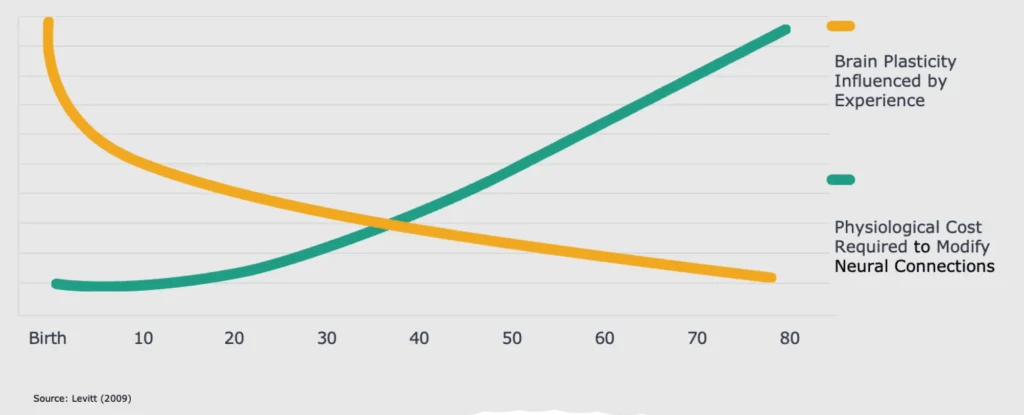
Most of that which really matters, in language, mathematics and in utterly determining early social development, happens before 7 years of age. If that does not go well, you will rarely turn things round. Everybody who has seriously studied learning know that to be true, so if Scotland is doing as claimed, then good. More please.
Evidence? There are mountains of it now but this Harvard starter might do:
Early-years learning (roughly from conception through age 5–8) is uniquely important because the brain is constructing its basic architecture during this window. Later learning remains possible and valuable—the brain stays plastic throughout life—but it is generally less efficient, more costly to remediate, and builds on whatever foundation was laid early. The difference is not that children “learn more” in some vague sense; it is that the biology of development, the timing of sensitive periods, and the way skills compound make early experience disproportionately consequential. https://developingchild.harvard.edu/science/key-concepts/brain-architecture/
Help Talking-up Scotland keep going
Crowdfunder at: https://www.crowdfunder.co.uk/p/help-talking-up-scotland-keep-going
Or by direct bank transfer to: JOHN WATSON ROBERTSON Sort Code – 08-91-04 Account – 12266421
Discover more from Scotland's First and biggest Rebuttal Service -Talking-up Scotland
Subscribe to get the latest posts sent to your email.
 Scotland's First and biggest Rebuttal Service -Talking-up Scotland
Within the pre-school and school sector, funding per capita allocations increased as age groups increased. So, allocations to pre-school organisations were less than those for primary and, these, in turn, were less than the allocations to secondary. And, within secondary, these were even greater for senior secondaries compared to junior secondaries and for students in Fifth and Sixth Years, the two years after the school leaving age of 16.
Students opting to continue beyond the statutory minimum leaving were disproportionately from families in the higher socioeconomic deciles.
These allocations revealed an underlying principle about the purpose of school education. There are other principles involved and, in the main, the principles are about the good of society. But, a further question is – whose society?
The principle relates to what a tutor of mine called ‘social control’ or, more euphemistically, ‘socialization’. Not all of this is bad and is about fostering community. However, it is also about ‘selection’, about choosing those who will carry out the jobs which are deemed more important, and those who will become ‘leaders’.
Selection, it goes without saying, applied only to the schools attended by the children of the great majority of the public, not to the private schools. Those whose children attended private schools were the ‘leaders’ and they were ensuring that their offspring would be in the same privileged positions. However, in an economy that was growing from the time of the Industrial Revolution (and earlier) this increasing complexity required recruitment of ‘able’ children from the ranks of the hoi polloi and the lower middle classes. These were the children who ‘passed their Qualy’ and went into secondary education, some of whom were permitted to continue beyond the minimum leaving age to study for Highers. A few of these attained sufficient Highers to enter Higher Education.
There was thus a ‘winnowing out’. There was also a social class aspect. Children for economically poorer families were less likely to pass the Qualy, and, for family financial reasons, left in greater numbers at the minimum leaving age, even though many were capable of progressing further academically.
This explains the disparity in funding levels of preschool and primary compared to secondary education and the disparity between funding of junior secondaries and senior secondaries and between funding for the earlier and later years of senior secondaries. Even at post school, further education (attended by many of the able working class children attended who had had to leave school at the minimum leaving age for economic reasons) was funded less generously than higher education.
With the ending of the Qualy and selection in Scotland, the introduction of comprehensive secondary schools, assistance to enable more children to continue beyond the minimum leaving age, the gradual blurring of the curricular differences between further and higher education, and the creation of more routes to continue education beyond school, social mobility became more common.
These are all, in my view, GOOD THINGS. However, despite that there are still funding disparities and, as has been the case in England since the 1990s, a vocal opposition to these changes which have widened access, because children of the hoi polloi were entering the higher echelons of the economy. They were competing successfully with the products of private schools.
Scotland has to a great extent resisted these pressures. And that the reason why the right wing media continually distort data to give the impression that Scottish education is failing.
LikeLike