

Help Talking-up Scotland keep going
Crowdfunder at: https://www.crowdfunder.co.uk/p/help-talking-up-scotland-keep-going
Or by direct bank transfer to: JOHN WATSON ROBERTSON Sort Code – 08-91-04 Account – 12266421
I was shocked to go back and read these reports from the inquiry into bacterial infections in the Queen Elisabeth University Hospital.
In the Daily Mail:
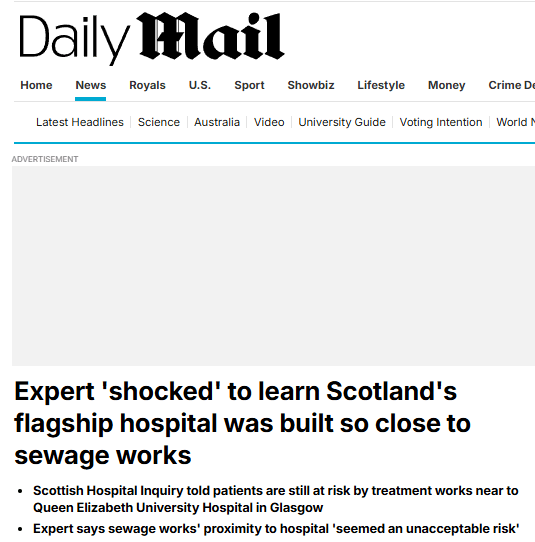
A water safety expert said he was ‘shocked’ to learn Scotland’s super-hospital has been built near a sewage plant. An inquiry into the Queen Elizabeth University Hospital in Glasgow heard that a microbiologist brought in following a spate of infections said its location next to wastewater treatment works was a risk to vulnerable patients.
Dr Tom Makin runs the Makin and Makin Consultancy which provides water quality advice to companies and healthcare facilities. Yesterday, he told the inquiry that the proximity of the sewage works ‘is still a risk today’ and tests should be carried out to see if airborne particles are getting into the hospital.
Dr Makin made his comments during evidence to the Scottish Hospitals Inquiry yesterday. He was contacted by NHS staff in Glasgow in April 2018 and asked to provide advice after contamination was found in the hospital water supply. Dr Makin said: ‘I first saw the hospital and its water system on 10th May 2018. I do recall approaching it for the first time and discovering that it had been built next to a sewage treatment facility. I was shocked by this
‘I was very puzzled as to why it had been allowed given that the hospital contained very immunocompromised patients. I was concerned regarding the possible implications for the hospital and its patients arising from potential increased transmission of microorganisms from the sewage treatment facility.
Airborne transmission of microorganisms from sewage treatment works is well documented.
‘You are dealing with faecal material and there’s agitation in the process to break down the sewage which generates aerosols that can move fair distances.
‘To actually have a hospital that contained highly immunocompromised patients so close seemed an unacceptable risk. I was surprised.’ https://www.dailymail.com/news/article-13785229/Expert-shocked-learn-Scotlands-flagship-hospital-built-close-sewage-works.html
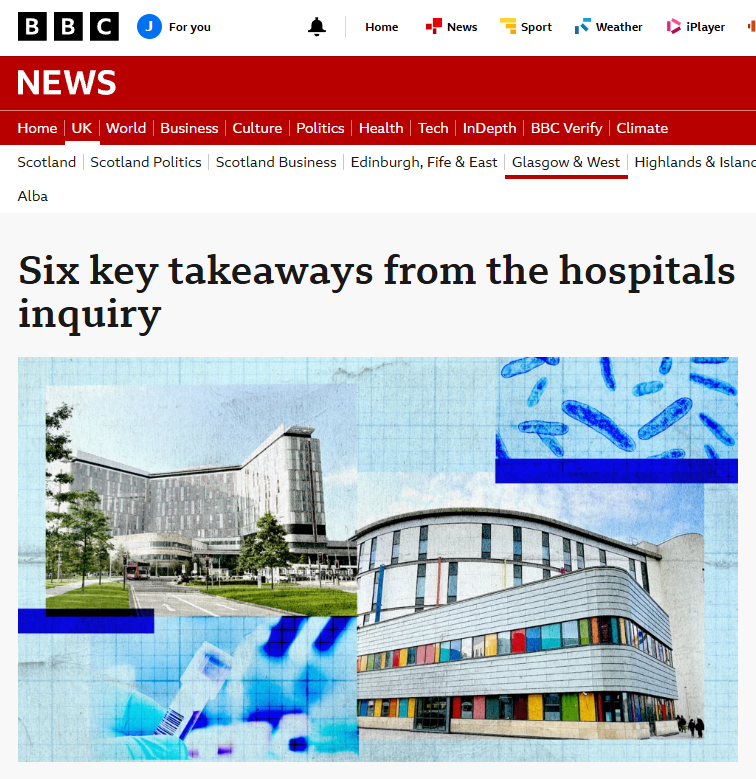
In their 1 500 word report, BBC Scotland, however, mention none of the above and ‘sewage’ appears only once, with:
While the health board now accepts there were issues with the water system, it says the impact of ventilation failings on patient safety remains subject to debate. It claims evidence presented to the inquiry supports its view that proximity to the Shieldhall sewage works may have led to unpleasant smells but did not harm patients. https://www.bbc.co.uk/news/articles/c3dm08x0780o
Help Talking-up Scotland keep going
Crowdfunder at: https://www.crowdfunder.co.uk/p/help-talking-up-scotland-keep-going
Or by direct bank transfer to: JOHN WATSON ROBERTSON Sort Code – 08-91-04 Account – 12266421
Discover more from Scotland's First and biggest Rebuttal Service -Talking-up Scotland
Subscribe to get the latest posts sent to your email.
 Scotland's First and biggest Rebuttal Service -Talking-up Scotland
It’s notable how often media articles have made mention of the impact of the Shieldhall sewage works on air quality and health. These includes stories going back to its effects on patients at the old Southern General Hospital.
From 1999: ‘PATIENTS KICK UP STINK OVER HOSPITAL STENCH’
See https://www.thefreelibrary.com/PATIENTS+KICK+UP+STINK+OVER+HOSPITAL+STENCH%3b+Sewerage+nightmare+on…-a060449227
From 2000: ‘izarre (sic) siting of Southern General Hospital ‘
See https://www.heraldscotland.com/news/12193642.izarre-siting-of-southern-general-hospital/
From 2023: ‘Glasgow hospital overwhelmed by sewage stench after refurb’
See https://www.glasgowtimes.co.uk/news/scottish-news/23589380.glasgow-hospital-overwhelmed-sewage-stench-refurb/
So the architects and engineers designing and building the new ‘South Glasgow Hospital’ would/should have been well aware of the local environmental challenges.
LikeLike
It’s even worse than you think, stewartb it goes back over a century! Those who instruct the architects and engineers were aware in 1910 when the sewage works were opened…next to a poorhouse with a hospital wing…who gave a f*** about segregated families in a poorhouse. They were aware in the early 1980s when the sewage works were renewed/enlarged. Who gave a f*** about Govanites. They were aware in 2000 when GGHB ignored its own ‘consultation’ which basically said “Cowglen FFS!” They were aware when Janis Hughes (Labour MSP) led a debate against the GGHB ‘consultation’ manipulations again describing the sewage problem as did John Young (Conservative), Dorothy-Grace Elder(oh please read her speech “You Couldn’t Make It Up, Could You?”) and Bill Aitken (Conservative) https://www.theyworkforyou.com/sp/?id=2001-01-17.307.0 They were aware when Labour’s Malcolm Chisholm ignored the MSPs who protested when he signed it all off in 2002: https://www.theyworkforyou.com/sp/?id=2002-09-12.13633.0&s=%22Acute+Services+Review+%28Glasgow%29%22 The SNP opposition led the debate and Nicola Sturgeon, Robert Brown (LibDem) and John Young (again!) all protested regarding the sewage works. Read the references – including the protests against the other hospital closures…who gave a f*** about anyone using the NHS. The decision makers were well aware but went ahead anyway – there is a rumour (nothing more) that envelopes were dippped in Shieldhall Shit to provide brown colouration. Private medicine only treats profitable conditions – VAT free! We and our children, irrespective of ‘class’ or ‘wealth’ are all in the poorhouse now
LikeLike
What Dorothy-Grace Elder MSP said in the Scottish Parliament 17th January 2001: “I thank Janis Hughes for securing this debate. I remember that, at one of the meetings the two of us attended at the sick kids hospital—I think it was last May—our jaws began to drop when we found out that the ambulance service had not been consulted before these plans were drawn up. We know the problems that are associated with basing everything on the idea that a monstrously large hospital must be created on the Southern general site. For the benefit of members who do not know Glasgow, ambulances would have to go through the tunnel, parts of which can be closed for repairs for weeks at a time. Furthermore, they would have to thread through the crowds going to football matches on the south side, putting health—and, on occasion, lives—at risk. I am reminded of the title that a friend of mine used for his column about the bizarre things that happen in life: “You Couldn’t Make It Up, Could You?” Well, no one could possibly make up a health authority in Britain—or, perhaps, no health authority other than Greater Glasgow Health Board—being determined to create a huge new hospital next to a sewage works. Janis Hughes, who has hands-on experience of the health service, knows how nauseous it can get down at the Southern general, yet the board will add child patients, pregnant women and mothers with newly delivered babies to the sufferers already down there if it goes ahead with its plans to remove the two major hospitals from the Yorkhill site.”
LikeLike
The full transcript of this debate in the Scottish Parliament on 17 January 2001 can be read here: https://www.parliament.scot/chamber-and-committees/official-report/search-what-was-said-in-parliament/meeting-of-parliament-17-01-2001?meeting=4278&iob=28854
What is abundantly clear from the record is substantial cross-party discontent with the nature of and response to the public consultation undertaken by the health board regarding options for the proposed new south Glasgow Hospital, including in particular its location. The issues concerning location included but went much further than proximity to a sewage plant!
The government reply to the debate was given by Labours’s Deputy Minister for Health and Community Care, Malcolm Chisholm MSP. Addressing the Chamber, the minister noted:
“.. as we have said on numerous occasions, decisions affecting local communities are best taken by those who provide the services locally in partnership with those who use the services. Therefore, it would be inappropriate for me to become too embroiled in the details of the Glasgow situation.“ Now there’s a line present Scottish Government ministers would get away with – aye right!
I believe the health minister at the time was Labour’s Susan Deacon MSP. The BBC News web site had this article dated 26 December, 2001: ‘Scottish politics review 2001 – January to March‘. In it we learn of another choice remark made by a Labour health minister: ‘Health Minister Susan Deacon had less luck in dealing with NHS doctors. The physicians and opposition parties aimed a barrage of criticism in her direction after newspapers alleged that she accused doctors of “sniping from the sidelines”!
(And off-topic, from the same BBC Scotland article, something I did not know: ‘The New Year was barely days old when a political identity crisis grabbed the headlines and caused untold grief for Henry McLeish who was just two months into the job of first minister. One of his most trusted lieutenants – Minister for Parliament Tom McCabe – had apparently suggested that the Scottish Executive could change its name to the Scottish Government in a bid to clear up any confusion over its responsibilities.’
And: ‘The Scottish National Party (SNP) seized gleefully on the statement and used it to press further claims for independence amid mutterings of disquiet in the ranks of London Labour. After much embarrassment the issue was finally put to bed when Henry McLeish insisted that the executive was a government and did not need a name change to justify this.’)
LikeLike