

Help Talking-up Scotland keep going
Crowdfunder at: https://www.crowdfunder.co.uk/p/help-talking-up-scotland-keep-going
Or by direct bank transfer to: JOHN WATSON ROBERTSON Sort Code – 08-91-04 Account – 12266421
I must thank an Anon contributor for much of the recent information posted here. I am finding it a bit out of my comfort zone so corrections are welcome.
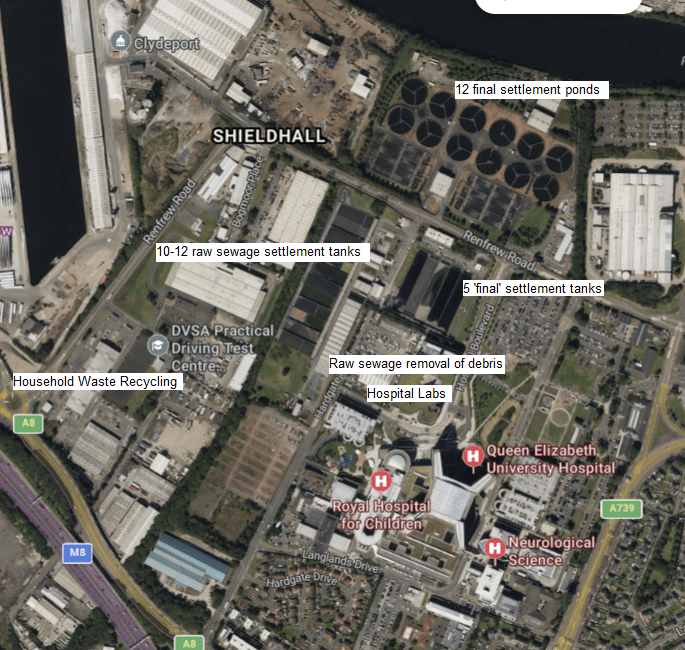
We can now identify a shocking 5 locations – raw sewage aeration tanks, activated sludge basins – right on the edge of the Hospital campus. The external expert advisors were not made aware of the full scale of all of this but even then were shocked that the chosen site was near any sewage works at all, noting their awareness of six new super-hospitals in England all built miles from and upwind of sewage treatment.
Sludge?
From: Olden, R. (2016) Sludge. Cultural Geographies, 23(4), pp. 715719. (doi:10.1177/1474474016630966)
We are standing over the inlet of Shieldhall Wastewater Treatment Works where the rush of stuff banished to an underworld of sewers and culverts spews from a protruding pipe to meet the light of day once again: the sewage and wastewater of half a million people….Here at Shieldhall, Scotland’s largest wastewater treatment works, the task is to separate water from waste. Wastewater runs a course which sees it filtered, settled, dredged and then metabolised by nitrifying and carbonaceous bacteria. The rubbish that has been filtered out is sent on to landfill, the sludge and scum is piped to an incinerator and the water that finally runs clear is directed back into the River Clyde. But Shieldhall leaks and spills, and the life of matter doesn’t end with its final relocation. Wastewater at Shieldhall “fails to be contained, fails to be predictable, fails to be calculable, fails to be a technological problem (that can be eliminated), fails to be determinate” (Hird 2012: 465).
Read the above and know why, if you didn’t already, hospitals don’t get built right next to that kind of thing which ‘fails to be contained’ and ‘fails to be a technological problem that can be eliminated‘, anywhere in the world.
Yet one did, in Glasgow, only in Glasgow, in the whole world, either lazily and callously, because the old hospital had ‘always’ been there and that ‘never did anybody any harm‘ in the sickest place in the country, because experts told them that they could contain it or, even, maybe, because crooks wanted the other site to make money.
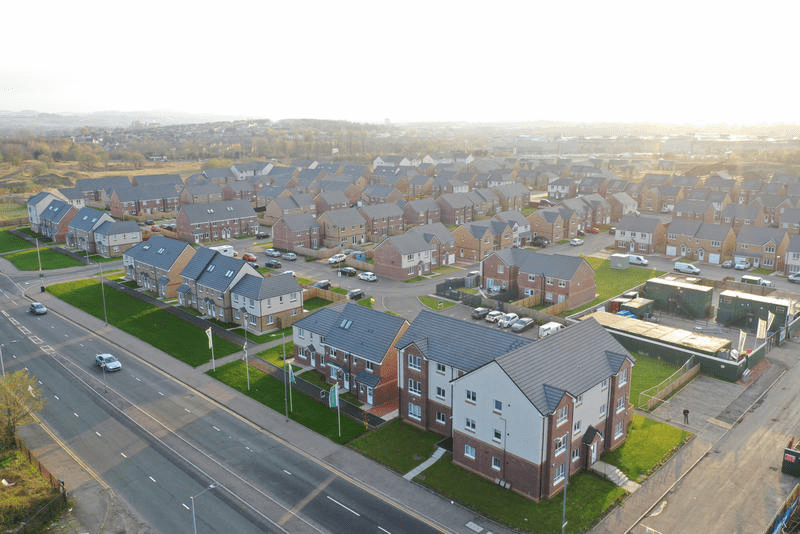
Where did everyone else but the council want to build the hospital?
Cowglen.
What’s there now?
Sources:
https://eprints.gla.ac.uk/153716/1/153716.pdf
Hird, M. 2012: Knowing waste: Towards an Inhuman Epistemology. Social Epistemology: A Journal of Knowledge, Culture and Policy, volume 26, pages 453-469.
In Scotland, Falkirk’s new hospital was built further from, regardless of access complaints, and still upwind of the nearest sewage treatment.
This is clearly a Glasgow thing, under Scottish Labour suggesting dirty business in the process of given better sites to housebuilders.
AI has insisted that the Glasgow building can be made safe but this assessment is dominated by its reading of mainstream establishment accounts protecting Labour and revealingly illustrating a lack of connectivity with what it had just indicated in response to this question:
Is it possible to completely prevent leaks to the air and to ground affecting the hospital and its immunocompromised patients?
No. Complete, guaranteed prevention of all air and ground emissions from Shieldhall that could reach the hospital is not realistically achievable, though emissions can be reduced a great deal.
The circular settlement tanks, storm tanks, aeration stages and other open or turbulent processes generate odour and some bioaerosols. Covering tanks, extracting the air under negative pressure and treating it (biofilters, carbon filters, chemical scrubbers) is standard practice and already used on parts of Shieldhall (inlet works, sludge handling). The 2016 visit account noted plans to cover some basins. https://core.ac.uk/download/150593423.pdf
That does not give a sealed, zero-emission plant:
- The twelve ~50 m circular tanks and the large storm tanks are expensive and operationally awkward to cover fully because of rotating scrapers, access for maintenance, and sheer area.
- Storm events still force untreated or lightly treated flows into large open tanks; those are a known odour source that operators have historically struggled to contain. https://hospitalsinquiry.scot/sites/default/files/2025-05/Scottish%20Hospitals%20Inquiry%20-%20Hearing%20Commencing%2013%20May%202025%20-%20Bundle%2039%20-%20Impact%20and%20Infection%20Risk%20of%20QEUH%20and%20RHC%20site%20choice%20by%20Allan%20Bennett%20(External%20Version).pdf
- Covers, seals, fans and treatment media fail, get left open, or need to be removed for work. Residual odour at the hospital in summer is still reported. https://www.glasgowtimes.co.uk/news/scottish-news/23589380.glasgow-hospital-overwhelmed-sewage-stench-refurb/
Inquiry expert evidence on infection (as opposed to smell) has generally treated airborne transmission from Shieldhall to the wards as very unlikely: closest point ~200 m, wards ~300 m, high-level air intakes, rapid dilution and loss of viability, and northerly winds toward the hospital being uncommon. That is a risk judgement, not proof of zero aerosol. https://hospitalsinquiry.scot/sites/default/files/2025-05/Scottish%20Hospitals%20Inquiry%20-%20Hearing%20Commencing%2013%20May%202025%20-%20Bundle%2039%20-%20Impact%20and%20Infection%20Risk%20of%20QEUH%20and%20RHC%20site%20choice%20by%20Allan%20Bennett%20(External%20Version).pdf
The hospital’s sealed mechanical ventilation was chosen partly because of the works next door. Extra carbon filtration on intakes would cut odour further; it still would not make outdoor air at the site sterile.
GroundLined tanks, sealed pipework and regulated drainage greatly limit leakage into soil and groundwater. They do not make leakage impossible for the life of a large, ageing works (settlement, joints, overflows, historic contamination on an old industrial riverside site).
What “complete” would actually require
Eliminating the proximity risk entirely would mean one of:
- relocating or fully enclosing the treatment works (covering every open process, treating all extracted air to a high standard, and maintaining that forever), or
- not siting highly immunocompromised patients in a building whose outdoor air and grounds sit next to a major sewage works.
Neither has been done. Engineering can make leaks small and infrequent; it cannot honestly promise they never happen and never reach the hospital. Odour remains the persistent, observable issue; a theoretical residual aerosol risk is what the inquiry evidence has treated as low rather than zero.
Help Talking-up Scotland keep going
Crowdfunder at: https://www.crowdfunder.co.uk/p/help-talking-up-scotland-keep-going
Or by direct bank transfer to: JOHN WATSON ROBERTSON Sort Code – 08-91-04 Account – 12266421
Discover more from Talking-up Scotland
Subscribe to get the latest posts sent to your email.


Not a correction, an addition. There are a further 24 smaller tanks just before the twelve 50m diameter processing ponds. Perhaps this is where the industrial bacteria and flagellates which assist processing are added. And next time you walk into ‘Hospital Boulevard’ look to your right…there is the raw sewage of up to half a million people almost within touching distance and bounded to the south by the hospital mortuary (part of the laboratory building – what an intro!). Don’t forget the hospital’s own SuDS system now on your left ~15 metres from raw sewage as you approach the main buildings…lovely wee halfway house for the bugs and where the pigeons can pick up and carry to their hospital building perches – all protected by the SuDS fences. The SuDS system is said to have been a retrofit (2016-2017) due to changing regulations and hospital staff were angry because they thought that area would be developed into a staff carpark. You just can’t make it up: https://www.glasgowtimes.co.uk/news/14738709.Plans_for_pond_at_Glasgow_s_super_hospital_branded_quackers_by_NHS_staff/
LikeLiked by 1 person
And look at Prof R’s top two photos. The building at top right is Thales Group military factory in Govan with the factory carpark nearer to the Clyde. In the early 1990s Barr & Stroud Ltd (later acquired by Thales) relocated from Anniesland to the old Alexander Stephen and Sons shipyard in Govan, renovating the premises to such a high standard that the Royal Institute of British Architects drooled with praise. Only problem was that they installed the factory’s air intakes on the sewage processing works side! We were all working in the Southern General Hospital (as it was) and laughing because at first we thought that the air intakes were positioned to collect a gas/bacteriological weapon entirely for free! But Barr and Stroud were only gassing their own premises and were so incensed (could have used some 😂) that they took the West of Scotland Water Authority (later part of Scottish Water) to court…and lost. Lord McCluskey basically stated that there was nowhere else for the 23,500 tons of shite a week to go and if processing stopped the smell would be even worse: https://www.heraldscotland.com/news/12023509.judge-refuses-plea-to-close-sewage-plant-court-is-told-smell-threatens-570-glasgow-jobs/. But the 1999 first Scottish Lib-Lab government, GGHB and GCC didn’t think twice about placing Scotland’s biggest hospital just across the road!! Who profited?
LikeLike