

By Mark E. Saunders of “The Scottish Minuteman” https://www.facebook.com/profile.php/?id=61575625542197
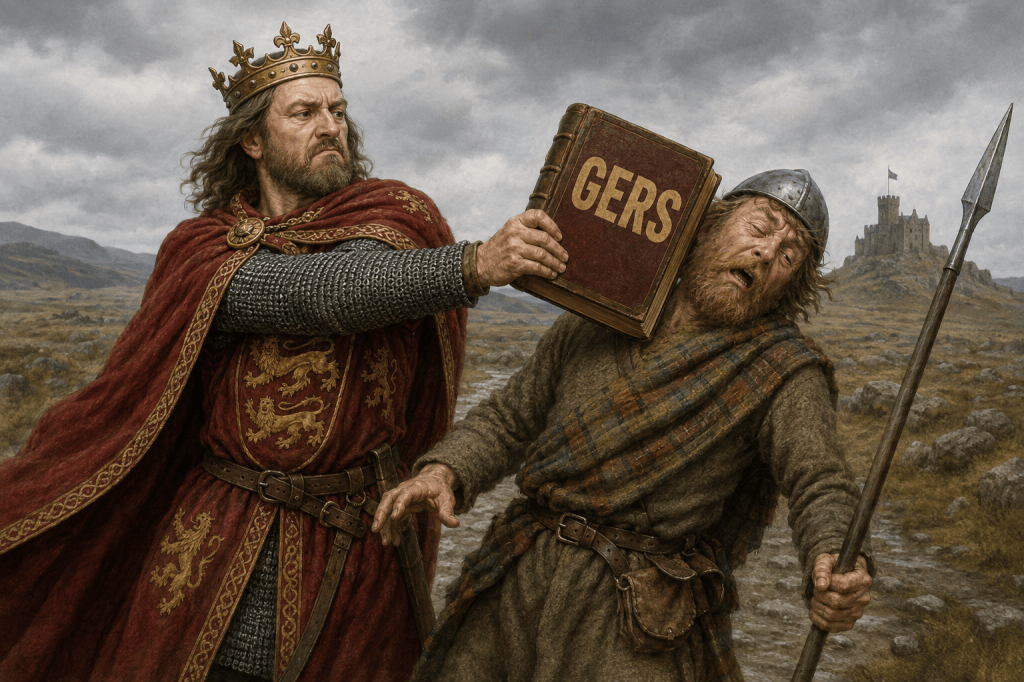
Every August, a report drops like a hammer — GERS.
The Government Expenditure and Revenue Scotland report arrives with the same ritual timing, and the same ritual headlines.
Scotland, we are told, is broke.
Scotland, we are told, is subsidised.
Scotland, we are told, cannot stand on its own two metaphorical feet.
I must admit, it is an interesting annual event. But I really don’t want to talk about the methodology of GERS, or the fact that 25 of its 26 figures are more guesswork than estimates. Those arguments have been made many times before by cleverer people than me — whether those arguments are well known to the public or well hidden from it is a separate problem.
But, whatever way you look at the published figures, GERS does not prove that Scotland has a crippling spending deficit. Nor does it prove that an independent Scotland would automatically be financially better off.
What it does demonstrate is arguably much more fundamental.
GERS describes Scotland’s fiscal position within the economic and spending framework of the UK as it exists today. It is not, and never has been, a set of accounts for a hypothetical independent Scotland.
Yet that distinction is often lost in the constitutional debate.
Union supporters and politicians treat the GERS ‘deficit’ almost as though it were an infallible financial statement saying: Scotland costs more than it raises, therefore Scotland cannot be independent.
Independence supporters and politicians, meanwhile, have responded by trying to dismiss or minimise the deficit altogether.
I think that misses the more interesting argument.
Neither approach really asks what GERS actually establishes.
Accept the figures. Then ask what they actually tell us.
If GERS is being used to argue that Scotland is supposedly too financially weak to be independent, then surely it also raises a much bigger question about the economic model within which Scotland has operated for decades.
It really begs the question: Can Scotland afford to remain part of the Union?
Or, more fundamentally: Is the economic model of the Union delivering the prosperity and fiscal sustainability that any country should reasonably expect?
If the answer is no, then GERS cannot, by itself, legitimately be offered as an argument for preserving the status quo.
It could just as legitimately be an argument for changing it.
There is also a crucial difference between saying “Scotland cannot afford independence today” and saying “Scotland could never build a financially sustainable independent economy.”
GERS cannot establish the second proposition.
GERS isn’t an independence balance sheet.
It is a picture of Scotland’s finances under the Union.
And that in itself doesn’t make GERS meaningless.
Quite the opposite.
It makes the question of what GERS is actually telling us far more important.
Because GERS doesn’t reveal that Scotland can’t afford to leave the Union. It actually reveals that Scotland can not afford to stay.
Discover more from Talking-up Scotland
Subscribe to get the latest posts sent to your email.


So why do the so called Scottish Government keep publishing this document. It chooses to do so
LikeLiked by 1 person
far as I know they are required to do so by law. EngUK law.
LikeLike
They could choose to refute it, but they don’t. Why?
LikeLike
When GERS was set up in the 1990s by then then Secretary of State for Scotland Ian Laing he wanted a political club to attack the SNP and chose measures which he knew would present the economy of Scotland as ‘unsustainable’ without UK support.
The Tories had form in this regard. In the early 1970s secondary education in Scotland, apart from the private sector was reorganised so that there was no selection and schools became comprehensives. When the Tories became the government in 1979 they began the process in England of opting out of local authority control. Towards the end of the 1980s they stepped up efforts to get schools in Scotland to opt out. Andrew Neill was in the forefront of this and got Mrs Thatcher to change the law in Scotland. The Secretary of State, Michael Forsyth, changed some of the criteria that were used by Her Majesty’s Inspectors to evaluate schools so that it was impossible for schools in areas of low socioeconomic status to be judged other than ‘unsatisfactory’. Although the Scottish Education did not adopt them, the mandatory publication of examination results led to the media in Scotland producing ‘league tables’ and, as was intended, schools in low socioeconomic areas were at the bottom. The intention was that middle class parents would take their children out of those schools and those whose children were in high league table schools would opt out so that they could exclude the ‘plebs’. Despite heavy propaganda led by ex Paisley grammarian, Andrew Neill, the parents of pupils at Paisley Grammar voted by a huge majority to remain a Renfrewshire Council School.
The majority of the population are savvy and can detect when politicians are trying to bullshit them.
LikeLiked by 4 people
No.
LikeLike
Basically they dont say exactly how much we raise, nor do they detail what exactly is spent on our behalf to create a notional debt. Any specific detail relates only to the collection of the minor devolved taxes excepting the portion of income tax. From the collection/expenditure it look like we get 7 per cent of the total expenditure which is down from 8 and 9 previously. Westminster withholds 85% for itself. And even that calculation is open to challenge as its based on so much guess work.
Sent from my Galaxy
LikeLiked by 1 person