


The Herald is owned by a corporation and serves the interests of that corporation including its preference for the stability of the UK within NATO.
The empirical evidence is clear and can be trusted far more than the Herald’s unconvincing claims:
Substantial empirical evidence from case studies, content analyses, and comparative work on these topics aligns with and supports the core predictions of Herman and Chomsky’s propaganda model. The model holds that structural filters (ownership, advertising, elite sourcing, flak, and ideology) systematically shape mainstream media performance to favor elite/state/corporate interests when those interests are relatively unified, limiting the range of debate and framing outcomes accordingly. It does not claim total uniformity or the absence of any critical reporting, but predicts patterned biases that are observable and testable. Evidence in industrial disputes (labor), taxation, and military interventions is among the areas most frequently cited as confirmatory.
Industrial disputes / labor coverage
Studies repeatedly document under-coverage, marginalization, or consumer-centric framing that disadvantages labor relative to management or elite economic interests:
- Network news and major papers devote minimal airtime/column inches to workers’ issues and unions. One analysis of 1989 coverage found only about 2.3% of network time on workers’ issues and even less on U.S. unions (excluding one high-profile strike). Domestic strikes against corporations often received less attention than comparable foreign ones (e.g., a major U.S. coal strike vs. a shorter Soviet miners’ strike). https://fair.org/press-release/fair-issues-new-study-on-media-coverage-of-workers-and-unions/
- Framing analyses of major 1990s labor conflicts (plant closures, airline and baseball strikes, UPS, WTO protests) show news routinely adopting a “consumer” narrative focused on inconvenience, prices, and availability rather than workplace conditions, class power, or citizenship issues. This submerged labor’s political claims. cornellpress.https://www.cornellpress.cornell.edu/book/9780801488870/framed/
- Broader patterns include emphasis on union corruption or leadership while downplaying rank-and-file conditions, and quiet cooperation with long-term anti-union campaigns by industry. These align with the model’s prediction that labor power challenges elite interests and therefore faces constrained or negative treatment when elite consensus exists.
TaxationContent analyses of major outlets show framing and sourcing that favor policies concentrating benefits at the top and under-represent majority public preferences for higher taxes on business/the wealthy:
- Coverage of the 2001 and 2003 Bush tax cuts emphasized putative collective benefits (economic growth) while downplaying or omitting the heavily skewed particularistic benefits to the top of the income distribution and the likely rise in inequality. This limited citizens’ ability to assess impacts on their own interests or broader values. https://www.researchgate.net/publication/241648841_The_Media’s_Role_in_America’s_Exceptional_Politics_of_Inequality_Framing_the_Bush_Tax_Cuts_of_2001_and_2003
- Quantitative assessments of New York Times and USA Today front-page tax coverage found consistent privileging of elite sources, near-absence of ordinary citizens’ voices, and misrepresentation of public opinion (which has long favored higher taxes on the rich/business even as policy moved the opposite way). Opposition to taxes was highlighted far more than support for progressive taxation. https://www.ineteconomics.org/uploads/papers/WP_73-Chomsky.pdf
- Related work on wealth-tax narratives in other high-inequality contexts finds anti-tax frames dominating. These patterns fit the model’s emphasis on ownership/advertising filters and elite sourcing that constrain debate within parameters favorable to concentrated wealth.
Military interventionsThis is the area with the densest body of paired comparative evidence originally developed by Herman and Chomsky and extended by others:
- Classic tests contrasted “worthy” vs. “unworthy” victims (e.g., extensive, indignant coverage of a murdered Polish priest under communism vs. minimal or matter-of-fact treatment of far larger numbers of religious victims killed by U.S. client regimes in Latin America) and elections (favourable framing of elections under terror in U.S.-backed states vs. skeptical treatment of those in adversary states such as Nicaragua). Volume, tone, and detail tracked geopolitical alignment far more than objective severity or democratic quality. https://en.wikipedia.org/wiki/Manufacturing_Consent
- Indochina (Vietnam, Laos, Cambodia) coverage was shown to operate within elite consensus assumptions about the legitimacy of U.S. goals, with criticism largely limited to tactics or costs once elite opinion fractured, rather than fundamental illegality or aggression. Similar patterns appear in later cases (Gulf War, 2003 Iraq invasion), including disproportionate reliance on pro-intervention official sources, under-emphasis on legality or peace offers, and amplification of enemy atrocities relative to those of the U.S. or allies. https://en.wikipedia.org/wiki/Western_propaganda
- Quantitative tallies (e.g., use of the term “genocide”) and source counts further illustrate dichotomous treatment keyed to whether the perpetrator was an official enemy or a client/ally. Later applications to other interventions have produced consistent results supporting the model’s predictions when elite consensus is strong.
The above research evidence is confirmed in the Scottish context be out numerous exposés :
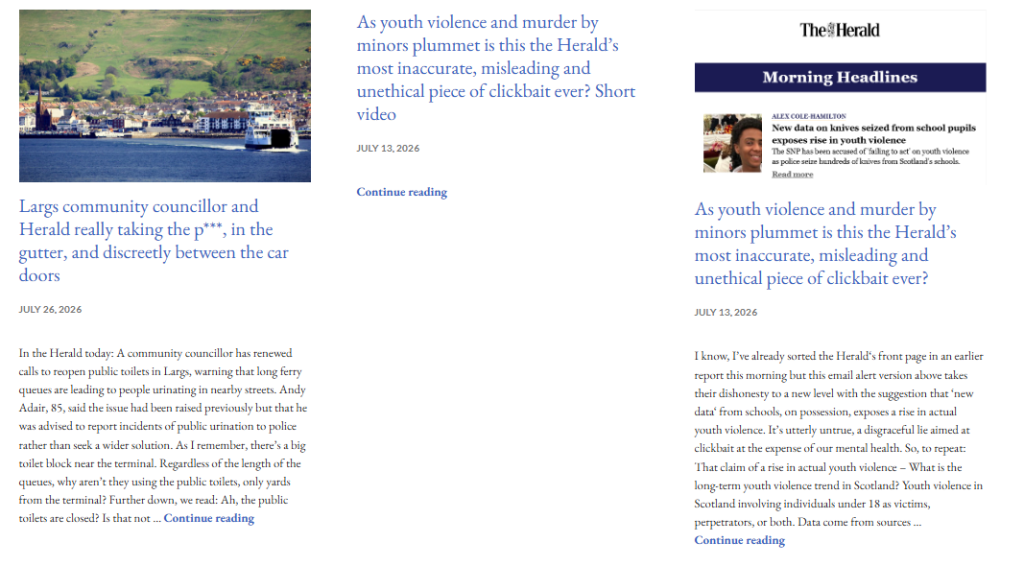
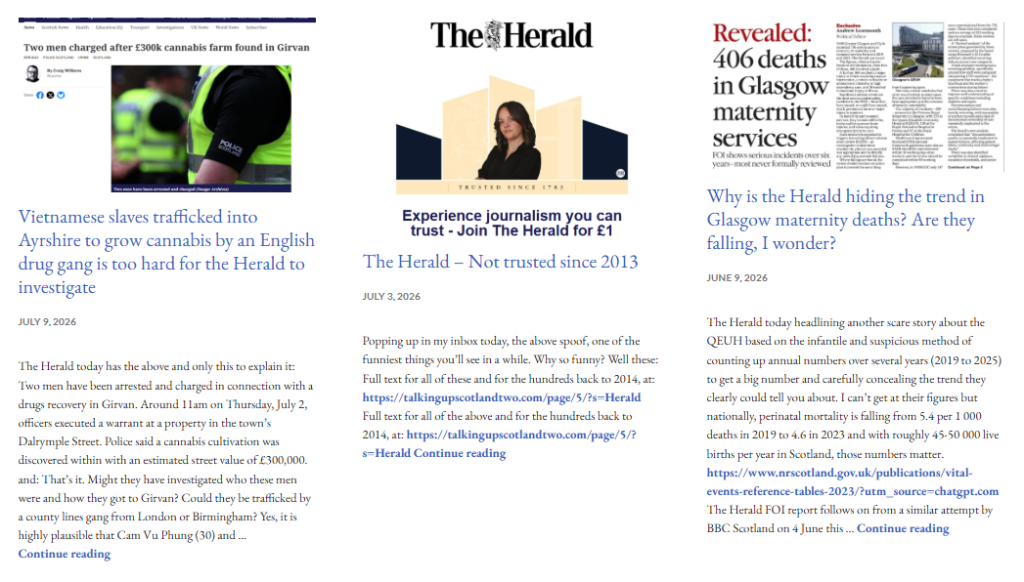
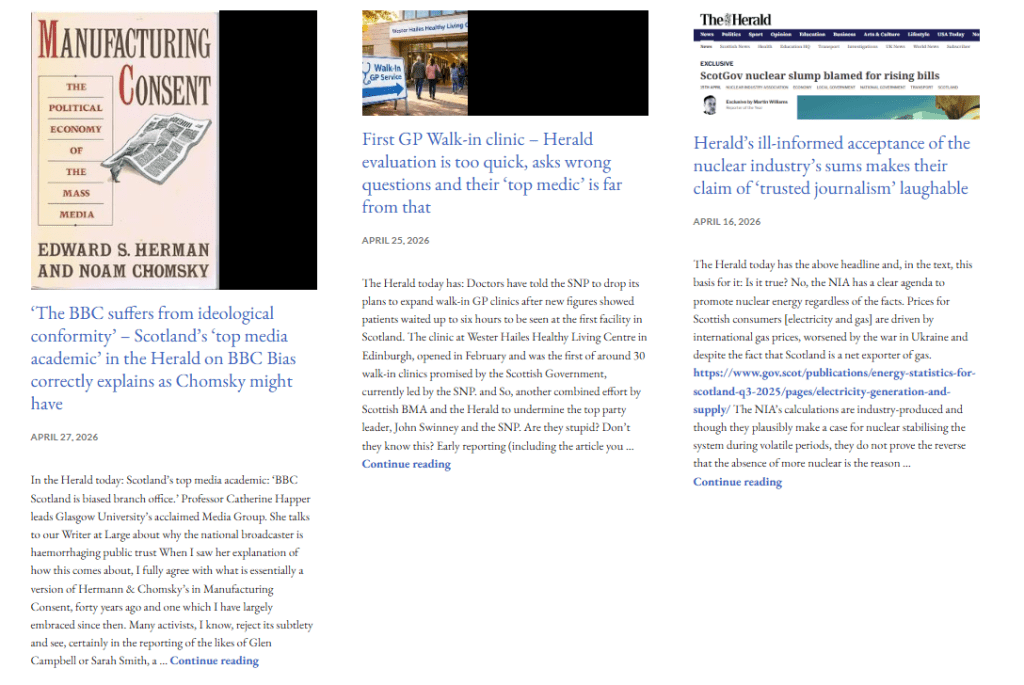
The above and umpteen others at: https://talkingupscotlandtwo.com/?s=Herald
Discover more from Talking-up Scotland
Subscribe to get the latest posts sent to your email.


The colonial nature of the Scottish media is worth writing a book about – hint! Most of them first published after Culloden and during the long process of destruction of the Scottish culture – still ongoing. The P&J first emerged in 1747.
LikeLike
Murray Pittock!
LikeLiked by 1 person
I thought you would be an excellent candidate with your research and presentation skills! Although where you would find the time….?
LikeLike
Hi, the fb share button is not working.
LikeLike
It is, on my elderly PC
LikeLike