

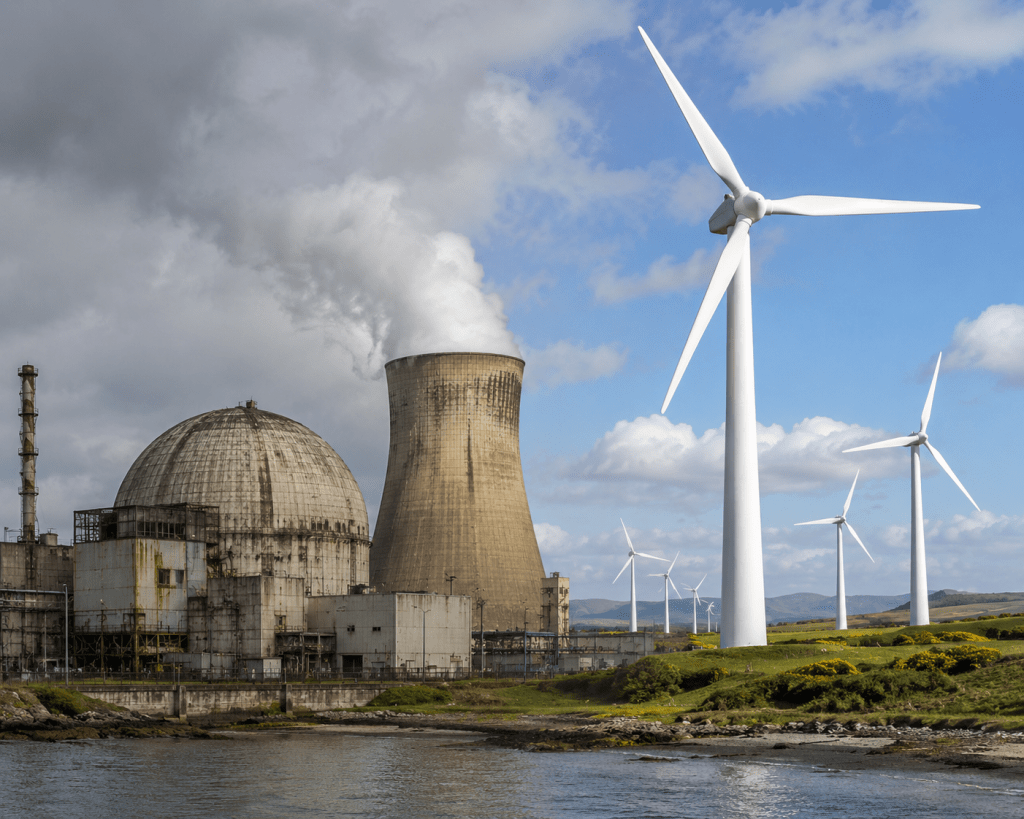
From Nuclear and offshore wind energy comparison information: EIR release – Information request and response under the Environmental Information (Scotland) Regulations 2004, published today:
Information requested
All internal briefings, analysis and minutes/notes from meetings, comparing nuclear energy and offshore wind energy, from the last three months.
Response
Some of the information you requested is available from the Office of National Statistics (ONS) Low Carbon and Renewable Energy Economy Publication. The publication provides estimates of the size of the UK’s low carbon and renewable energy economy, including turnover and employment. Data is available for nuclear, and offshore energy. The latest publication can be found at the following link:
https://www.ons.gov.uk/economy/environmentalaccounts/bulletins/finalestimates/latest
Additional information – that was found in emails and briefings – can be found below. Please note that this material reflects the best information held at the time.
Email Extract 22 January 2026
- Nuclear power has proved significantly more expensive than renewables. In 2024’s allocation round, Hinkley Point C’s strike price of £92.50 per MWh was over 40% higher than the onshore wind price of £64 per MWh and 27% higher than offshore wind at £73 per MWh.
- The UK Government’s own levelised cost analysis in 2023 – which accounts for the full lifetime costs of building, operating, and decommissioning power plants – shows new nuclear at £109 per MWh is nearly three times more expensive than onshore wind at £38 per MWh and more than double offshore wind at £44 per MWh.”
Briefing Extract 22 January 2026
- “Nuclear power has proved significantly more expensive than renewables. In 2024’s allocation round, Hinkley Point C’s strike price of £89.50 per MWh was nearly 40% higher than the onshore wind price of £64 per MWh.
- The AR7 offshore wind strike price in Scotland of £89 per MWh reflects the continued investment in research and development by offshore wind developers as they push technological boundaries. Offshore wind is a relatively new and rapidly advancing technology while nuclear remains stubbornly expensive despite being a mature technology that’s been developed for over half a century.”
Source: https://www.gov.scot/publications/foi-202600511058/
Discover more from Talking-up Scotland
Subscribe to get the latest posts sent to your email.


As far as Scotland is concerned, I think the economic case for small modular reactors is invalid. We are producing several times our national electricity requirements from renewables.
Yes, I know the sun does not shine at night and there are periods when wind in some parts of the country is not blowing hard enough, but the nuclear loonies tend to exaggerate these issues. Hydro can still operate, as can tidal sources and, given the entire territorial area of Scotland, it is unlikely there is no wind anywhere.
Battery technology is improving by leaps and bounds and the cost of batteries and solar panels has fallen greatly, while the efficiency of these technologies has improved. Batteries have depended on supplies of Lithium, but, immediately below Lithium in the Periodic Table and in the same family is Sodium. While Lithium is not available in Scotland to any great extent, Sodium is in the trillions of litres of seawater around our coast. Sodium battery technology is developing rapidly, because of its plentifulness. Although Sodium burns, as Lithium does, the fire is not as fierce, so Sodium technology becomes more attractive and can be based on local sourcing, creating local industry. With better storage solar and wind derived energy can be available at night and on balmy days.
We can also embark on a major programme of retrofitting our tenements so that residents require less energy. New builds are already employing passivhaus methods and installing air source heat pumps and solar panels.
Lastly, we should discontinue the current National Grid arrangements and pricing structure and move to local pricing, including community involvement in local energy generation, either profits distributed for the common, community good.
LikeLiked by 3 people
Absolutely agree. It is also a fact that Scotland and the UK and the EU exist in an energy market, where excesses are exported and deficits are imported. Scotland exports much more than it imports and yet pro-nuke propagandists insist we have nuclear power.
It is forgotten these days that Torness was originally commissioned to provide electricity for England, and to give work for the nuclear industry. New nuclear in Scotland would be for exactly the same reasons. We pay, they use. They benefit, we don’t.
The excuse for SMRs (according to the Minister), is to re-industrialise the Midlands………ever hear Wee Dougie propose to re-industrialise Scotland?
gavinochiltree
LikeLike