


The Times today is front-paging a story of a floor-cleaning fluid and the apparent lack of clear instructions on its use. Staff have been ‘offered the chance to speak to occupational health.’
Disturbing, I agree. Something should be done, I agree but front page on a major newspaper?
Is it there, only because the hospital in question has been subject to repeated, ill-informed, hyperbolic, claims from Scottish Labour and associating it with the current SNP Government?
Using real, important, data, just how good is the QEUH and compared to other hospitals across the UK not, it seems , ‘scandal -hit?’
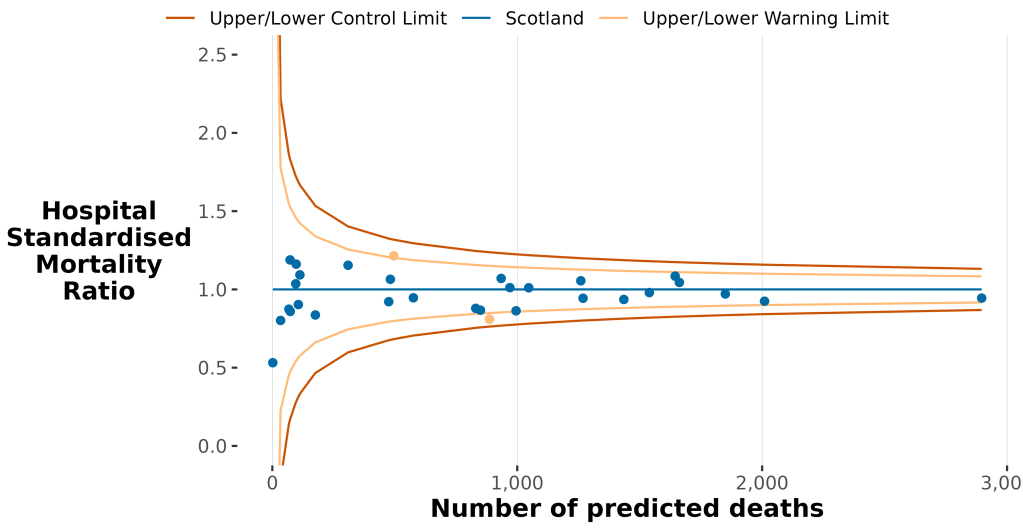
From Hospital Standardised Mortality Ratios January 2025 to December 2025 published today, the above chart and:
No hospitals had a significantly higher standardised mortality ratio than the national average.
HSMR acts as a signal, highlighting hospitals where mortality is higher or lower than predicted. This prompts hospitals to review their care processes, check for possible issues and identify areas for improvement.
In Scotland, the national HSMR is set at 1.00. A hospital with an HSMR less than one has fewer deaths observed than predicted within 30 days of admission, whereas an HSMR greater than one indicates more observed deaths than predicted in the same period. https://www.publichealthscotland.scot/publications/hospital-standardised-mortality-ratios/hospital-standardised-mortality-ratios-january-2025-to-december-2025/
The above funnel chart allows the presentation of hospitals with widely varying sizes on one illustrative image. The blue dot at the extreme right is the so-called Queen Elisabeth University Hospital in Glasgow and those to the left are the tiny ‘county’ hospitals such as those in the Borders and the Western Isles. The QEUH had an HMSR of 0.94 and 200 fewer deaths than predicted. The QEUH has had this level for years now and is thus, objectively, not ‘troubled’ , as much as Anas Sarwar and Scottish Labour might wish it was.
Things are very different in England, with a clear postcode lottery:
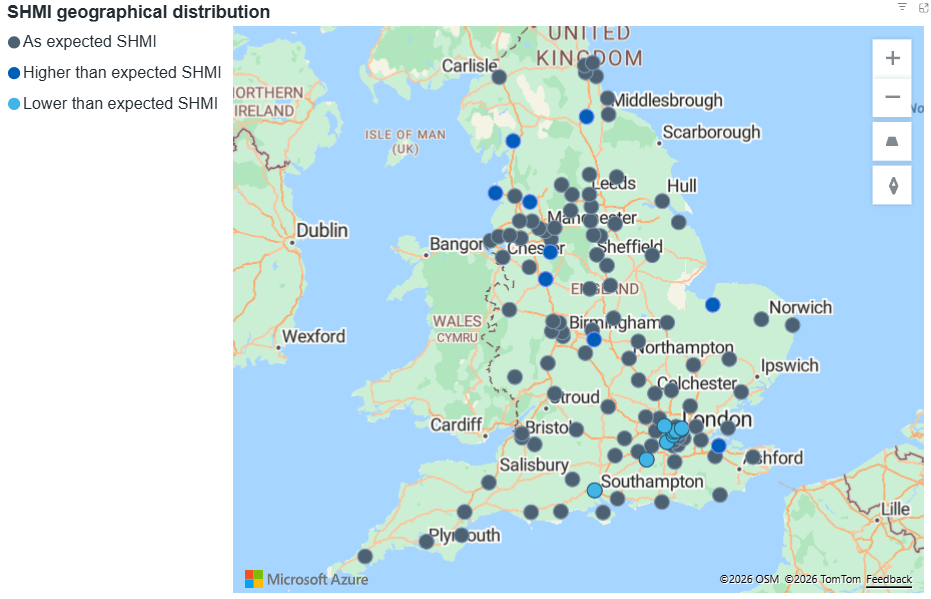
Look above at the clustering of high high mortality (mid blue) in the north and of low mortality (pale blue) in the more affluent south.
Look below at the 10 English hospitals with significantly higher, above 1.2, mortality rates:
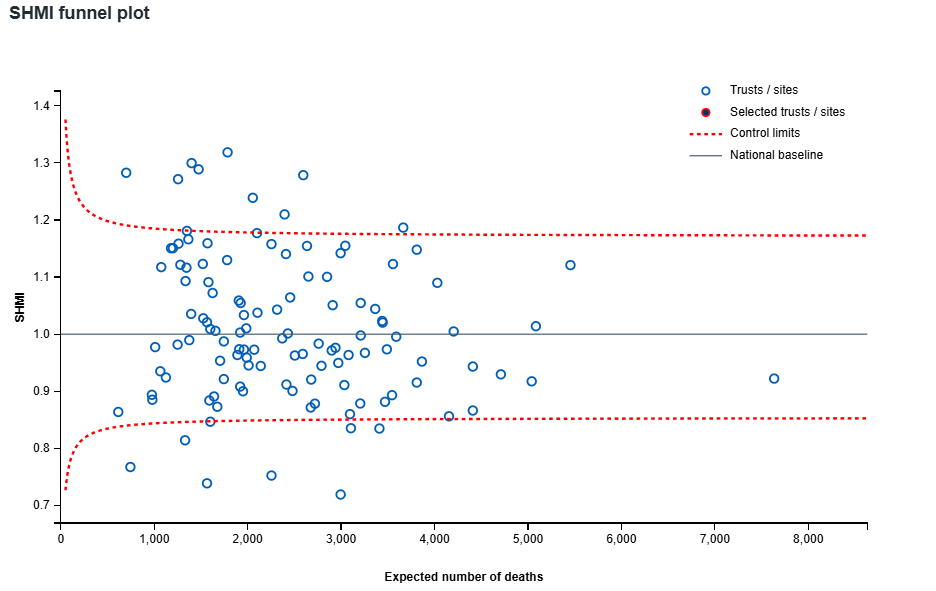
Blackpool, 1.31, had 600 more deaths than predicted. Medway 1.29, had 400 more deaths than predicted. All ten are in the North other than one in Norfolk and one in Coventry.
While, in Scotland, you need not worry where you are treated, there are hospitals in England you might want to avoid.
Source: https://digital.nhs.uk/data-and-information/publications/statistical/shmi/2026-04
Discover more from Scotland's First and biggest Rebuttal Service -Talking-up Scotland
Subscribe to get the latest posts sent to your email.
 Scotland's First and biggest Rebuttal Service -Talking-up Scotland
The QEUH campus is enclosed on two sides by sewage plants – the Waste Water Treatment Works (WWTW) to the north across Renfrew Road and the almost equally large Shieldhall Waste Transfer Station (SWTS) directly contiguous with the QEUH campus to the west and in plain sight as one walks along the Hospital Boulevard! SWTS receives vast quantities of raw sewage now including waste from the Shieldhall Sewage Tunnel and removes unprocessable material before passing raw sewage to the interconnected WWTW. The QEUH should have been sited at the former Cowglen Hospital but Greater Glasgow Health Board (GGHB) all but ignored the results of its own consultation during April to September 2000 and received approval from successive Scottish Labour Health Ministers, the official sign-off being given by Malcolm Chisholm in 2002 (http://news.bbc.co.uk/2/hi/uk_news/scotland/2188390.stm). It would be nice to see Anas Sarwar acknowledge this – his father Chaudhry Sarwar was MP for the area (1997-2005) and all decisions regarding the siting of the QEUH and RHCG had been completed before Labour left power in 2007. It is not clear how deals were conducted with the house builders at Cowglen…does anyone know?
LikeLiked by 2 people
I am certainly no expert on the best location of new hospitals and never will be, but being close to a sewage plant and I believe a new incinerator being built over the M8 is not, in my mind the best place for that hospital.
However, one thing we can be sure is that the “Scottish” media will brand this as an SNP failure, even though the decision to build it there in the first place was Labour.
Imagine paying £3.20 for a printed copy of the Times!
Stephen McKenzie
LikeLiked by 2 people
While prevailing winds take the sewage aerosol and smell over the hospital and beyond, the incinerator is south of the hospital and will tend to waft any emissions over the Southwest Glasgow population accompanied by sewage aerosols, but less frequently over the hospital campus itself. Try this Australian systematic review paper for the effects: https://www.sciencedirect.com/science/article/pii/S132602002300732X “A range of adverse health effects were identified, including significant associations with some neoplasia, congenital anomalies, infant deaths and miscarriage, but not for other diseases.” But I am sure this doesn’t apply locally 😜. Read Tom Makin’s prepared statement and Q&A at the Scottish Hospitals Inquiry about his shock regarding the works themselves and the sewage aerosols. The sewage works were first constructed next to Merryflats Poorhouse (as QEUH campus was then) in 1910 – who gave a s*** about a Poorhouse – then extended around 1980 and the Shieldhall Sewer Tunnel contents added in very recently. Plus the Victoria Infirmary and RHSC Yorkhill have closed so even if you can afford to pay VAT-free charitable institutions, sorry, Private Hospitals and their Consultants moonlighting from the NHS to treat any profitable conditions you have (you can forget the serious unprofitable stuff)….rich or poor, we’re all in the Poorhouse now.
LikeLike
The hospital in where the Southern General Hospital was for over 100 years.
LikeLiked by 1 person
Merryflats Workhouse/Poorhouse was build in Govan between 1867 and 1872. The poorhouse included a hospital site which was expanded and was renamed the Southern General Hospital (SGH) in 1923. The Poorhouse itself fully closed in 1936 leaving only the hospital which became part of the NHS in 1948. Presumably no-one who had a say cared about the opening of Shieldhall sewage works across the road from the poorhouse in 1910. The Poorhouse hospital site is still there, the former general medical unit of the SGH and now the campus admin block, 159 years after the building of the Poorhouse commenced https://portal.historicenvironment.scot/apex/f?p=1505:300:::::VIEWTYPE,VIEWREF:designation,LB33307
LikeLike
Interesting that it is an “SNP Hospital”, not NHS Scotland or Greater Glasgow and Clyde Health Board Hospital, but SNP.
it was authorised by the previous Labour Government at Westminster and work commenced under the LabLibDem Coalition at Holyrood and Labour had a huge majority of Glasgow City Council.
LikeLiked by 1 person
But what deals went on from the largely ignored GGHB ‘consultation’ in 2000 until the building of the large housing estate on the rejected Cowglen Hospital site including the demolition of the amazing National Savings Bank building which it was said could not be demolished…until it was https://www.glasgow.gov.uk/media/1337/Cowglen-Spatial-Masterplan/pdf/Cowglen_Spatial_Masterplan_-_final_version_220611.pdf?m=1666947339887. Does anyone have info…?
LikeLike
Persimmon seem to have been the main housebuilder and they’re planning to add another 140 homes at Boydstone Road to the 500 or so they’ve built in the area since 2016.
LikeLike