

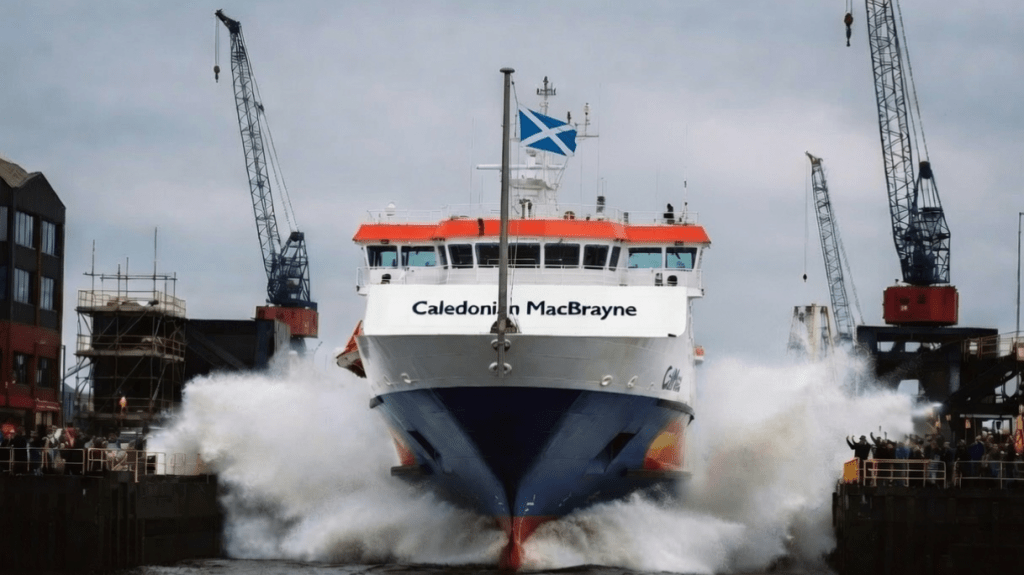
From BBC Scotland today:
CalMac’s newest ship – the Turkish-built MV Isle of Islay – is to be withdrawn from service for repairs later this month, just 15 weeks after carrying its first passengers.
The roll-on roll-off ferry entered service on 31 March, but six weeks later a hinge problem with its bow doors meant it has had to operate “single ended” ever since.
The issue is understood to be the only “big ticket” item out of about 150 lesser problems that CalMac wants fixed under warranty. Separately, Scotland’s state-owned ferries body is trying to establish if three other CalMac ships being built at the Cemre shipyard will be further delayed because the firm is facing economic challenges.
The second ship in the order, MV Loch Indaal, was due about now, nearly 18 months later than the contracted delivery date, but Caledonian Maritime Assets Ltd (CMAL) could only confirm that the ship is still expected this year.
A spokesperson said: “CMAL is working at pace with Cemre Shipyard, Transport Scotland and CalMac to confirm a full project timeline.”
You see what is going to happen here – 5 run-of-the-mill boats that could easily have been built on the Clyde are going to have to be finished off and sorted-out, at great expense, somewhere else. They should all be towed to the Clyde and the money that might have been spent elsewhere with little guarantee of success, used to expand the nationalised yard.
The full story:
From the UK Defence Journal 26 June 2026, indicating the kind of broader definition of national security, we hear more of today:
Caledonian Maritime Assets Limited has taken ownership of the three remaining vessels under construction at the Cemre Shipyard in Turkey as a precautionary measure to support their completion and delivery, the publicly-owned ferry operator stated.
The three ships, MV Loch Indaal, MV Lochmor and MV Claymore, are now assets owned by CMAL ahead of their formal handover. According to the organisation, the decision has been taken against the backdrop of what it described as exceptionally challenging economic circumstances affecting Cemre and many businesses across the region, with global economic pressures including the impacts of the conflicts in Ukraine and Iran, together with disruption to shipping in the Red Sea, all contributing to the situation. By transferring ownership of the vessels ahead of formal handover, CMAL has said it is acting to protect the project and to ensure the continued delivery of much-needed ferries for Scotland’s island communities.
https://ukdefencejournal.org.uk/cmal-takes-early-ownership-of-three-calmac-ferries/
These are straightforward vessels of the kind Clyde shipyards have historically delivered on time. The so-called ‘ferry fiasco’ beloved of the MSM operating in Scotland is entirely a consequence of first-time projects to build hybrid dual fuel vessels.
Scottish yards have a long history with complex vessels (including naval and offshore work). The Ferguson experience shows what happens when capability has atrophied after limited recent large commercial ferry work, combined with ambitious specs. With the yard now state-owned, a stable pipeline (recent direct awards for four vessels announced in 2026), and lessons learned, future performance on less pioneering projects could improve markedly. Supporting domestic capacity builds resilience and skills for exactly these kinds of challenging builds.
‘Turkish Delay’ – Costs and timescales could worsen further for these three ferries (MV Loch Indaal, MV Lochmor, and MV Claymore).
Why?
Regional and Turkish economic instability shows little sign of quick resolution:
- Ongoing fallout from conflicts (Iran-related tensions, Red Sea/Hormuz disruptions, Ukraine spillover) continues to drive high energy prices, freight/insurance costs, supply chain volatility, and inflation.
- Turkey’s broader economy faces lira pressure, higher import costs (energy/raw materials), and tighter financial conditions, which strain private yards on fixed-price legacy contracts.
- Near-complete vessels still need components, labour, testing, certification, and outfitting. Persistent issues could slow suppliers, raise input costs, or reduce yard efficiency (e.g., cash flow problems affecting workforce or subcontractors).
If instability persists or escalates, this could translate into:
- Additional months-to years of slippage, especially for Lochmor and Claymore. CMAL would likely need to finance or arrange completion, potentially moving unfinished work elsewhere.
- Extra overruns borne by CMAL/Taxpayers, beyond the original contracts, which are now effectively paid in full via early ownership. This could include higher finishing/commissioning expenses, transport/logistics if vessels are moved, or incentives to keep the yard viable.
If instability persists into 2027 as seems certain, cumulative effects could push timelines out further and add meaningful costs with potentially millions more per vessel.
Discover more from Talking-up Scotland
Subscribe to get the latest posts sent to your email.


The ferry contract being awarded to the Turkish yard is a consequence of the mendacity associated with ‘competetitive tendering’, which, often, ends up as ‘what is cheapest’.
When the contract was awarded to the Turkish yard, the right wing and unionist press crowed that this was because the tactics of ‘trade union bully boys’ in the Scottish yards had made them unsustainable.
But, as you point out, the demise of the Scottish yards on political grounds because ‘these fuckin Jocks keep voting for socialism’ led to a loss of centuries of skill. The ship designs by the Scottish yards in 1980/90s were not as the Tories lyingly claimed, ‘out of date and not fit for purpose’. It was an excuse to close the yards as part of the Tory plan to eviscerate heavy industry in the UK. (It was not just Scotland which suffered, in the quest to maximise profits for posh boys.)
When the Clyde yards closed, the South Korean Government bought the entire design book and recruited ex shipyard works to start the South Korean shipbuilding industry and from this, the multinational giant Hyundai emerged.
LikeLiked by 1 person
‘ …. is a consequence of the mendacity associated with ‘competetitive tendering’, which, often, ends up as ‘what is cheapest’.
I have a very vague memory of Thatcher saying something along the lines of ‘the most expensive tender does not necessarily mean it will give the best result’. Which equated to ‘just go for the cheapest. It’ll do just as well’. And that has been the philosophy ever since. She was busy privatising everything at the time.
Most of us ordinary householders tend to know better.
J & J
LikeLike
Shipbuilding in Scotland started to decline in the early decades of the 20th Century. At the end of WWII 18% of the World’s ships were built in Scotland. By 1958 that 18% had reduced to 4.5% and some German yards could build ships in half the time it took Scottish yards.
In the 1960s around 12 yards closed on the Clyde and more than half were closed during Wilson’s time as PM. In the late 1970s Callaghan’s Gov nationalised shipbuilding in the UK.nthere were only 6 ship yards in Scotland left to be nationalised: 1 in Aberdeen, 1 in Dundee and 4 on the Clyde.
So Labour was just as implicated in the demise of shipbuilding in Scotland as the Tories.
LikeLike
South Korea started their modern shipbuilding in 1970. In 1972 they started to build what was then one of the largest ship yard in the World. There they started to build super tankers. The S Koreans had sent engineers etc to Scotland about that time, early 1970s, to find about ship design and took that knowledge back to S Korea. Their main cooperation/partnership when it came to shipbuilding was with Japan.
Labour has fostered the idea that Mrs Thatcher was responsible for the demise of Scottish Industry but Labour was every bit as culpable and even more so since they had two periods in power before Mrs Thatcher became PM when they did little to stop the decline.
LikeLiked by 1 person
Undoubtedly, shipbuilding on the Clyde has ups and downs during most of the 20th century. Much had to do with the failure to invest in modernizing the yards, and also generally bad industrial relations.
Yes, there had been shipbuilding development in Asia during the 20th century. My father remembers, Japanese engineers coming to the yards as early as the 1920s.
My point about Hyundai was based on an exhibition my wife and I saw at the Pompidou Centre around 2000. It was promoted by the Government of South Korea. The Tories had been spreading the mendacious tale that the designs by UCS were not the kinds of things modern shipping needed and that the tradesmen did not have modern skills. The right wing media promoted this lie. As I said, the South Koreans bought the entire design book, invested in a completely new shipyard in the small fishing village of Hyundai and recruited redundant Clyde shipyard workers to train local staff.
And the ship designs which Thatcher claimed were out of date, were built and were bought by shipping companies. Hyundai developed into the huge company today which produces cars as well as ships.
The purpose of this site has been to debunk the unionist narrative that Scotland and Scots ‘are not very good and incapable of running things for themselves’. Decades of this deprecating narrative had conditioned many Scots to have low self esteem. The Hyundai story gave the lie to the ‘Scotland is rubbish’ narrative.
LikeLike
In 1971 the Hyundai collaborated with Scott Lithgow and used the designs of Scott Lithgow vessels to kick start their shipbuilding industry. In the late 1970s the newly established Daewoo conglomerate collaborated with Scottish naval architecture firms in the design of ships for their new venture.
The newly formed S Korea ship building companies did buy the designs of Scottish yards that had closed in the ’70s. They also collaborated with Scottish shipyards that were still operating such as Scott Lithgow in the design of ships.
But as I said by the time of nationalisation in 1977 there were only 6 yards left in Scotland
All of that happened before Mrs Thatcher came on the scene.
Industrial relations and the effect they had on ship building was certainly a factor in the decline of shipbuilding and that had a huge impact as I touched upon. The boom in building ships in the immediate aftermath of WWII saw 18% of the world’s ships being built in Scotland by 1958 that had fallen to 4.5% and some German yards could build ships in half the time it took Scottish yards. That information is covered in one of Prof Devihe’s books.
That fall continued and was in large part due to poor industrial relations and failure to modernise work practices. This failure to take full advantage of modern work practices especially when it came to pricing would result in further closures when global pricing became more competitive.
LikeLike
Every problem seems to have the same root. We have no industrial strategy for any part of the base we need as an independent country. The Scottish Government and the inept Civil Service continue to use sticking plaster rather than a complete rebuild from the bottom up.
Do they actually know the naval capabilities of the firms in this country? Do we have firms, maybe not on the Clyde who could service the ferries, make parts in advance for older ships so there replacements are at hand, not a six month wait. Have they canvassed what they would need in terms of supporting, opportunities for training as a maritime nation, we will need those skills for decades.
The construction of the Ferry Companies and Transport Scotland are as flawed as the ferries, no Naval Architects, Naval Engineers, No Consumers.
Every area has no plan to engage and build. Does no one in power know that each individual part needs to be properly, designed, built and installed before a design will work. There are historical data which shows how that can be achieved. Attlee and Beaverbrook had most of the small engineering firms build the parts for the war machine so there was no knockout blow.
As an aside: So many small bridges in this country are closed, why has no one in authority thought about the modern military equivalent of the Bailey Bridge or better still have a publicly owned company build standard two lane wide precast bridges which could be assembled on site. It’s not difficult.
George Caldow
LikeLike
Westminster loses £Billions on Defence Contracts. They are not delivered. Out of date before they are delivered. Then another project is started,
Brexit means no defence shared with the EU. Now more expensive. Trident and redundant weaponry losing £Billions.
LikeLike
Norway builds over 100 vessels a year. Supply boats, trawlers, liners etc.
LikeLike
Japan and Germany both prospered by not being allowed to spend on rearmament after second WW.
LikeLike