

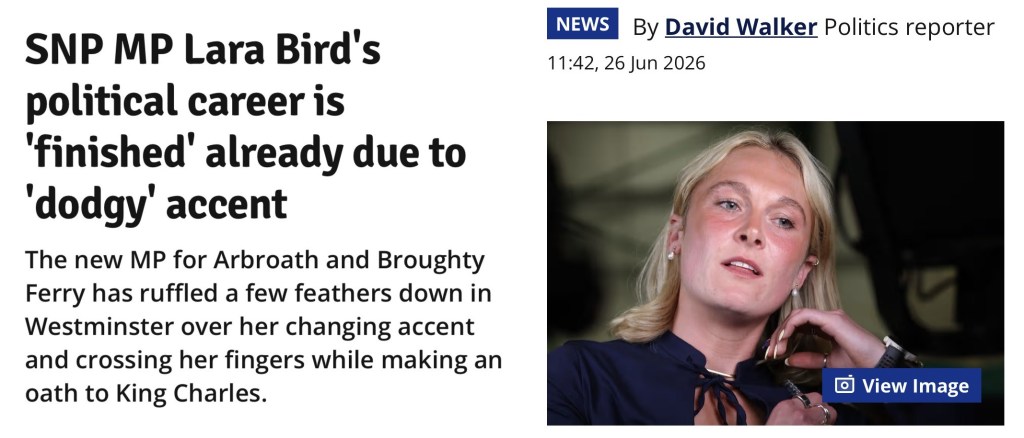
By Mark E. Saunders of “The Scottish Minuteman” https://www.facebook.com/profile.php/?id=61575625542197
When we read through today’s article abovefrom The Daily Express, it appears to be little more than comedy gold worthy of Armando Iannucci. Read it in the context of Scottish history, however, and it becomes something rather more sinister.
The debate is supposedly about authenticity. But authenticity measured by what? Policy? Integrity? Competence? No. Pronunciation.
For centuries, the British state understood something that many modern commentators of the British experiment often overlook: language is power.
Following Culloden, the assault upon Scotland did not end with disarmed clans and outlawing highland dress. It continued in classrooms, churches and courts. Gaelic — and Scots speech more broadly — became associated with backwardness. English became the language of advancement. Success increasingly meant sounding less like your forebears and more like the new centre of power.
Few of us realise that Scots were once beaten in classrooms for speaking Gaelic — even when it was the only language they knew. Children were humiliated, punished and taught that the sound of their own voice was something to be corrected rather than cherished.
Those laws are long gone. Those punishments belong to history. But history rarely leaves empty-handed. It leaves habits. It leaves expectations. It leaves an instinct — often unconscious — that some voices sound educated, authoritative and respectable, while others require explanation or invite suspicion.
And here lies the absurdity.
Scotland was once told that its language, its customs and even its identity were obstacles to progress. The Scottish voice was something to be softened, corrected and made acceptable. “Talk properly,” our mothers and fathers used to say — especially in our beautiful West Coast.
Yet when the echoes of that history remain — when people naturally move between the different worlds created by that pressure — the very ambiguity produced by it becomes a target — a source of ridicule.
Scotland cannot win. Change too much, and you are accused of losing yourself. Remain too much yourself, and you are treated as something to be closely watched.
The British Empire’s greatest achievement was never simply changing laws. It was demanding conformity.
Once, conformity was enforced by statute. Today, it is enforced by ridicule. Yesterday the schoolmaster corrected your language with a swift rap across the knuckles. Today a British run newspaper questions your authenticity. The methods are different; the result is familiar.
Language, dialect and accent have always been more than sounds. They are markers of belonging and something of which to be proud. Any nation would express a similar belief.
The irony is that a society which has spent centuries encouraging Scots to soften, alter or abandon aspects of their very identity now finds endless fascination in deciding who sounds Scottish enough.
The article sets out to ridicule one person. Instead, it accidentally exposes something much older: that the struggle for Scotland’s unique voice did not end when laws changed.
The Draconian laws of old may have disappeared. The knee-jerk reflex they created remains.
Discover more from Talking-up Scotland
Subscribe to get the latest posts sent to your email.


I well remember being chastised by my mother for “not speaking properly”.
LikeLiked by 4 people
As a native speaker of Shaetlan, now recognised as Scotland’s third language, with its multilingual vocabulary and Norse rooted grammar I can confirm that the knee jerk reaction from Scots who apparently speak the King’s English is stronger than ever.
LikeLiked by 4 people
Sad though, isn’t it.
LikeLiked by 3 people
I have had to point out to several people that Scotland has three ISO recognised languages and that English is no more one of them than it is in any of the myriad of countries that use English as a common language.
LikeLiked by 3 people
When I was a youngster , I remember being told that we must speak ”the Queen’s English” . Did anyone ever speak like the late Queen ?
She was privately educated with an accent that invited parody ! Even the arse-lickers around her didn’t speak in the same accent .
Trying to speak like her in the East-end of Glasgow was a recipe for a ”doin’ ” !
LikeLiked by 4 people
Dinna fash yersel!
LikeLiked by 3 people
Having never heard of Lara Bird until after she was elected, I decided to follow her on Facebook to find out more. I almost regretted doing so after the half dozen or so of her posts – due mainly to the avalanche of vitriol and downright disgusting comments posted by angry unionists – angry over her apparent multiple accents as well as her finger crossing in Westminster when being sworn in, with many calling for removal.
As well as the usual suspects – some Rangers fans and other semi-literate knuckle draggers – there was a category I had never noticed before, one which made me think that the attacks were orchestrated – large numbers of past and present military personnel.
After a short spell of arguing with them, I decided that that approach was a waste of time – it only brought them out in large numbers transferring their bilious attacks in my direction. So I changed tack and started to clean up my own timeline by blocking them all. An interesting exercise as my block list grew by about 600 in a very short space of time.
A very therapeutic activity though – I’d recommend it to everyone.
LikeLiked by 3 people
Could not agree more! Being a child of the 1940’s I was encouraged by parents to talk properly otherwise I wouldn’t get a good job. Shades of fear of the hungry 1920’s & 30’s?
I ended up as a shipyard apprentice where my pronunciation was ridiculed by workmates.
Many years later a hotel receptionist in Paris congratulated me on my pronunciation of her language!
LikeLike
I’m a millennial, one of the youngest millennials at that, and while I was never physically punished for speaking Gaelic or Scots, it was something that was constantly corrected and looked down on when I was in school. My mum would never, she understands. But teachers would correct you if you used Scots in your work or spoke Scots words. Even small things like being told “it’s not a tattie-masher, it’s a potato-masher” go towards teaching children their native language is wrong, or stupid, or uneducated.
LikeLike