

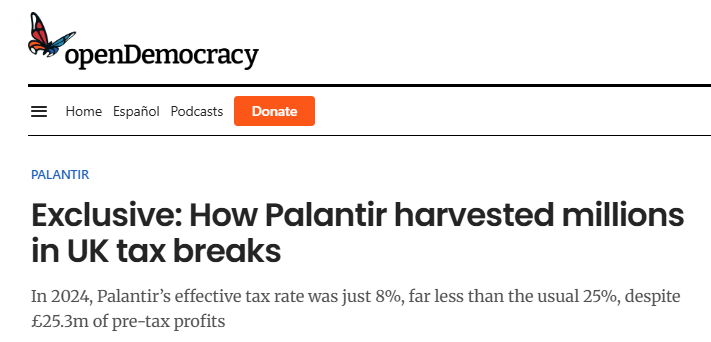
From Open Democracy yesterday:
Palantir is benefiting from millions of pounds of tax deductions that allow it to pay very little corporate tax in the United Kingdom despite soaring profits, an investigation by openDemocracy reveals.
The controversial tech firm has won at least £670m in UK public contracts in recent years, which have helped to make the country its second-largest market by revenue after the United States, where it is headquartered. Yet despite accounting for 10% of the company’s global revenue last year, its tax payments in the UK amounted to less than 5% of its total global cash tax spend, according to US filings.
The filings suggest Palantir’s UK subsidiary paid less than $1.08m (£820,000) in cash tax in the UK in 2025 – less than it paid in Korea, Japan, France and Germany – after accumulating tax deductions due to stock prices. Palantir’s stock has surged since the company went public in 2020, peaking in 2025 before paring back gains this year.
There’s no mention of Scotland in the report. Here’s why:
In August 2024, the BMJ warned:
NHS England must cancel its contract with Palantir – Patients and campaigners have been raising concerns about Palantir’s creeping involvement with the NHS for years based on concerns about ethics, outsourcing, and privacy. The tech company has a long and controversial history of supporting predictive policing, deportations, state surveillance, and drone strikes in Iraq and Afghanistan.
NHS England risks further losing the trust of health workers, patients, and the public if it continues with this contract with Palantir. On 3 April 2024, more than 100 health workers, patients, and allies picketed the offices of NHS England to demand that the contract is cancelled.
Outrage from health workers, patients, and the public will only grow as further atrocities are committed by the IOF. If NHS England is to recover its own reputation and maintain public trust in health data systems, it must cancel the contract with Palantir. Patients and campaigners have been raising concerns about Palantir’s creeping involvement with the NHS for years based on concerns about ethics, outsourcing, and privacy. The tech company has a long and controversial history of supporting predictive policing, deportations, state surveillance, and drone strikes in Iraq and Afghanistan.15
NHS England risks further losing the trust of health workers, patients, and the public if it continues with this contract with Palantir. On 3 April 2024, more than 100 health workers, patients, and allies picketed the offices of NHS England to demand that the contract is cancelled.
Outrage from health workers, patients, and the public will only grow as further atrocities are committed by the IOF. If NHS England is to recover its own reputation and maintain public trust in health data systems, it must cancel the contract with Palantir. https://www.bmj.com/content/386/bmj.q1712
In 2023, the Scottish Government rejected pressure from the Secretary of State for Scotland to follow NHS England’s lead and rejected Palantir, adopting instead as partners, AstraZeneca UK and Lenus Health.
You can read the full proposal at: https://www.digitalhealth.net/2022/12/scotland-gets-national-digital-platform-to-improve-data-access/ and the memorandum of understanding with university and industry partners at: https://www.digitalhealth.net/2022/09/nhs-scotland-set-for-transformation-with-new-collaboration/
Discover more from Talking-up Scotland
Subscribe to get the latest posts sent to your email.


Nothing in NHS Scotland health informatics is patient centred. There has been no ‘opt-out’ for secondary uses of personal health data since the previous poor system ended on 31st August 2023. Sadly, Lenus Health appears to have evolved from an Edinburgh firm (StormID) then the Irish health service and claims to have a permission portal but how does this apply in Scotland after 31/08/2023? Where is SICSA in all this https://sicsa.ac.uk/? To access MyCare.scot the patient must open a ScotAccount (=BritCard or worse), part of the ‘Digital Front Door’. Here are some of the firms contracted, costs where known: Netcompany, Scott Logic; (ScotAccount) Experian, Mitek, Google, Plausible Analytics, Cifas, AWS, Atlassian; (MyCare) BJSS/CGI £27.8m, AWS, Microsoft; (GP systems) OneAdvanced took over InPS part of Cegedim narrowly averting system collapse; (NHS24) BT and Capgemini (system collapsed £117million lost), rinse and repeat now Coforge (formerly NIIT), Pega, AWS, current budget £48m. To which Prof Robertson adds Lenus Health (AI) and AstraZeneca UK. “Our data bought and sold for multinational
goldhold, What a farcical dystopian nation!”LikeLike
Maybe just put all of that into clear and concise words, with links to evidence about all the companies that you name here.
Also ‘Britcard’ is that not a UKEngGov requirement?
‘Dystopian nation’, to which do you refer? England?
LikeLiked by 1 person
Thanks for responding, ArtyHetty. Impossible to keep up with dystopia (and I mean Scotland) but I don’t know who is doing this – politicians’ positive comments on MyCare.scot indicate that they don’t understand what their civil service is doing. The ScotAccount privacy page has already changed – omitting Google Analytics and Plausible Analytics and adding Netcompany and HM Passport Office but I didn’t screenshot the original (sorry): https://www.mygov.scot/privacy-notice-scotaccount still has the temerity to state that Atlassian is transferring data outwith EEA, which suggests a lynchpin role when they have to publicly admit this. Very limited space, sorry for lack of clarity, just wanted anyone (anyone!) to confirm that this is really happening, you’re the first person ever to pass comment. BritCard reference simply to point out that Scottish approach is no better than England’s, perhaps worse, and way more sleekit!
LikeLike
The ‘civil service’ in Scotland..is that not an English outfit and are the staff not mostly at least appointed by the EngGov? I know they built a HUGE brand new office (you can’t miss it!) slap bang in the centre of Scotland’s capital city of Edinburgh a few years ago…btw who paid for that and who ARE the staff and where do they reside are they F/T resident in Scotland, or are they brought into the colony by England? Plenty nice mostly unoccupied properties for them to occupy that’s for sure.
Certainly looks like there needs to be some level of transparency in regard to the ‘civil service’ operating in Scotland and what powers and leverage they have at the Scottish government level.
Scary face emoji.
LikeLike
Ongoing response to ArtyHetty: MyCare privacy page also changed/expanded and now includes Plausible Analytics (German startup with one of the better ethical policies) and references to Google Analytics have been dropped in favour of Google Firebase (AI platform): https://mycare.scot/public/information/privacy. Basically I start at the privacy notices and follow the links and company references and try to visualise a coherent system. New companies noted while responding to you include Queue-it.com (Danish, I’m guessing subcontracted from NetCompany), in turn linked to ‘Amazon Web Services Cloudfront’. Also Functional Software Inc. of San Francisco supplying ‘Sentry’ app. I’m not yet clear about the NDP User Store or National Clinical Datastore. You’ll begin to see the problem about clarity. If you can suggest any Scottish or other outlet which might be interested in my rabbit hole collection of these companies and links and attempts to understand. I’d be so grateful. No Scot should trust ScotAccount or MyCare IMHO
LikeLike
Thanks again, ArtyHetty. What you are saying may be supported by the merger between NHS National Education Scotland (NES) and NHS National Services Scotland (NSS) into Public Services Delivery Scotland (PSD) https://publicservicesdelivery.scot/. PSD has overtly dropped the titular pretension of relatedness to the NHS as the dystopian centralisation and control (with no ‘opt-out’) of Scottish citizens’ personal data gathers pace, though PSD, like its predecessors, remains defined as a ‘national special health board’. The decision appears to have been known as far back as June 2025 https://healthandcare.scot/stories/4186/health-care-service-renewal-reform-population-health-framework, in response to criticism by Audit Scotland https://www.healthandcare.scot/default.asp?page=story&story=4015, formally ratified in January 2026 https://www.parliament.scot/-/media/files/committees/health-social-care-and-sport-committee/correspondence/2026/scotlands-public-service-reform-strategy-from-the-cabinet-secretary-health-and-social-care.pdf and specifically timed for implementation (by the ‘civil service’?) together with the post-pilot MyCare.scot rollout just before the Scottish Parliament dissolved for the May election).
LikeLike