


I knows this one is divisive. More than a few Talking-up Scotland readers disagree with us on it but here is the case, again, that Scotland is one of the few places with the resources – water and energy – to make a lot of money out of data centres, once independent of course.

From the Sunday Mail 28 December 2025, the above back-to-front headline and:
Massive new data centres planned in Scotland to power the AI revolution would use up to three quarters of the country’s total electricity demand [sic], a new study has claimed. Research firm Foxglove, which campaigns for fair tech, found the “staggering” amount of power as well as water required by data centres “carries serious environmental risk” for Scotland. Its study this month found 11 “hyperscale” data centres currently in the planning system could use up an astonishing 3000 megawatts of electricity supply once all operational.
“And they produce a huge amount of heat. Some of these data centres may use water cooling systems for their computing equipment which can have a very big demand on the local water environment.”
To begin:
Would use up to three quarters of the country’s total electricity demand [sic]
Surely you use up supply not demand?
How is our supply?
So, in 2024, Scotland consumed 21.7 TWh but generated 51.8 TWh of supply making for a 30TWh surplus which was just transferred to England. https://www.gov.scot/publications/energy-statistics-for-scotland-q3-2025/pages/electricity-consumption/
Now, if the SM is correct and these new AI data centres would need three quarters of our demand, that’d be about 15TWh from the 30TWh over-production which an independent Scotland could just sell to the companies owning them and then sell the rest to rUK. Of course, the huffy rUK, after independence, might just refuse to buy it and insist on paying more to the French whom they, especially the English, love so much.
Finally the demand on the local water environment? Already answered here in October 2025:
Chill – Scottish data centres powering AI only require 0.00004% of Scotland’s 745 trillion litres of water

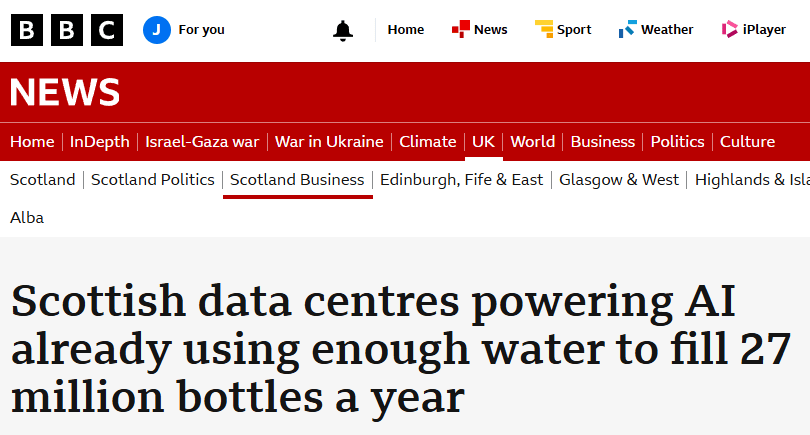
BBC Scotland had the above headline and:
Data centres powering artificial intelligence (AI) in Scotland are using enough tap water to fill 27 million half-litre bottles a year, according to data obtained by BBC News.
AI systems such as the large language models (LLMs) that power OpenAI’s ChatGPT and Google’s Gemini require warehouses full of specialist computers.
The equipment is power-hungry, consuming large amounts of energy, but they also use tonnes of water in their cooling systems to stop the servers overheating.
Freedom of Information data shows the volume of tap water used by Scotland’s data centres has quadrupled since 2021. https://www.bbc.co.uk/news/articles/c77zxx43x4vo
OK, 27 million half -litre bottles is 13.5 million litre bottles.
Where on earth will we get that? We’ll, in Scotland from just three of us?
Scotland has 5.5 million litres of water per person, 40 times that in England
Scotland’s Loch Ness alone contains 7,452 million cubic meters [745 million litres] of water, which is more than the combined volume of all lakes and reservoirs in England and Wales.
https://www.environment.gov.scot/our-environment/water/scotland-s-freshwater/ https://www.nature.scot/landscapes-and-habitats/habitat-types/lochs-rivers-and-wetlands/freshwater-lochs
England and Wales, by contrast, have far fewer natural lakes, with reservoirs like Rutland Water (12.5 km²) and Kielder Reservoir being among the largest, but their total volume is significantly less than Scotland’s.
http://www.fao.org/3/T0798E16.htm
Scotland’s water reserves are estimated at 30 trillion litres [5.5 million litres per person], compared to England’s 134,000 liters per person, highlighting a vast disparity due to Scotland’s smaller population (around 5.5 million) and abundant resources compared to England’s larger population (around 56 million). Scotland is often cited as having around 90% of the UK’s freshwater resources, largely due to its extensive loch system and higher rainfall (averaging 1,500–3,000 mm annually compared to England’s lower averages, particularly in the south).
https://www.studycountry.com/wiki/does-scotland-have-more-fresh-water-than-england https://www.thenational.scot/news/19515230.big-corporations-could-make-scotlands-water-next-oil/
So, the data centres need 13.5 million litres. Three of us, 16.5 million litres, should do that. That is only 0.00004% of the 30 trillion available.

Discover more from Talking-up Scotland
Subscribe to get the latest posts sent to your email.


You have conveniently ignored the times the Grid won’t be able to supply these data centres and massively polluting back-up diesel generators will have to be used. Also the burning question how will this affect electricity prices for the people of Scotland and who exactly will benefit economically? Local people living downwind of the generators or the big multinational companies and their shareholders??
LikeLiked by 2 people
Read it again?
LikeLike
Dear Professor Robertson, datacentres exist to centralise and monopolise the World Wide Web including all of our creative and intellectual property. Scotland had an opportunity to join the (Free and) Open Source Software (F)OSS world, together with peer to peer networks and distributed databases and completely leave the ‘big tech’ ecosystem. Tim Berners-Lee is trying similarly with SoLiD. Non Western powers are doing this en masse as now are some Western nations. Minimal or no datacentres are required in this environment. Scotland is digging a financially disastrous dystopian hole for itself using a plethora of multinationals to build and impose ScotAccount and MyCare.scot with more control structures to follow while hypocritically disdaining ‘BritCard’ and Palantir, which are no worse. We could build a new learning environment for our teenagers with (F)OSS mobiles and disdain the ‘big tech’ environment poisoning them. Please consider speaking to your former colleagues in SICSA (UWS is a member). And get yourself some FOSS to cut your software expenses (to zero!). Thanks for reading this.
LikeLiked by 1 person
Your critique works best when challenging the media’s sloppy terminology (“demand” vs “supply”) and exaggerated framing.
But to be persuasive at a policy level, it surely needs to engage with:
• The quality and reliability of power, not just quantity. Data centres are “on” all the time.
• The localised nature of water and environmental impacts.
• The non-trivial role of diesel backup systems.
• The risk of long-term stranded assets if technology shifts (eg to satellite).
I concede Scotland’s resource advantage but argue that infrastructure design, environmental externalities, and long-term planning risks are the real issues—not absolute scarcity.
LikeLiked by 1 person
Data centres are on all the time? Batteries, always windy out at sea?
Localised nature – agreed so not everywhere but far more in Scotland than in other places?
Diesel backup? Increasingly no need as above.
The risk of long-term stranded assets – satellites – how real is that? Must admit I don’t know
LikeLike
What data? Who controls it and who decides? I’ve read several accounts of dire consequences for communities of USA data farms similar to the problems caused by nuclear power though less deadly.
The fact is that there is no policy and allowing oligarchs to build monstrous power and water drains without adequate risk assessments is just wrong.
Action to Protect Rural Scotland has warned about the folly of this unregulated development.
APRS Data Centres Campaign – Action to Protect Rural Scotland
LikeLiked by 1 person
What worries me most about these centres is the speed of their delivery. One week we have none, next week twenty planning applications.
We know from experience anything that the UK government is enthusiastic about usually is of very little benefit to us. We also know we cannot trust the word of big business.
So, where does that leave us, ordinary folk like me, who can only glean knowledge from higher minds than mine?
LikeLiked by 2 people
As well as the significant negatives mentioned in the other replies, there is the sheer physical size of these things. Auchtertool village, for example, will be completely dominated (ruined?) if that one is built.
Grid problems: in some areas local housing can’t be built just now because a data centre has taken the available local capacity.
Despoilation of greenfield sites.
Having enough energy or water is irrelevant but why not use “our” renewable energy or water for beneficial local purposes rather than looking for ways to use it all up. We should be using less energy overall.
Not needed, not wanted.
LikeLiked by 1 person
I would not be surprised if these data centres become a Trojan Horse to create the demand for “reliable” nuclear energy. The wind doesn’t always blow and back-up diesel generators are terribly noisy and polluting. But hey – Scotland could become home to small nuclear plants and their toxic waste.
LikeLiked by 1 person