

By Mark E. Saunders of “The Scottish Minuteman”
https://www.facebook.com/profile.php/?id=61575625542197
https://www.youtube.com/@TheScottishMinuteman
https://www.tiktok.com/@thescottishminuteman/video/7544331813578231062
Author’s Note: The following article is offered as speculative political commentary. It reflects personal interpretation and historical parallels and should not be read as established fact. No allegation of wrongdoing is made against Stuart Campbell, nor is any claim made that the UK state has influenced his publications.
The Curious Case of the Wee Blue Campbell
Is it peculiar that a person can one day be portrayed as a menace when attacking the Union and the next as a valuable whistleblower when attacking the SNP?
2014: “Dangerous nationalist cybernat influencing the independence movement.”
2026: “Useful critic of the SNP whose allegations about party finances deserve attention.”
I don’t know. But let’s dive in.
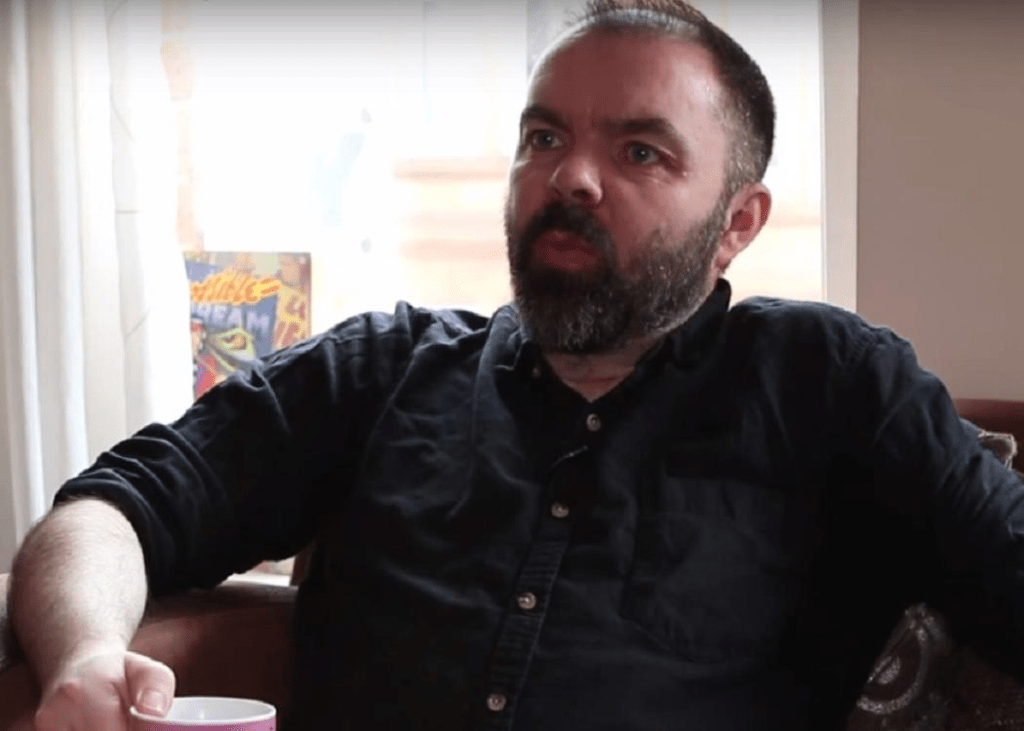
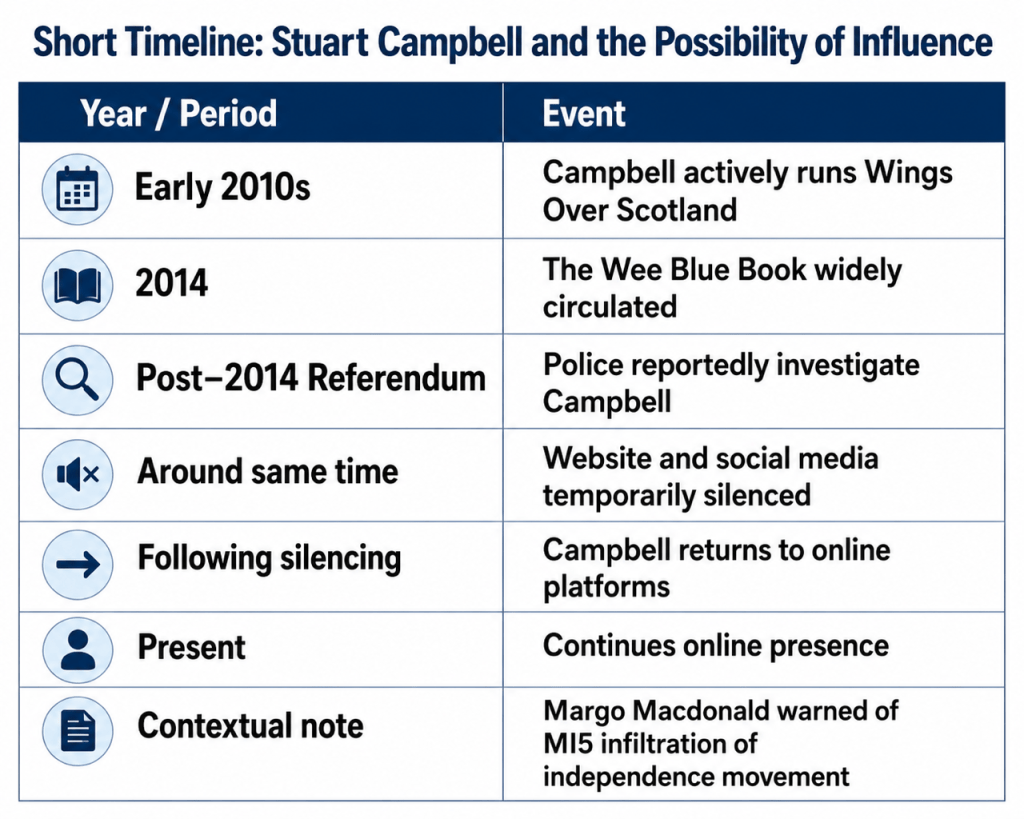
Stuart Campbell, the voice behind Wings Over Scotland, has long been a prominent commentator on Scottish politics. Campbell was particularly known for his strong support for Scottish independence.
Over the years, his platform became known for its sharp critiques of the UK state and the British political establishment. Campbell also crowdfunded and produced The Wee Blue Book, an influential and widely circulated guide that became an invaluable tool during the latter stages of the 2014 Scottish independence campaign.
Campbell was reportedly the subject of police attention at one stage. However, the details of this investigation remain fairly murky in the public record. Around the same period, his website and social media accounts were temporarily shut down.
Following these events, many Wings Over Scotland readers noticed what they saw as a subtle but discernible shift in its content. There appeared to be a move away from strident criticism of the UK state towards almost daily attacks on the institutions of Scottish governance and various aspects of the independence movement.
If one were inclined towards conspiracy theories, it would be easy to speculate that this sequence of events represents more than mere coincidence. It is theoretically possible that legal scrutiny by the police, or other factors, may have caused Campbell to moderate his public voice.
Such influence need not be overt or even formal. The simple awareness of potential legal exposure can produce self-censorship or even a genuine re-evaluation of one’s public persona.
The Sword of Damocles has always been one of the most sobering of weapons.
Supporting this line of conjecture, the late Margo Macdonald once suggested that elements of the Scottish independence movement had been infiltrated by MI5. Her comments implied that state monitoring of pro-independence voices was not without precedent.
While this article provides no direct evidence regarding Stuart Campbell, it attempts to place his experience within a broader context in which political activists can be subject to observation, scrutiny, or pressure from state agencies.
The subtle use of public voices to shape opinion and influence political outcomes is not new in Scotland. Historical examples abound. Daniel Defoe’s role in promoting and legitimising the 1707 Union, for instance, demonstrates how writers and commentators have long been used to support political agendas.
This pattern highlights a longstanding tactic whereby governments seek to shape political narratives through persuasive public figures, sometimes quietly and indirectly, but often with considerable effect.
It is crucial, however, to stress that none of this is proven fact. The theory remains the idle musing of someone who has perhaps read too many spy novels.
No public evidence confirms state coercion or direct intervention in Campbell’s case. His change in tone could equally stem from personal reflection, strategic repositioning, or simple burnout after years of intense political commentary. Yet when one examines the timeline of the shift, some may regard the possibility of external pressure as conceivable, even if it remains unprovable.
In the absence of concrete evidence, this remains a speculative hypothesis. It serves primarily as a reflection on the subtle ways in which state power, legal scrutiny and personal safety considerations can interact with political expression, particularly in highly charged political environments such as the Scottish independence debate.
Discover more from Talking-up Scotland
Subscribe to get the latest posts sent to your email.


While your hypothetical theory is portraid as such, there is a equal hypothetical theory, that is that the SNP as the main party of government has moved away from there independence remit, to a position where a independent person is needed to highlight this, and continue to do so, until it becomes so obvious that the electorate do something about it.
LikeLiked by 1 person
while both hypotheses might require some stretching, British history in Ireland and in other parts of empire give the one here some potential for consideration. Your hypothesis requires a bigger suspension of reality to give it credence. No critic of the snp has yet pointed to a surefire way of achieving independence at any time over the past 12 years. Indeed. The underlying belief that the snp could and should have done more relies on ignoring a fundamental democratic situation that shows that a majority hasn’t supported unilateral action or even independence itself. The lessons of Rhodesia dictate the UDI should be regarded simply as madness.
LikeLike
Les Roberts: Your assertions are borrowed from the opponents of Scotland’s rights, repeated here parrot fashion. You are badly ill-informed. (I add that in case you enjoy a position informing others.) Even now, same day as you post, the statistics are easy to find showing independence is well past the 50% mark, and has been sustain there for many months. Rest anxious; Scotland’s move to reinstate its autonomy and full civil rights is unstoppable. No nation ever rose up to demand its abolition.
LikeLiked by 1 person
On the face of it, It was the SNP that changed. Back in the day I was a regular financial backer of Wings – I really believed in what he was doing in the 2012-2016 period.
The post Salmond takeover of the SNP by various militant groups, the purge of the heavyweight independence promoters and the lurch towards identity politics would suggest that it is the SNP that was infiltrated by the British state and totally derailed away from it’s core remit rather than Wings.
Stuart Campbell was the first to see the infiltration of the SNP and focus on it. Subsequently his own original remit was consumed by having to highlight what was happening within the SNP. Most people couldn’t quite fathom how to deal with the trans agenda that for a time had Scottish politics in a demented death grip. Stuart kept his head above the parapet and was proven to be correct in what was happening to the SNP – and their finances.
Now an element of control has come back to the SNP leadership and Murrell has been busted I am hoping Wings will get behind this Salvo effort more prominently, as that is something I would support financially. Wings could still prove to be an important link with the wider independence supporting public in clarifying what is going on with that.
LikeLiked by 2 people
I do financially support Salvo and Liberation Scotland with their efforts at the UN. I see this as the only route to a UN controlled referendum.
LikeLike
The SNP was infiltrated pretty well on its inception and its leadership singled out for public castigation, “Commies and weirdoes”, falsehoods that soon moved on to “Nazi sympathisers”.
LikeLike
I assume that the political arena is riddled with undercover state actors determined to preserve the status quo by all means necessary. When has it ever been otherwise.
Does an action tend towards independence or does it tend to preserve the status quo? Does arresting, imprisoning or defaming political leaders tend towards independence? Or not.
LikeLiked by 2 people
It was possible at one time to ignore his psychotic personality as he was , for a while , an effective voice in the Independence cause .
However , his inner arseholeness eventually came to the fore and his embittered , petulant , Trumpishness overwhelmed any existing spark of decency that existed in his self-absorbed personality .
LikeLiked by 4 people
I used to follow Wings and remember the police intervention and the resultant hiatus before its return. It never again led on independence, focussing instead and increasingly on promoting divisions in the independence “movement” and attacking the SNP hierarchy.
Nobody should expect the SNP to be perfect but that was the expectation that Wings set up so it could incessantly criticise. Being a malcontent is easy, it is promoting solidarity and cohesion that is difficult, made all the more so with with Wings taking cheap shots.
Whether Wings is acting are an organ of the UK state is up for debate, the fact that it is now a negative force against independence is not.
LikeLiked by 6 people
Eloquently written piece, John.
Stuart Campbell is an absolutist, the issues he attaches his name to are black or white. His good work dissipated after he stopped attacking the Scottish press and moved onto more sophisticated political subjects. (“If it wasn’t for the newspapers I’d not know what to write.”) Hence the Beater News site and its sister Analysis site filled the void by taking over the role of daily press watch and critique.
His loss of over £200,000 of donations on a hubristic court case to prove what we all understood anyway, that he is not homophobic, signalled a celebrity blogger’s mindset. His alarming view of Trump’s Praetorian Guard – ICE’s street murders of civilians – shows a startling naivety about fascist dogma, how prevalent it is in US society.
His best work was in his early ethical years, lately more of a sad cult. “When people attack me, dear readers, they are attacking you.) He is as often proved wrong on a topic summation as right, but no other blogger seems as adept at interpreting statistics than Wings, a skill from which issue a lot of Campbell’s views. And he uses Daily Mail prose to get across his message that helps attract readers.
What a pity he convinced Alex Salmond to place his (then) nascent fringe ALBA party in competition for Regional seats. I have an abiding memory of an isolated, morose Salmond standing in the middle of the ballot counting hall, reading the dire nil, nil, nil result.
Speaking personally, I regard Campbell as an Indy pup. (Or maybe a puffling.) For over fifty years I’ve argued the Cause by teaching, lectures, talks, filmed drama, essays and books that Scotland is at the mercy of a corrupt neighbour, but it would not occur to me to ask for money to do that moral task. Then again, I trained as a dominie. Education, enlightenment – a fine invention of the Scots – is the basis of teaching that encourages co-existence and how to make adult moral decisions.
As for money, donations, it has cost a large portion of my income. I will however, need one-off funds to re-erect Salmond’s Tuition Stone in a new location, the symbolic stone taken down by the capital’s Heriot Watt University and left in store. It might be the last thing I can do for the Cause, but an accomplishment if my health holds out.
He likes to dominate, boast of readership figures, is confrontational, holds money important to boost his confidence, and is devoid of empathy for anyone but himself. His sustained ‘Reverend’ brand is irrelevant and odd. Does he ever talk of close friends? As someone wrote, you can admire him, but its hard to like him. Incidentally, (and for his followers) I have defended Wings whenever it got attacked, often in long-form articles, a response not reciprocated to my knowledge, despite Campbell’s boast of influence via mass readership.
As readers know, I eschew commenting about Indy bloggers; some are articulate, some unskilled at what they do. I assume all are genuine and dedicated. Suffice to add, Campbell is the only blogger to dare tell me what to write about him, not once but on three occasions, arrogance rebuffed on the spot. But that’s his character. The layers of the onion are the onion.
Unlike his opponents, I have no complaint about Wings fighting the good fight from the comfort and splendour of Palladian Bath, but it crossed my mind a few times (and perhaps the mind of others), fighting for the cause of Scotland’s civil and constitutional rights is better made here within Scotland, where one is subject to all the vagaries and pressures of facing the public in person, and best of all, testing voter support by standing for our Parliament.
Onward!
LikeLiked by 6 people
Thanks GB but the eloquence is all Mark’s
John
LikeLike
interesting but he modorated his tone as the was warbed about liability
Now Sturgeon did a great job during COVID however even with 56 MP did nothing
she campaigned to stop BREXIT which the people of wngland voted for but did nothing to get Scotland the aame deal as N Ireland.
was part of the conspiracy to get Salmond and was supported by the BBC!!
Go figure who was compromised (around 2016/17)
She us not alone hence the support and silence around her.
Go figure indeed
LikeLiked by 2 people
Apologies for my thumb typing
LikeLiked by 1 person
And now leaving tge door open for a westminster investigation!!
They will turn over rocks we did not know about
Swinney knows this but does nothing – go figure
LikeLike
Sent from Proton Mail for Android.
LikeLike
He is and always has been an oddball and a complete arsehole, and a highly effective one during Indyref. He was right about a whole lot of things, but completely incapable of admitting when he wasn’t. He lost me forever when he stood by Craig Murray: Russia apologist and fruitloop, Graham Linehan: TERF extraordinaire, and Alex Salmond: unrepentant sex pest and compromised Russian asset. When that lot are your best pals, your moral high ground is looking a bit shaky.
LikeLike
Thanks for letting me know the name of the cowardly piece of shit who wrote that drivel.
LikeLike
Gosh, hard to know where to start with the ever-Revolting Stu’s impressively intellectual, well crafted response.Happily, I am sure people will admire and revere it as a fine example of its kind.
LikeLike
I dunno, maybe start by making up some more demented bullshit lies like you have above, since you’re too much a blubbering coward to allow replies on your own site from people you defame?
LikeLike
Says the ludicrous ‘Anonymous’.
LikeLike