

The Herald today has:
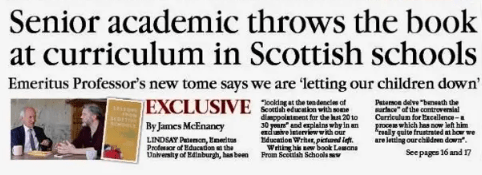
I’ve lost track of how often I’ve felt the need to deal with Prof Paterson, Scotland’s only regular rentagobprof across Scottish and English MSM, always ready to tell everyone that education in Scotland is in decline and worse than elsewhere and, to my knowledge, only fan of Pisa data.
He is, to my knowledge, the only serious educationist publishing in peer-review journals who thinks the Pisa scores are of any value at all. I’ll come back to Pisa scores below but first and perhaps explaining his odd attachment to them:
Why is Paterson not an expert at all? This:
Professor of Educational Policy at Edinburgh University, Lindsay Paterson is a statistician with a background in agricultural and medical research using statistical methods. He has absolutely no experience of teaching in schools or in teacher education methods. He has no experience of school management or of research into the curriculum other than in counting assessment data. He’s just a jumped up bean-counter. Despite that, he’ll turn up on request, rent-a-gob, to say something bad about any Scottish Government decision that involves numbers.
So, to the Pisa scores he relies upon:
Here’s what an experienced, retired, Glasgow head teacher, has to say about Pisa scores:
By Alasdair Macdonald
The issue is with PISA. It has very little statistical rigour and offers nothing in the way of improving educational practice.
I was a secondary school head teacher at the time it and other ‘measures’ were introduced in education in Scotland in other places. I and my colleagues argued against it.
Educational provision, like everything else, ought to be continuously evaluated, partly to get evidence on whether it is achieving the aims set out for it and partly to get information on areas which require attention. However, there are, literally, hundreds of aspects to be measured and many of these aspects are not measurable by things like tests of arithmetical competence. Such tests are part of the picture but their results are not the full picture (insofar as a full picture can be obtained) Most of the data have to be set in a fairly long time context so that temporary fluctuations can be seen. Usually such temporary fluctuations are easily explainable, in the cases of individual schools.
Such data do, in fact exist. There is a great deal of it and it requires a great deal of care and experience to identify things which are of statistical significance. And things can be significantly ‘good’ as well as ‘poor’.
PISA is of no benefit in this evaluative context. It is an instrument of BLAME and, as such, is a tool of control and compliance over schools and teachers. For some politicians and their media mouthpieces it is a malign instrument which stifles the creativity which is an essential part of teaching.
Some of those in power see such creativity as presenting a threat to their power.
Creativity and the autonomy necessary to be creative can challenge power, but it is the way that people in all walks of life improve things. It is essential in medicine, science, engineering, the arts, social policy, etc.
PISA is a club to beat creativity out of teachers and schools.
Footnote:
Further reading suggested by the Editor –
Interpreting PISA Results: It’s Poverty, Stupid (With a Bit of the iPhone)
As for Scotland performing ‘below’ England? Complete twaddle. See:
The England PISA sample consisted of 201 eligible schools having at least one pupil in this age range. In England, 3,852 pupils from original sample schools and 911 pupils from replacement schools participated. Pupils in participating schools that did not participate are not replaced. 159 agreed to participate, along with a further 32 replacement schools, but 16 schools withdrew before data collection. Data was therefore collected from 143 schools in the original sample and 32 replacement schools. Of this total, nine original sample schools and one replacement school were omitted from the response rate adjudication process, leaving a total of 134 schools from the original sample and 31 replacement schools.
chrome-extension://efaidnbmnnnibpcajpcglclefindmkaj/https://assets.publishing.service.gov.uk/media/656dc3321104cf0013fa742f/PISA_2022_England_National_Report.pdf
So, in England, in the end, 165 schools and 4 763 pupils took part.
The Scottish participation, from only a tenth of the pupil population and schools, was:
117 secondary schools participated in the survey, representing a school response rate of 96.4 per cent; exceeding the OECD’s minimum standard of 85 per cent. 3,257 students took part giving a weighted student participation rate of 79.4 per cent, slightly below the student participation technical standard of 80 per cent. https://www.gov.scot/publications/programme-international-student-assessment-pisa-2022-highlights-scotlands-results/
There are 357 secondary schools overall in Scotland so a sample of 32.8% was used.
Only 4 763 pupils in 165 schools took part in England. There are 3 458 secondary schools in England so only 4.7% of them took part. Were they then representative or just maybe, the best performing?
There are roughly 10 times as many 15 year-olds in England yet the sample-size was less than twice.
The Pisa results in England and Scotland are simply not comparable and had the English sample of schools been similarly representative and not so suspiciously selective, we can only guess that Scotland would have performed far better than England.
Discover more from Talking-up Scotland
Subscribe to get the latest posts sent to your email.


Every time Prof. Paterson pronounces on Scottish Education I am immediately reminded of the phrase ”Never mind the quality , feel the width !”
Has he not been given his Knighthood yet ?
LikeLiked by 1 person
Aw c’mon, what did you expect from the Herald “Trusted Journalism” 🙂
I am surprised that this “wheeled in expert” has not give his views on ferries yet.
Stephen McKenzie
LikeLiked by 1 person
Scotland is full to the brim with managers and academics who’ve sold their soul to the devil.
it’s a middle class thing.
John Lawson
LikeLiked by 2 people
It’s not that hard to find educationalists internationally who are either sceptical or straightforwardly negative about the OECD’s PISA rankings. This from one ‘expert’ in a peer reviewed journal:
Zhao, Y. Two decades of havoc: A synthesis of criticism against PISA. J Educ Change 21, 245–266 (2020). https://doi.org/10.1007/s10833-019-09367-x
Abstract: ‘The Programme for International Students Assessment (PISA) has become one of the most influential forces in global education. The growing influence has been accompanied by growing criticism. For nearly two decades since the first round of PISA was conducted in 2000, the global assessment program has been roundly scrutinized and criticized by education researchers all over the world. But the mounting criticism seems to have had little impact on PISA’s influence as evidenced by its growing power in global education policy and practice. (my emphasis)
‘The lack of impact of criticism does not mean the criticism is not valid or PISA has improved. It simply means that the criticism has been largely ignored. The lack of impact is no reason to give up exposing PISA as a flawed business that has great power to misguide education.
‘The expanding influence of the PISA enterprise makes it more even more important to be critical of this juggernaut today. It is also important to consider more effective and more straightforward approaches to present the criticism. The purpose of this article is to present a summary of criticisms that reveal the most fundamental flaws of PISA in non-technical language in one place. Specifically, the article focuses on criticisms of PISA’s three fundamental deficiencies: its underlying view of education, its implementation, and its interpretation and impact on education globally.’
Credentials?
Profile: ‘Dr. Yong Zhao is a Foundation Distinguished Professor in the School of Education at the University of Kansas. He previously served as the Presidential Chair, Associate Dean, and Director of the Institute for Global and Online Education in the College of Education, University of Oregon, where he was also a Professor in the Department of Educational Measurement, Policy, and Leadership.
‘Prior to Oregon, Yong Zhao was University Distinguished Professor at the College of Education, Michigan State University, where he also served as the founding director of the Center for Teaching and Technology, executive director of the Confucius Institute, as well as the US-China Center for Research on Educational Excellence.
‘Additionally, he worked as a professor of educational leadership in the Faculty of Education at University of Melbourne and senior researcher at the Mitchell Institute of Victoria University in Australia.
‘He was a visiting Global Professor at University of Bath and a visiting scholar at Warwick University in the UK. ‘
‘He is an elected member of the National Academy of Education and a fellow of the International Academy of Education.
‘Yong Zhao has received numerous awards including the Early Career Award from the American Educational Research Association, Outstanding Public Educator from Horace Mann League of USA, Distinguished Achievement Award in Professional Development from the Association of Education Publishers, ACEL Nganakarrawa Award, and AECT 2022 Outstanding Digital Learning Artifact Award and AECT Distinguished Development Award.
‘He has been recognized as one of the most influential education scholars.
‘In about four decades of his professional career, Yong Zhao has led large research projects, directed research and practice centers and institutions, designed schools, curricula, and textbooks, and initiated and led the development of software systems for learning and professional purposes. He has worked with teachers, schools, professional organizations, businesses, and governments in many countries in Asia, Australia, New Zealand, North and South America, and Europe.’
In short, someone whose point of view is worth considering.
LikeLike
Lindsay Paterson is part of the problem
LikeLiked by 1 person
Parent should complain for a total stranger, collecting their child’s data.
LikeLike