

By stewartb
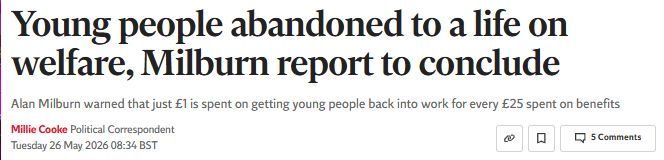
The interim report from the Milburn review examining the issues around NEETs gained a lot of MSM attention.
See Milburn, A. (May 28, 2026) Independent report: Young people and work: interim report. Report for the Department for Work & Pensions.
Its stated geographic scope is clear from the outset: it’s the whole of the UK. The report does acknowledge that certain germane policy areas are devolved: ‘Where policy areas discussed are devolved to Scotland, Wales or Northern Ireland, this is noted.’
However, whilst some of the statistics provided are for the UK, most are for England only. No disaggregated stats for NI, Scotland and Wales. The critique of issues around public policy design, implementation and outcomes either refer to the UK (whilst really describing England) or more commonly, explicitly focus on England. There is no attempt to document or evaluate how the devolved administrations have addressed the issues around young people and work: there is no attempt to document or assess how the interventions by devolved administrations succeed or otherwise alongside ‘reserved’, UK-wide Department of Work & Pensions (DWP) practices. In short, there is no account of what is being done and what is being achieved in NI, Scotland and Wales – for good or ill. This UK-wide review is substantially England- centred.
Just one example, in a section on the importance of access to affordable public transport for young people: ‘The relationship between transport and participation is direct and measurable. Research for the Social Exclusion Unit found that two in five young people had turned down a job, training or education opportunity because of transport problems. Transport concerns were listed as one of the three main reasons why students considered leaving college.
‘London is the exception that proves the rule. Free bus travel for those under 18 and discounted travel for anyone 18 to 21 removes transport as a barrier to participation. London also has the lowest NEET rate of any English region and the strongest post-16 destination outcomes. Transport is obviously not the only reason; but it is no coincidence that the city with the best youth transport offer has the best youth participation outcomes.’ Nothing happening in Scotland? Free bus passes?
The report makes much about negative consequences for the support system in England that arise from an overly complex array of organisations that play a role in this policy space. In this context, the absence of a systems-level assessment in the review of what is being done by the devolved administrations is all the more odd when the report acknowledges in this context (in Para 603): ‘There are examples of good practice we can build on, including Skills Development Scotland’s 16+ Participation Portal, and the government’s work with local partners in the Sheffield Community Mission Challenge. But these are currently exceptions in the wider UK context.’ (For info, see https://www.skillsdevelopmentscotland.co.uk/what-we-do/scotlands-career-service/16plus-participation-portal )
To be fair, there are other positive references to Scotland:
‘The lack of evidence concerning targeted and individual approaches that seek to reduce the exclusion of autistic pupils who are vulnerable to exclusion is a significant gap in the literature and this needs to be addressed. This may involve looking to other countries, where exclusion rates are lower or alternative approaches are taken, to explore their policy and practice in this area. For example, the approach to school exclusions by the Scottish government provides a useful counterpoint to the English model given the much lower exclusion rates in Scotland.’ (my emphasis)
And: ‘Looking at England specifically, a far smaller proportion of apprenticeship starts are made by younger people aged 16 to 18, around 20%, compared with Scotland and Northern Ireland at around 40% and 46% respectively for 16- to 19-year- olds. The post-16 system needs to learn from parts of the UK and examples internationally where younger people are more effectively connected to work-based pathways from compulsory education.’
These positive references to Scotland are provided in isolation: there is no attempt to place them in a policy framework that exists in Scotland .. or in NI or Wales. Only England merits such treatment within a UK-wide policy review! Anyone surprised?
On a subject area favoured by opponents of the SNP government, another topic covered in the Milburn review is ‘interesting’ – ‘What happens outside the school gates’:
Para 293. ‘But first, an important piece of context. A study for the Department for Education found that 84% of the variation in GCSE attainment is explained by individual pupil factors or factors outside the school gates. Schools matter enormously. But they operate on only a minority of the factors that shape outcomes. (my emphasis)
294. ‘What happens at home – parenting, family composition, cultural expectations and the wider community – does most of the heavy lifting, for good or for ill. Yet this is too often the missing piece in the debate. Much of the focus in this report is rightly on public services and employers. But their actions alone will not shift the life chances of 1 million young people. Families are not a peripheral influence but are central.’
And from para 310: ‘… the relationship between social background and educational attainment in England is unbroken. It has survived every reform of the past three decades. Disadvantaged children still perform substantially worse at every stage of education. The gap does not close as children move through the system. It widens.’
Discover more from Talking-up Scotland
Subscribe to get the latest posts sent to your email.


Millburn seems to be an example of his own educational limitations and poor attainment. UK = England. D minus in geography, history and modern studies (if indeed they teach these in England. So few politicians and broadcasters seem to understand what they’re talking about).
LikeLiked by 1 person
“Mixing up” UK and England is a deliberate “UK” policy. See here for an official example:
EXCLUSIVE: We Publish the English Ambassador’s Email Refusing to Correct the Erasure of Scotland’s Identity Across 3 Billion People. The English Colonial State & Foreign Office’s Global Linguistic Annihilation of Scots; and Scotland’s Colonial Condition
LikeLiked by 1 person
The report identifies the factors which have significant impacts on the life chances of young people. But, these things have been known for decades. It is political willingness to invest significantly that is lacking. To be fair to Blair and Brown, they made significant investments and these had significant impacts.
However with their ‘triangulation’ concept of seeking a path between left and right, they handicapped the system by an excess of targets and ‘accountabilities’ which stifled creativity by teachers and others. In education, in England, they adopted the Ofsted system and the baleful prejudices of its chief inspector. Fortunately, in Scotland we avoided much of that.
The big crime of Brown particularly was his failure to make the arguments – which he was capable of doing – but deliberately chose not to do because he did not want to anger the right wing media. So, he failed to change the Thatcherite paradigm and we know from Blair’s recent ‘essay’, Labour was fully committed to Thatcherism, but tried to ameliorate it at the edges. So, Blair and Brown left no hegemonic paradigm around which people could rally and Cameron, Osborne and Clegg swept it all away within a year of taking office.
It is obvious Starmer’s government has no plan. It has made several potentially promising moves, but often only after mistakes and political assassinations of people with radical views.
Although the report claims to be ‘BRITISH’ it is English and Milburn throughout demonstrates the inherent Anglocentism and a failure to understand fully that things ARE different in the Celtic nations.
What is needed is a huge decentralization of money and powers to the regions of England and the devolved parliaments with limited powers by Westminster to overrule things by use of legislations like the egregious Single Market Act. I prefer independence, but a massive devolution of powers would be a good start.
Quote from ‘Scottish’ Labour – That wull be right! Gie they Nats fuck a!
LikeLiked by 1 person
Millburn’s report is for Pat McFadden , the current Minister for Work and Pensions . Being a Proud Scot but ..Pat will ensure that the voice of Scotland is ignored .
LikeLike