

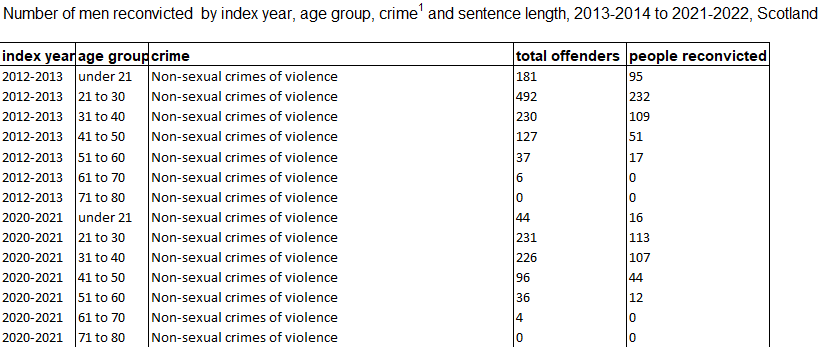
There is a clear positive trend revealed in the data above from Re-conviction statistics for male offenders: FOI release published today.
Violent crimes over the eight year period from 2012/13 to 2020/21, among under 21s fell from 181 to 44, more than three-quartered! For 21 to 30 year-olds from 492 to 231, it more than halved!
Then, however, for all of the over 30 years groups, there were much more modest improvements.
What might explain this?
On 1 January 2000, lead in petrol was banned in the UK, when Scotland’s under 21s and 21s to 30s were still very young or, in most cases, unborn.
Why might that matter?
One increasingly convincing theory is:
The “environmental lead–violent crime theory” is the idea that widespread exposure to lead — especially from leaded gasoline, paint, pipes, and industrial pollution — increased aggression, impulsivity, and reduced cognitive control in children, which later contributed to higher violent crime rates when those children reached adolescence and adulthood.
The theory became especially famous because crime rates in several countries rose and fell in a pattern that roughly matched childhood lead exposure about 15–25 years earlier. 2, 3
So, the 31 years plus offenders in 2020/21 and those in 2012/2013 had both been exposed to lead pollution but in 2020/21 the under 30s, mostly, had not.
Sources:
- https://www.gov.scot/publications/foi-202600514951/
- https://www.nber.org/papers/w13097?utm_source=chatgpt.com
- https://pubmed.ncbi.nlm.nih.gov/17451672/
Discover more from Talking-up Scotland
Subscribe to get the latest posts sent to your email.


Crime is a gender issue. Usually committed by males. There are 7,000 males in jail. 300 females. Violent crime is usually committed by young men. Under the influence of alcohol or drugs.
LikeLike