

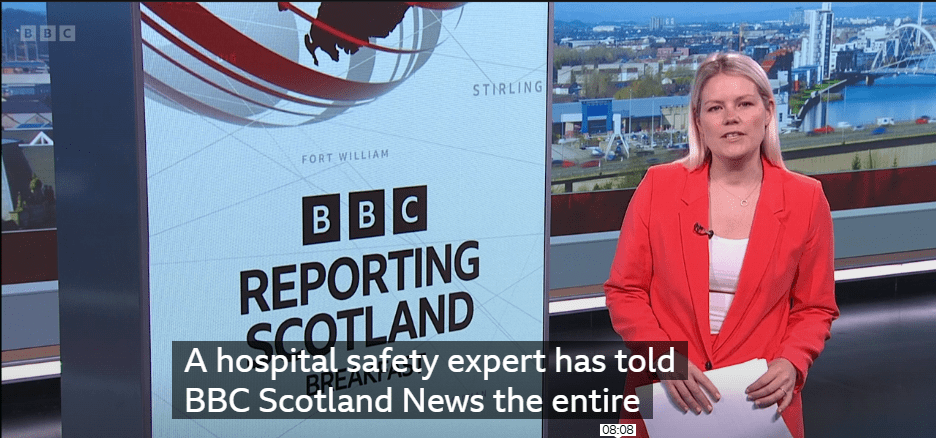
the entire Queen Elisabeth University Hospital campus in Glasgow should be risk assessed.
Who is this safety expert?
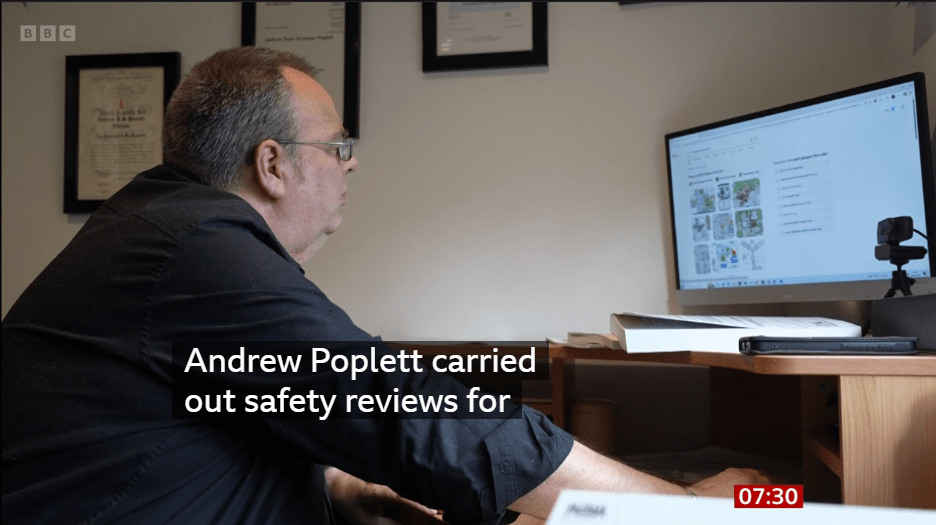
for the Scottish Hospitals Inquiry and says it’s incredibly difficult to say whther the hospital is safe or unsafe for all patients.
Only yesterday, we had confirmation in the form of official mortality statistics that the QEUH is safer than average in Scotland and far safer than several hospitals in England. See:
Looking back over the years to the period of the Inquiry, here are the facts confirming the safety and rejecting Poplett’s attention seeking:
In August 2025, BBC Scotland returned with an extended piece on the re-convened public inquiry into ‘safety and wellbeing issues‘ at two Scottish hospitals, the Queen Elizabeth University Hospital in Glasgow and Royal Hospital for Children in Edinburgh.
I’ll deal only with the former here. The BBC text is presented as quotes with my rebuttals below them in plain text:
In the coming weeks it will examine contentious new evidence from Glasgow’s health board about the risk of infection from the water and ventilation systems
This is a long-running practice where any case made by the Scottish Government or one of its agencies is described as ‘controversial‘ or ‘contentious.’ Why so? There is no quote in the full text attributing the word to an expert, indeed anyone. It’s just Lisa Summers deeming it so just as once she described Oncology in NHS Tayside as ‘dysfunctional‘ though no one other than her had ever said it. It’s ‘new‘ evidence in a 218 page report.
But a series of infection outbreaks and concerns around the water and ventilation systems began to emerge three years later – and a number of patients died including 10-year-old Milly Main. The report found a “series of problems” with the design and build of the hospital, but no clear evidence to link those failures to any “avoidable deaths”. However, that investigation did not consider child cancer patients.
See that lazy, casual but also sneaky linking of the deaths to infection outbreaks and the cancer ward? As early as 2019, Greater Glasgow and Clyde Health Board had commissioned an independent expert report and this had found that there was ‘no evidence of a single point of exposure [in the building] causing the blood stream infection‘, implying that the bacteria could have been brought into the wards by visitors, and that infection rates in QEUH’s child cancer wards were no different from those in NHS Grampian and Lothian equivalents (p54).1
The announcement followed [….] a series of of infection outbreaks – and at least four deaths – at the QEUH.
Again the dishonest tagging on of deaths to the infection outbreaks and the insertion of ‘at least four‘ when it was only four? There’s quite a lot to say about this:
First, infections after surgery are more likely due to bacteria already on your skin than from microbes in the hospital.
Most health care-associated infections are caused by previously harmless bacteria that patients already had on their bodies before they even entered the hospital.2
Most infections in hospitalized patients are endogenous, meaning they are caused by bacteria that have already colonized the patient’s digestive tract prior to infection. Nosocomial [brought in by patients, relatives] infections more than double the mortality and morbidity risk for hospitalized patients, resulting in an estimated 20,000 deaths a year3
Second, there was no statistically meaningful mortality spike
As in the Lucy Letby case, we see the dangers of widespread ignorance of statistical significance among, of course, patients and journos, but also among some experts in medical fields. An increase in mortality in the QEUH child cancer wards was detected by investigators in 20194 but crucially this report’s key comment below was not reported:
It is not possible to determine whether changes in episodes are confounded by changes in the patient population and their underlying medical conditions.5
Third, the spike/blip may be as much the result of more children coming in already infected as of more becoming infected after being admitted.
As early as 2019, Greater Glasgow and Clyde Health Board had commissioned an independent expert report and this had found that there was ‘no evidence of a single point of exposure [in the building] causing the blood stream infection‘, implying that the bacteria could have been brought into the wards by visitors, and that infection rates in QEUH’s child cancer wards were no different from those in NHS Grampian and Lothian equivalents (p54).6
A BBC Scotland investigation in June 2020 also spoke to senior doctors at the QEUH campus who said their attempts to raise concerns about risks to patient safety were not taken seriously.
They spoke to two. The link to the BBC Disclosure report has been disabled. One whistle-blower, a Dr Inkster had a memory lapse or did she just want to tell a different story to suit BBC Scotland and Scottish Labour? In the 2021 study she lead, they found the organism thought to be a risk factor was in other hospitals too and it was always in the outlets thus crucially not in the feed to the wards.7
The inquiry also heard how a doctor told a mum her son would be safer at home getting cancer treatment than at the QEUH campus. Other evidence included a mother, whose son was being treated for cancer on a children’s ward, likening the hospital environment to “a third world country”.
This is shameful, shoddy and unprofessional. Pickens and Summers are operating here at sub-tabloid-level presenting gossip and rumour which is deeply offensive to the staff. QEUH is proven to be one of the safest hospitals in Scotland and safer than most in other parts of the UK.8, 9 More than two thirds, around 80 hospitals in England, had a worse ratio than QEUH10. Journalism is about choices of sources. Back in the day, BBC Scotland would not have touched this stuff and today BBC England, Wales and Northern Ireland, still would not.
One expert said she had never experienced a “more seriously toxic atmosphere” than the one she found among infection prevention and control staff at the QEUH. A former infection control nurse also told the inquiry that staff at the children’s hospital felt “extreme anxiety” that child cancer patients were unsafe. And a senior doctor gave evidence that she was “appalled” at the state of child cancer wards when the new £870m hospital opened in 2015.
Little better, the above is anecdotal, based on single sources of uncertain motive. Still shoddy. Still shameful. Still offensive to the 40 000 staff in NHS Glasgow and Greater Clyde.
This section of the inquiry will consider new evidence from NHS Greater Glasgow and Clyde (NHS GGC), submitted in a 218-page report claiming the Queen Elizabeth University Hospital campus had no excess infections since 2015. The findings of the report were in conflict with a previous independent review of cases, which connected the deaths of at least two child cancer patients in part to infection linked to the hospital environment.
This is just nonsense. Connecting the deaths of at least two child cancer patients in part to infection linked to the hospital environment is both utterly weak as evidence and does not, in any way, contradict statistics revealing no excess infections in a population of many hundreds.
It finishes with:
What have some of the affected families said?
I have four children. To lose a child must be the most awful thing and the slightest suggestion that their death was unavoidable must consume your live but that does not make you an expert witness. Indeed, such is the intensity of your pain, you should not be prominent in the mediated discourse for fear of distorting it badly with your burning passion and perhaps paranoia. In the past, you would not have and BBC Scotland or the Labour Party would not be grooming you.
I’ll finish there.
Sources:
- https://www.gov.scot/binaries/content/documents/govscot/publications/corporate-report/2021/03/queen-elizabeth-university-hospital-nhs-greater-glasgow-clyde-oversight-board-final-report/documents/queen-elizabeth-university-hospital-nhs-greater-glasgow-clyde-oversight-board-final-report/queen-elizabeth-university-hospital-nhs-greater-glasgow-clyde-oversight-board-final-report/govscot%3Adocument/queen-elizabeth-university-hospital-nhs-greater-glasgow-clyde-oversight-board-final-report.pdf
- https://theconversation.com/infections-after-surgery-are-more-likely-due-to-bacteria-already-on-your-skin-than-from-microbes-in-the-hospital-new-research-227435
- https://www.ncbi.nlm.nih.gov/books/NBK2632/#:~:text=Most%20infections%20in%20hospitalized%20patients,digestive%20tract%20prior%20to%20infection.&text=The%20majority%20(60%20percent)%20of,evidence%2Dbased%20practices%20are%20presented.
- https://hpspubsrepo.blob.core.windows.net/hps-website/nss/2902/documents/2_review-of-nhsggc-paediatric-haemato-oncology-data.pdf
- https://www.epsu.org/article/uk-hospital-cleaning-brought-house-scotland-wales-n-ireland
- https://www.gov.scot/binaries/content/documents/govscot/publications/corporate-report/2021/03/queen-elizabeth-university-hospital-nhs-greater-glasgow-clyde-oversight-board-final-report/documents/queen-elizabeth-university-hospital-nhs-greater-glasgow-clyde-oversight-board-final-report/queen-elizabeth-university-hospital-nhs-greater-glasgow-clyde-oversight-board-final-report/govscot%3Adocument/queen-elizabeth-university-hospital-nhs-greater-glasgow-clyde-oversight-board-final-report.pdf
- https://www.nss.nhs.scot/media/4038/nhs-scotland-assure-research-qa-cupriavidus.pdf
- https://www.publichealthscotland.scot/publications/hospital-standardised-mortality-ratios/hospital-standardised-mortality-ratios-july-2023-to-june-2024
- https://digital.nhs.uk/data-and-information/publications/statistical/shmi/2024-05#highlights
- https://digital.nhs.uk/data-and-information/publications/statistical/shmi/2024-05#highlights
Discover more from Talking-up Scotland
Subscribe to get the latest posts sent to your email.


I saw this item high in BBC Scotland’s News website and immediately though “Prof Robertson will deal with this!” and so here we are again.
It’s pathetic that the denizens of BBC Scotland whinge on endlessly about the QEUH. Why do they constantly obsess about this one hospital? Is it just laziness i.e. it’s local? Was Milly Main a relative of the BBC controller? Is it uniquely associated with the SNP which makes it a target?
Perhaps the QEUH should sue BBC Scotland for defamation. Relentlessly putting staff and patients in this malicious spotlight is a nasty bullying form of harassment.
LikeLiked by 5 people
BBC Debate night……tonight.
Non politician panel member – Isabel Hardman – Assistant Editor of The Spectator (right wing publication whose editor is the ex Tory UK government Minister, now a Peer, Michael Gove) – she lives in London– she is married to John Woodcock the right wing ex Labour MP who is now a Lord , thanks to Boris Johnson the former Tory PM awarding him a peerage.
So the panel has 4 British Nationalists (5 including the host) against the one SNP panel member .
So will Hardman be introduced by the host as being the wife of a former Labour MP who was then made a peer by a former Tory PM.
Woodcock also endorsed the Tory party in the 2019 UK GE.
Woodcock is noted as being a ‘crossbench’ Peer but he was appointed by the former Tory UK Government as an Independent Adviser on Political Violence and Disruption in November 2020.
He holds a number of paid positions as an adviser for lobbying and consultancy companies. He is “paid chair of the Purpose Defence Coalition, members of which include arms manufacturer Leonardo which has “extensive links” to Israel’s military”.
On 18 July 2018, Woodcock resigned from the Labour Party and he called Jeremy Corbyn “a clear risk to UK national security”.
So it will be interesting (predictable) to hear what his wife has to say tonight , I am sure that she is only there as a panel member because there was absolutely no Journalist available who actually is Scottish or who works within Scotland.
The BBC still at it , I mean who was it from that programme that invited a London Journalist from a right wing magazine to be a panel member on a supposed Scottish political debate programme, just after the SNP won the recent Scottish election on 7 May.
BTW the Reform UK newly elected MSP on their panel is Kim Schmulian, she was formerly a candidate for the Tories in 2022 in the Glasgow Council elections, she lost. She later defected to Reform UK (just like a lot of her current Reform UK colleagues both at branch office and at HQ level).
Also worth noting that on the recent Scottish Parliament election she, Schmulian, came third in the election for the Glasgow Cathcart and Pollok constituency with 5,320 votes, and so she ended up being elected on the Glasgow regional list.
No doubt she will , like all of the other political losers on the panel, try to school the SNP on what they should be doing and why.
Only in Scotland will we witness a winning party (the SNP) be made to feel like they were the somehow the real losers in a recent election and as per this political pantomime will be produced and hosted by those who are , as a supposed media, forever hostile and also constantly corrupt in their attitude and in their output towards the SNP.
No guesses of whom I write, as it’s the BBC of course, out of the traps and intent on continuing where they left off prior to the Scottish elections in relentlessly campaigning to convince voters that the SNP are #BAD while somehow other parties are what ?
Liz S
LikeLiked by 3 people
I don’t know why the SNP bother turning up for these pretend “debates”. He could just sit there with his arms folded and let them talk amongst themselves.
LikeLiked by 1 person
Yes they really should just not bother with the English BBC so called ‘debates’, a waste of time and energy.
LikeLike
Might the fact that England’s governent just raised the pension age to 67 be discussed? They are even debating about making it higher! Work until you drop folks, soon theer will be no pension and guess who benefits from the pension most, the well off because they tend to live longer and so take the pension for many amny more years than the poor.
Anyway, that’s me fecked.
LikeLike
Sounds like a get together better together party for the right wing dodgy as heck folks, in front of the cameras, all to demonise the SNP and as you say the real party in government chosen by the people of Scotland, will be made to appear the losers. Reject the English BBC in Scotland, it’s propaganda on stilts.
LikeLike
But, but, but !
the BBC said that somebody died in hospital.
LikeLike
BTW before anyone in Scotland, including the media here, is tempted to go all goo goo over the prospect of Andy Burnham potentially becoming the next Labour leader, if that is , he does manage to acquire a seat in the HOC’s.
Well remember this:
In August 2022 Burnham claimed at the Edinburgh Fringe that Nicola Sturgeon had failed to reply to his request to meet during his visit to Scotland, an allegation that he also repeated in a interview with The Sunday Mail.
However Nicola Sturgeon refuted this claim made by him, in that on the same day that the interview with The Sunday Mail came out she then posted this response online:
“Interesting interview with Andy Burnham in today’s @Sunday_Mail I was a bit perplexed by this part of it tho – Andy and I met on Wednesday afternoon in St Andrew’s House and had a constructive discussion about a range of issues”.
(She then circled the “this part” of his interview in the Sunday mail where he claimed he got no response about meeting with her).
Burnham then had to respond to her tweet in him saying that the interview with the Sunday Mail had occurred before the meeting had been confirmed.
He wrote: “We certainly did Nicola – it was good to see you. This interview took place before the meeting had been confirmed.”
So if that was (really) the case why then did he not advise The Sunday Mail of this, get them to retract that (now) incorrect statement prior to the article being published, thus they could remove the part that was 100% incorrect and also was, as a statement, potentially damaging to Ms Sturgeon.
Why indeed (if that was indeed the actual case).
(Maybe more a case of Ms Sturgeon was on the ball -again- and so he, Burnham, was caught out).
We should also remember the petty strop that he took when during Covid he told Nicola Sturgeon, when she was the FM, that he was “angry at the Manchester-Scotland travel ban” and that “she was doing to Greater Manchester what she had criticised UK Ministers of doing to Scotland – which was taking decisions without consultation or warning”.
A Scottish FM of a country apparently having to consult with a Metro Mayor of an English city , so who was playing politics here.
Also he obviously saw his status as a Metro Mayor of an English city as being either equal to or above that of her status as the Scottish FM?
So let’s not forget that he, Burnham, is no friend to Scotland and is also just another Labour politician determined to stop Scotland becoming independent.
(Andy Burnham has also argued that “regions like Greater Manchester should have the same fiscal powers, financial, and autonomy as Scotland, specifically pushing for an English equivalent to the Barnet Formula” He also argued in 2020 that an “English equivalent to the Barnett Formula is necessary to ensure extra public spending in England is matched similarly to how Scotland, Wales, and Northern Ireland receive funding” – is that not the same argument that Nigel Farage made in 2014 – as in who speaks for England and what about England ?)
Burnham another waste of space and one who , if next PM, would make sure England was well (and better) served before Scotland, just as Starmer is doing now.
So basically for Scotland the potential new (Labour) boss would be the same as the now potential old (Labour) boss.
#NoThanks
Liz S
LikeLike
I have to say that with the current position Keir Starmer now finds himself in, that is his own position as Labour leader and PM being on a shoogly peg, the expression ‘Pride comes before the fall’ springs to mind.
As after Labour winning the UK GE in 2024 Starmer decided to goad the SNP in referring to their now reduced numbers in saying this in the HOC about the SNP who had just asked him a Q at PMQ’s:
“He has to shout, Mr Speaker, because they’re so far up there, so few of them, that they can’t get heard without shouting”.
He also said “”I remember when that rhetoric used to come from them sitting down here,” pointing to the opposition front bench formerly occupied by the SNP.
Well soon Starmer may find his own position will move from the despatch box to the backbenches, so then we will remember where he used to sit also, but because he turned out to be so very useless as a party leader and also as a UK PM he then may find himself ousted by his own party.
I knew one day that he, Starmer, would end up having to pay for his own over inflated ego and arrogance.
Seems we may all end up saying this at some point soon:
” I remember when he (Starmer) used to sit on the front benches and his “rhetoric used to come from him sitting down there “now he is sitting “so far up there” .
Delicious is it not this Karma thing.
(However no doubt some other equally nasty piece of work will take his position as the new Labour leader/PM and then perhaps reward Starmer with a peerage, for what was clearly him being a huge failure as a UK PM, – to then see Starmer join all of the other Labour rejects and failures currently sitting in the HOL’s).
Starmer will accept it as he , like so many other Labour HOL gravy train residents, has absolutely no shame.
Liz S
LikeLike