

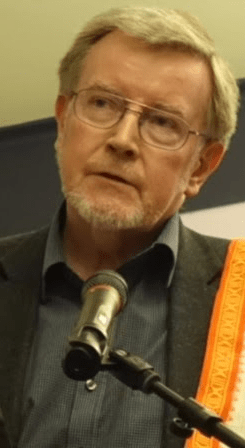
From a BBC Scotland interview with Prof Alan Riach (above) on the 10th November 2025, the text:
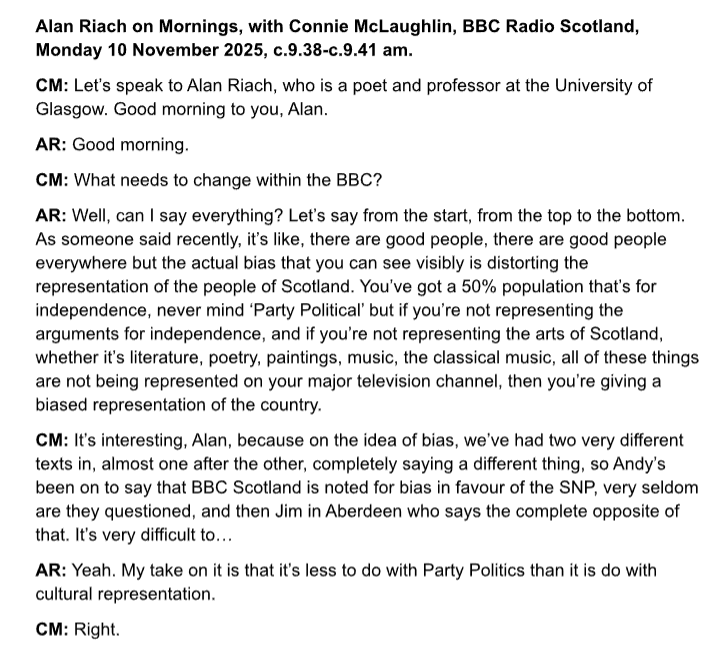
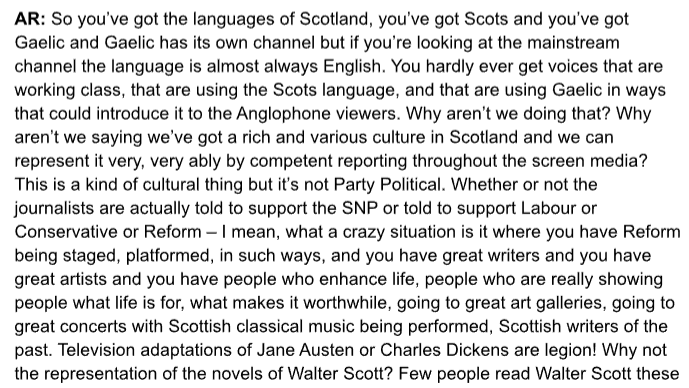
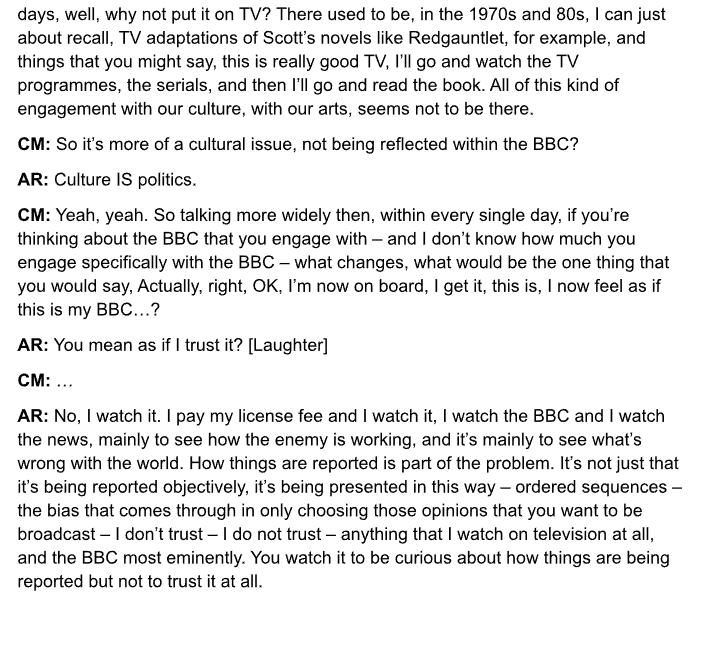
Listen at:
Alan Riach (b.1957) Poet and Professor of Scottish Literature, Glasgow University. Born
Airdrie, Lanarkshire, studied at the Universities of Cambridge and Glasgow, worked at the
University of Waikato, New Zealand, 1986-2000, returned to Scotland 2001. Books include
poetry: The Winter Book (2017), Homecoming (2009), Wild Blue: Selected Poems (2014),
The MacDiarmid Memorandum (2023); criticism: Representing Scotland (2005), Hugh
MacDiarmid’s Epic Poetry (1991), and co-authored with Alexander Moffat, Arts of
Resistance: Poets, Portraits and Landscapes of Modern Scotland (2008), described in the
TLS as ‘a landmark book’. His 734-page Scottish Literature: An Introduction (2022) was
described in The Times as ‘magisterial’.
Discover more from Talking-up Scotland
Subscribe to get the latest posts sent to your email.


Excellent response – am surprised they actually aired it
LikeLike
The first rule of good management is to ‘recognise and give praise for things that are well done’. How well this has been done in this case is a matter for debate, but, this kind of interview is not something I can recall before on BBC Scotland. So, I welcome that.
Anent Alan Riach’s mention of the lack of the spoken languages of many Scots being heard on BBC Scotland, I recall the case of a young trainee, economics reporter from Coatbridge, who was the daughter of a bus driver. She spoke fluently, clearly and knowledgeably in a West of Scotland accent. This evoked a torrent of letters from the twee parts of Edinburgh, Glasgow, Perthshire, etc expressing their horror that the uncouth patois of the hoi polloi was being permitted on the BBC. It must cease forthwith! And it did. She did not present another economics report.
The young reporter was Helen Liddell, who went on to become a Labour MP and cabinet minister. Alas, she succumbed to embourgeoisement, became a member of the House of Lords and took to pronouncing her surname as LidDELL.
There was also the case of a young Shetlander, known locally as ‘Peerie Norie’ or ‘Little Norman’. His surname was Lamont which was pronounced in the Scottish way as LAmont. However, he went to Oxbridge, became a Tory MP by the name of Norman LaMONT.
LikeLiked by 4 people
Alan Riach is absolutely right. We are starved of our Scottish culture and bombarded daily with the output of a London based broadcaster i.e. a foreign culture.
Walter Scott, Robert Louis Stevenson, Hugh McDairmid, Robert Burns, Muriel Spark, Nan Shepherd, Val McDermid, Irvine Welsh, James Robertson, James Kelman, Ian Banks, Ian Rankin, Josephine Tey, J M Barrie, John Buchan – then the oldies such as William Dunbar, James Hogg, … etc etc
At least in my youth we had The White Heather Club! It showcased popular Scottish musicians, singers and comedians. All gone.
The last “Scottish” series I remember was Hamish Macbeth written by Marion Chesney starring Robert Carlyle. That was in 1995, 30 years ago!
LikeLiked by 1 person
Great from Alan Riach, surprised to see him allowed on air.
But the balance on the show reflected the issue. The presenter got away with gaslighting that pro/anti SNP has may be equal 😂, a gross falsehood uttered on the airwaves in an instant never to be corrected.I
Also giving the impression that there is a great effort to ensure impartiality relying on one journalists , no doubt sincere , expression of intention.
LikeLiked by 2 people
I remember a particularly egregious example of BBC Scotland’s concept of ‘balance’ on the equally egregious Kaye Adams Show.
There had been a report indicating that smoke from smokers’ cigarettes had a significant effect on non smokers in the vicinity. The show had a GP and a representative of a go-to group regularly pontificating on the BBC – FOREST (Freedom Organisation for the Right to Enjoy Smoking Tobacco). The group is funded by the tobacco industry, but the BBC did not say that, simply describing it as ‘a group campaigning on behalf of smokers’. Their spokespersons work in PR.
The GP explained lucidly how the exhaled smoke affected other people. The FOREST spokesperson said, “Some people disagree with that.”
Whereupon, Ms Adams shrieked, ‘Faced with such diametrically opposed views, how can ordinary people know what the truth really is?’
Are we supposed to believe that an opinion, unsupported by evidence, expressed by a person being paid by a tobacco company is equivalent to the explanation provided by a GP of a rigorous peer reviewed piece of medical research?
LikeLiked by 2 people
20% of people smoking.
Professor telling it like it is.
LikeLike