


Support Talking-up Scotland's work to counter the lies and get you the facts, daily, at: https://www.crowdfunder.co.uk/checkout/help-talking-up-scotland-tell-truth-about-scotland/payment/nBQxjVzq/details
By stewartb
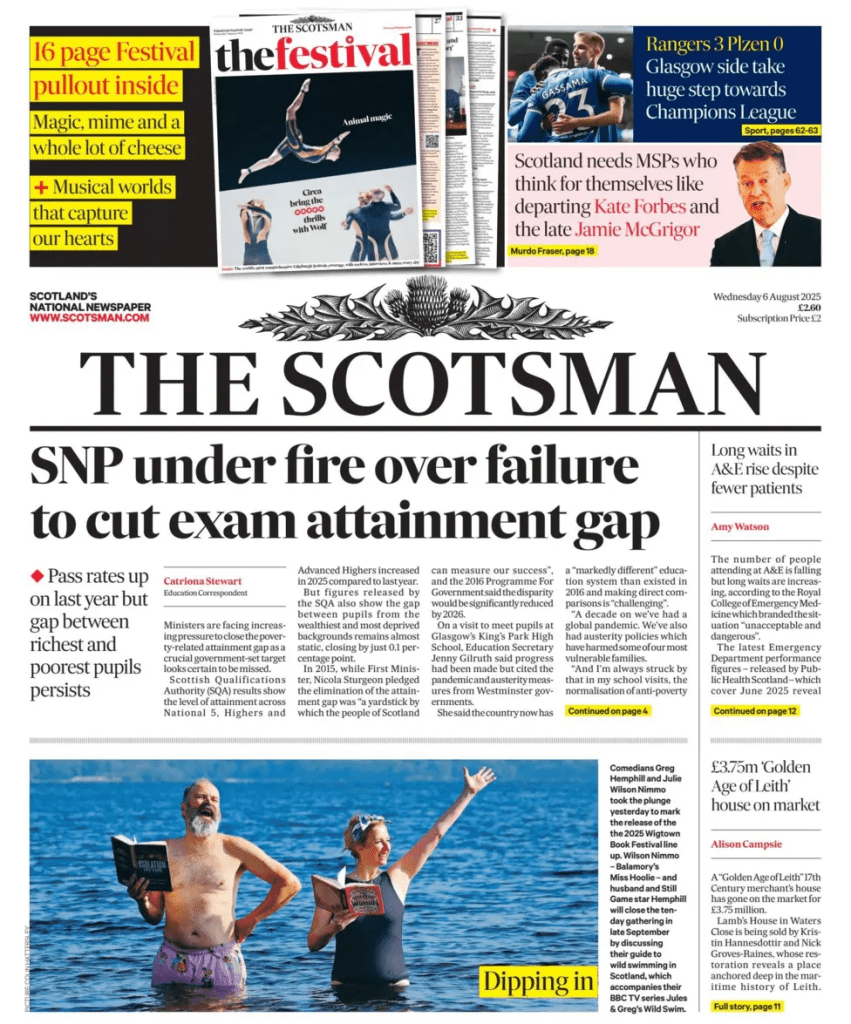
The contrast in treatment by politicians and the mainstream media of the 2024-25 examination results in Scotland and in the rest of the UK was stark.
I listened to extensive news coverage by the BBC of the results for England, NI and Wales. Journalists, politicians and various ‘stakeholders’ commented on the nature, persistence and intractability of the attainment gap in England. Candidly, the coverage was informative: contributions were made in a ‘grown-up’ kind of way. Partisan politicking was at most minor.
Meanwhile in Scotland, opposition politicians use a mainstream media that is averse to UK-wide comparative analyses in order to enable political point scoring. Effectively this allows them all to dodge fundamental issues, to avoid having to address what are systemic issues not just in education but in society and across the whole UK.
The cover for the approach adopted by opposition politicians in Scotland is simple. It is a policy objective – an aspirational commitment – once set by a former First Minister in an SNP government which has not been met. But was it a daft objective?
Asked to inform on what and when FM Sturgeon committed to on the attainment gap, ChatGPT rightly observes: ‘That clarity—both in words and in timeline—helps explain why this pledge became a central benchmark for her education legacy.’ The AI tool offers this reflection: ‘Nicola Sturgeon’s commitment was indeed bold and honorable – but the evidence shows it was extremely ambitious. Still, that doesn’t mean such goals are inherently destructive or unfair; they challenge us to envision and invest in uplift that benefits everyone.’
Notwithstanding the ‘honorable’ mention, was Ms Sturgeon’s commitment misguided – wrong to make? Was it a daft objective in the first place – at least in the simple (simplistic?) way it was articulated? Why no explicit acknowledgement for example of the complementary importance – the benefits – of ‘progression’ within each quintile in the assessment of poverty or disadvantage?
On eliminating a poverty-related education attainment gap, has it ever been done, even substantially, in any other UK nation? Indeed, has as it ever been done in any Western democracy? Sturgeon’s commitment may have been laudable, but is such a thing really achievable without serious limits placed on the attainment of the LEAST disadvantaged? Is it really achievable without a government having the powers necessary to make radical socio-economic policy reforms, not just reform what happens within the education system?
To these questions, the AI research tool responded:
Has any Western democracy achieved—or substantially reduced—the poverty‑related attainment gap? Globally, no case of complete closure: there’s no Western democracy where the socioeconomic attainment gap has been fully eliminated. Most advanced countries—including those with strong social support systems—continue to exhibit persistent disparities tied to income and background.’ (my emphasis)
It added: ‘While countries in the Nordic region (like Denmark, Norway, Finland, Sweden) show relatively higher intergenerational mobility and narrower income-linked educational gaps, these do not equate to fully closed gaps—just comparatively better outcomes on average.’
It also referred to rare successes due to targeted programmes, but not full gap closure e.g. the London Challenge between 2001–2005, was an initiative focused on raising attainment in disadvantaged areas of London. It achieved notable progress, with GCSE results in London improving faster than the national average.
ChatGPT also asserts that the outcomes of the London Challenge demonstrate that lifting the performance of the most disadvantaged students does not have to occur alongside suppressing outcomes for the least disadvantaged. The overall attainment improved, including among disadvantaged pupils: ‘The idea is that raising the floor can lift all boats, not just level the waters.’
Intuitively ‘lifting all boats’ would seem to put ‘elimination’ of an educational attainment gap realistically beyond reach. Gap narrowing then becomes reliant on gradual convergence over time of relevant attainment metrics for the least AND most disadvantaged cohorts – convergence but only to a degree. Of course educational outcomes affected by levels of disadvantage are linked to a complex of socio-economic factors, including ones external to the sites of education provision.
My understanding is that the London Challenge was extended across England as the ‘City Challenge’, with very mixed results.
In summing up the legacy of the London Challenge and similar initiatives in England, Mansaray (2013 – an academic from Kings College London, School of Education, Communication and Society) noted: ‘In the current economic climate, the IFS have forecast that the number of children in poverty will increase considerably. This is likely to impact negatively on school attainment. Therefore tackling child poverty must be a key element in the drive to improve attainment.’
This must remain the case today and yet the British Labour Party in government in Westminster – with all the necessary powers – is still not acting to abolish the Tory two-child benefit cap.
 Talking-up Scotland
Spot on observation…
LikeLike
Great post stewartB………
Meanwhile on the BBC website …………….there is still this story, but it’s significance is descending on the Scotland main page of their BBC website….
“Councillor jailed over sex offences against teenage girl” (Former Labour Councillor)
This is a article on the BBC website , as of this afternoon (just after12.30pm ) , and it has only been on their website on the Scottish main page for seven hours as the (former) top story….but now it is the eighth story on their main Scotland page….and it is still not on their Scottish Politics page…but it is still the top story, for now, on the regional page for Edinburgh, Fife & the East.
How quick a negative article on their website disappears from the Scottish main page of their BBC website when it is connected to a UK party…..yet how long does any (and all) negative articles linked to the SNP stay on their BBC website….. for days sometimes much longer….
Indeed we often also see these existing negative articles regarding the SNP sometimes having additional updates to them to then try to prolong their existence on the BBC Scotland pages of their BBC website…..
So Yes, the contrast in treatment by the majority of UK media, more so the BBC, towards the SNP in anything and everything is startling and also so very obvious…..
That is the BBC News in Scotland and some other media too…..who all seem to care not a jot on their continued biased behaviour and also their hostile attitude when it comes to Scottish politics…though that from them is often just confined to their excessive amount of #SNPBAD (often fabricated and exaggerated) articles…..
Liz S
LikeLiked by 1 person
Remember its BBC Israel these days. Israel also seem to be running the UK Gov!
🏴🏴🤪😉🙃😋🏴🏴
LikeLike